


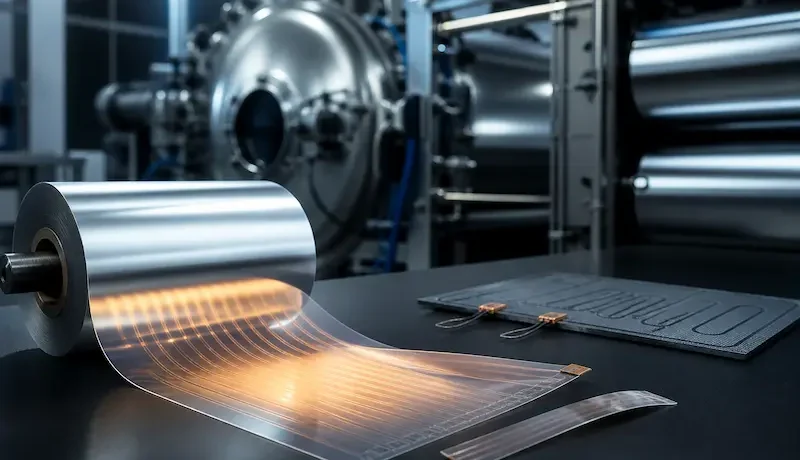
Metallized Film for Flexible Heaters and Heating Elements
Every heated car seat, defogging mirror, and medical warming pad hides the same trick: a conductive layer that turns electricity into heat. For years, manufacturers built that layer from etched metal foil or resistance wire. Today, metallized film for flexible heaters offers a thinner alternative.
Metallized film carries a vacuum-deposited metal layer with a controlled resistance. Consequently, it works as a heating element with very low thermal mass, so it warms up quickly and spreads heat evenly. In this guide, we explain how the material works, how it compares with competing technologies, which applications fit, and what a coating line must deliver.
How a Thin Metal Layer Becomes a Heating Element
A resistive heater follows one simple rule: current flowing through resistance releases heat. Therefore, any conductive layer with the right resistance can serve as a heating element, and that includes a vacuum-deposited metal film.
The process works like this:
- Vacuum metallizing deposits a thin metal layer — aluminum, a nickel-chromium alloy, or copper — onto a polymer film such as PET or polyimide.
- The operator tunes sheet resistance by controlling layer thickness, because resistance falls as the layer grows thicker.
- Bus bars carry current into the film, and the layer dissipates heat across its entire surface.
- Insulating cover layers sandwich the conductor, so the finished flexible heater stays electrically safe.
Because the metal layer measures only nanometers to a few micrometers, heat has almost no mass to warm. As a result, the heater reaches temperature in seconds, and it uses less energy than a bulky alternative. Meanwhile, the polymer carrier keeps the part thin, light, and bendable.
The Parameters That Decide Heater Performance
Designers specify a heater by a handful of interacting values. Sheet resistance sits at the center, because it sets how much power the film delivers at a given voltage.
- Sheet resistance (Ω/sq): the core value; lower resistance draws more current and produces more power.
- Power density (W/cm²): the heat delivered per unit area; silicone-rubber heaters typically stay below 2 W/cm², and other designs push higher.
- Operating voltage: 12 V and 24 V DC suit automotive systems, while mains-powered products run higher.
- Temperature coefficient: some films self-regulate through a positive temperature coefficient (PTC), which raises resistance and limits heat as the film warms.
- Thermal mass: a thin metal layer heats fast, which saves energy and improves control.
- Dielectric strength: the insulating cover layers must block the working voltage safely.
Notice the tension in that list. A heating element made from a very thin layer offers speed and flexibility, yet it cannot match a thick foil for raw power. Therefore, designers match the film to the wattage their product needs.
Metallized Film vs Etched Foil, Wire, and Printed Heaters
Etched foil remains the workhorse for demanding products, because a designer can pattern any circuit shape and reach high power. Metallized film wins a different race: it delivers the thinnest possible element, near-transparent options, and rapid response. For a closer look at how thin metal layers behave, see our article on metallized film for capacitors.
Where Metallized Film Heaters Fit
Manufacturers apply metallized film for flexible heaters across several product families:
- Automotive: seat heaters, mirror defoggers, battery warmers, and camera-lens heating, all of which run on 12 V or 24 V DC.
- Medical: patient-warming pads, blood and IV warmers, and incubator panels that need gentle, even heat.
- Transparent heaters: display defogging and window heating, where researchers have driven sheet resistance down to about 18.77 Ω/sq while keeping transmittance near 92%.
- Wearables and smart textiles: thin, bendable heating for outdoor gear and heated apparel.
- Appliances and anti-condensation: door seals, camera housings, and sensor windows that must stay clear.
- Aerospace and instruments: low-outgassing heaters for sensitive equipment.
In every case, the same advantages repeat: low mass, even heat, and a thin profile that fits where a wire-wound heater cannot.
What a Coating Line Must Deliver
Vacuum metallizing a heater film rewards precision, because power tracks resistance so closely. A small thickness error becomes a temperature error, and a hot spot shortens product life. Therefore, buyers should weigh these capabilities:
- Tight thickness control — the layer must hold its sheet resistance within a narrow band.
- Uniform deposition across the width — edge-to-edge variation creates hot spots and cold spots.
- Multi-metal capability — aluminum, nickel-chromium alloys, and copper cover different resistance targets.
- Gentle web handling with stable tension — thin PET and polyimide webs wrinkle easily, which disturbs uniformity.
- Surface preparation for adhesion — a treated surface keeps the metal bonded through lamination and bending.
- Inline resistance monitoring — closed-loop control holds the layer on target roll after roll.
A platform such as Tempo Machinery’s fully automatic suspension vacuum coating machine brings a free-suspension web path, double coating-drum cooling, online OD detection, a Siemens PLC, and four servo motors that hold constant tension. Our sputtering capability extends the metal range to alloys and other high-melting-point materials. In practice, our standard machines cover 6–150 µm, so we always recommend discussing your exact film and resistance target with our engineers before you order.
Quality Checks That Prevent Hot Spots
Heat punishes inconsistency, so quality control for metallized film for flexible heaters targets resistance and durability.
Because adhesion and pinholes cause most field failures, our guides to adhesion testing for metallized film and vacuum coating defect troubleshooting help operators set practical limits.
Market Outlook for Flexible Heaters
Demand grows with electrification and portable medical care. SNS Insider reports that the flexible heater market should reach $2.59 billion by 2032 from $1.34 billion in 2023, while Polaris Market Research values the market at $1.13 billion in 2021 and projects a 7.1% CAGR. Beyond those headline figures, automotive electrification pulls seat, battery, and sensor heating into more vehicles, and wearable and medical devices keep shrinking their heaters.
Notably, the same trend favors metallized film for flexible heaters: as products get thinner, designers need a heating element that adds almost no thickness. That requirement plays directly to vacuum metallizing.
Conclusion
Metallized film for flexible heaters gives designers a thin, flexible heating layer with low thermal mass and even heat. It suits automotive, medical, wearable, and transparent applications, and it pairs naturally with the roll-to-roll platforms of vacuum metallizing. However, the material demands tight thickness control, uniform deposition, and disciplined quality checks, because power tracks resistance so closely. Therefore, choose equipment built for thin-film precision, and verify sheet resistance before you commit to volume production.
Ready to evaluate a coating line for heater film? Contact our team for machine specifications, customization options, and a free consultation on your coating requirements.
FAQ
1. Can metallized film really work as a heating element?
Yes. Any conductive layer with the right resistance releases heat when current flows. A vacuum-deposited metal layer with controlled sheet resistance therefore works as a thin heating element, especially where low mass and fast response matter.
2. How does sheet resistance affect heater performance?
Sheet resistance sets the current a film draws at a given voltage, and power rises as resistance falls. Consequently, a small change in sheet resistance shifts the wattage, so heater films demand tight thickness control.
3. Which metals suit a metallized film heater?
Aluminum covers cost-sensitive designs, while nickel-chromium alloys offer stable resistance at higher temperatures. Copper serves low-resistance targets. The right choice depends on the wattage and the working temperature.
4. What limits the power density of a film heater?
Thin layers limit how much current they can carry safely, so film heaters suit low to moderate power density. For high wattage, designers move to etched foil or wire-wound elements that handle more current.
5. Where do metallized film heaters deliver the most value?
They excel in thin, flexible, and transparent products, including automotive mirror defoggers, medical warming pads, wearables, and transparent display heaters, where a bulky element would not fit.