


Metallized Film Adhesion Testing: Tape Tests, Cross-Hatch, and What Results Really Mean
Adhesion failure ranks among the top reasons converters reject metallized film. The metal layer looks perfect on the rewind roll, yet printing smears, lamination bubbles, or heat sealing peels the coating right off. Each rejected roll costs material, downtime, and customer trust.
Metallized film adhesion testing catches these problems before they reach your production line. Two quick methods dominate the industry: the tape test and the cross-hatch (cross-cut) test. Both take minutes, need simple tools, and deliver a clear pass/fail signal.
This article explains how to run both tests correctly, how to read the 0-to-5 rating scale, what the results really mean, and which process factors cause adhesion failure in the first place. Moreover, you will learn how to prevent delamination at the source — during vacuum metallizing — rather than discovering it downstream.
Related Reading: How to Troubleshoot Common Vacuum Coating Defects: A Practical Guide for Operators
1. Why Adhesion Matters in Metallized Film
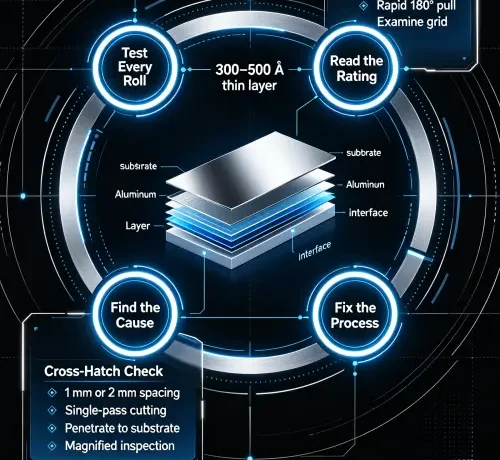
A vacuum metallizer deposits an aluminum layer only 300 to 500 Å thick — far thinner than a human hair. That layer carries the product’s entire value: its metallic look, its barrier properties, and its compatibility with printing and lamination. If the layer does not bond to the substrate, every downstream step suffers.
Common failure symptoms include:
- Printing defects. Inks and lacquers lift the metal layer during printing or over-coating.
- Lamination failure. The adhesive bond pulls aluminum off the film instead of bonding the two webs together.
- Heat-seal problems. Sealing jaws create folds where the coating flakes away.
- End-user complaints. Labels scratch, sachets lose barrier performance, and decorative film looks blotchy.
In short, adhesion testing protects your entire conversion chain. A five-minute test on every production roll beats a rejected order every time.
2. The Tape Test: Step by Step
The tape test follows ASTM D3359, the international standard for rating adhesion by tape application. The standard describes two methods: Method A (X-cut) for thicker coatings and Method B (cross-cut) for thin coatings. Metallized film structures usually fall under Method B.
How to run the tape test on metallized film:
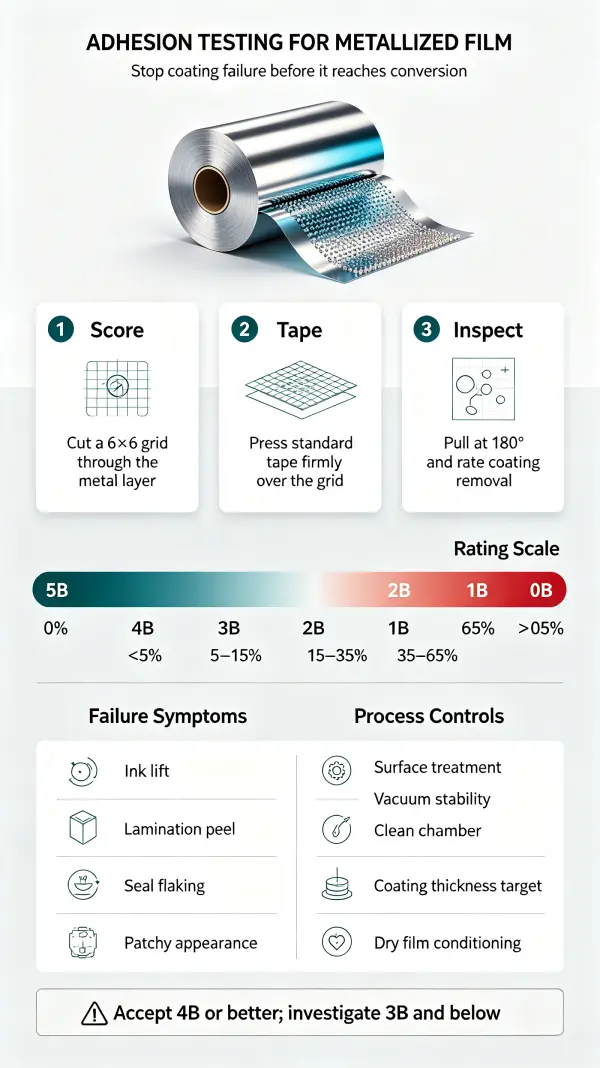
- Cut a clean lattice. Use a cross-hatch cutter with parallel blades spaced 1 to 2 mm apart. Score six parallel cuts, rotate 90 degrees, and score six more to create a 6×6 grid. Cut through the coating to the substrate in one smooth pass.
- Brush away loose flakes. Sweep the grid lightly with a soft brush so detached particles do not stick back.
- Apply the tape. Press a strip of pressure-sensitive tape (the standard specifies type and adhesion strength) firmly over the grid. Rub it with your fingertip until the tape turns uniformly transparent.
- Pull at 180 degrees. Grasp the free end and pull it back rapidly — within one or two seconds — at an angle as close to 180 degrees as possible.
- Inspect the grid. Examine the cut area for removed coating and compare it with the rating scale below.
For the full procedure and required tape specifications, refer to the official ASTM D3359 standard.
ASTM D3359 adhesion rating scale (Method B):
Most converters accept 4B or better for metallized film. A rating of 3B or lower signals a process problem that requires investigation.
3. Cross-Hatch Testing: What It Adds
Cross-hatch testing — also called cross-cut testing — shares the same principle as the tape test and follows the similar international method ISO 2409. The difference lies in emphasis: cross-hatch work focuses on lattice cutting precision and substrate penetration.
Key execution points:
- Blade spacing. Thin coatings use 1 mm spacing; thicker structures use 2 mm. The chosen spacing must match the coating system.
- Single-pass cutting. Operators should score each line in one continuous motion with steady pressure. Multiple passes create ragged edges that distort results.
- Penetration depth. Cuts must reach the substrate. Cuts that stop inside the coating produce misleadingly good ratings.
- Clean inspection. Wipe the grid clean before applying tape, and examine the area under good lighting or magnification.
Cross-hatch testing gives you the same 0-to-5 signal as the tape test, so many laboratories run them interchangeably. The important point: whichever method you choose, apply it consistently across all production batches. Consequently, your quality records stay comparable over time.
4. What the Results Really Mean
A 5B rating does not mean “perfectly bonded for life.” It means the coating resisted the tape’s pull under the test conditions. Understanding this distinction prevents overconfidence:
Adhesion vs. cohesion failure. When the tape pulls the metal layer off the substrate, you have an adhesion failure — the bond between coating and film broke. When the coating tears within itself but stays on the substrate, you have a cohesion failure. The remedy differs for each: adhesion failure points to surface preparation or contamination, while cohesion failure points to coating brittleness or thickness.
Operator consistency matters. The ASTM standard notes that pull angle, pull speed, and visual assessment strongly influence results. Therefore, train every operator to follow the same technique, and have one trained person verify borderline batches.
The test has limits. Tape tests detect weak adhesion, not strong adhesion. Two films may both rate 5B, yet one survives aggressive forming while the other fails. For critical applications, add a practical test — crease the film, heat-seal it, or laminate it — and inspect the result.
In short, treat the tape test as a fast gate, not a final verdict. Pair it with process control to build real confidence in metallized film adhesion.
5. Root Causes of Adhesion Failure in Vacuum Metallizing
When adhesion fails, look at the process, not just the film. Six causes account for most problems:
Low surface energy. Polymer films like BOPP and PE carry low surface energy, so aluminum struggles to bond. Without corona or plasma treatment, the metal layer adheres poorly from the start. Our article on corona treatment and surface energy explains how pre-treatment raises the film’s wetting level.
Surface contamination. Dust, oils, and additives migrate to the film surface and block contact between aluminum and polymer. Contaminated rolls produce patchy adhesion and pinhole-like defects.
Insufficient vacuum. Water vapor and residual air in the chamber oxidize aluminum atoms before they reach the web. Oxidized metal bonds poorly and looks dull. Stable vacuum levels — maintained through proper vacuum pump maintenance — keep deposition conditions clean.
Excessive coating thickness. Thick aluminum layers carry internal stress. Beyond a certain OD, the layer becomes brittle and delaminates during bending or sealing. Coating thickness and adhesion therefore need a balanced target.
High deposition temperature. Overheated evaporation sources can damage the substrate surface, reducing bond strength even when the coating looks fine.
Moisture in the substrate. Hygroscopic films absorb water during storage. The outgassing moisture disrupts the growing metal layer and weakens adhesion.
6. How to Prevent Adhesion Problems
Prevention beats inspection. Five practices keep metallized film adhesion strong from the first meter of the roll:
Treat the surface before coating. Corona or plasma pre-treatment raises surface energy and removes loose contamination. This single step resolves most adhesion complaints.
Control the vacuum environment. Keep chamber pressure stable, monitor for leaks, and follow a scheduled pump and seal maintenance plan.
Clean the chamber regularly. Aluminum buildup on shields and rollers flakes off and contaminates fresh rolls. Regular cleaning prevents both adhesion defects and pinholes.
Set realistic coating targets. Specify OD according to the end use — decorative film does not need the same thickness as barrier film. A fully automatic suspension vacuum coating machine holds thickness uniform across the web, avoiding stress concentrations that trigger delamination.
Store and condition substrates properly. Keep film rolls sealed, dry, and at stable temperature. Conditioning rolls to room temperature before loading reduces condensation and outgassing.
For a deeper look at how tension, speed, and evaporation affect overall film quality — including adhesion — read our guide on factors affecting coating uniformity in high-speed vacuum metallizers.
FAQ
Q1: How often should I test metallized film adhesion?
Test every production roll at minimum, and test both ends plus the center of each roll. For new substrates, new coating recipes, or after chamber maintenance, test more frequently.
Q2: Which is better — tape test or cross-hatch test?
Both deliver the same 0-to-5 signal. Choose one method, standardize it, and use it consistently. The tape test follows ASTM D3359; the cross-hatch method aligns with ISO 2409.
Q3: Why does my film pass the tape test but fail during lamination?
The tape test measures a specific pull strength. Lamination applies different forces — adhesive cure shrinkage, heat, and pressure. Add practical tests (laminate, crease, or seal a sample) for applications that stress the coating.
Q4: Can I improve adhesion after metallizing?
Not easily. Once the metal layer delaminates, re-treatment is rarely economical. Fix the cause upstream: surface treatment, vacuum quality, chamber cleanliness, or coating thickness.
Q5: Does Tempo Machinery help with adhesion issues on its machines?
Yes. Our technical team supports process optimization, including surface pre-treatment recommendations, vacuum parameter tuning, and trial coatings on your substrate. Contact us to discuss your film and application.
Conclusion
Metallized film adhesion testing takes minutes, costs almost nothing, and prevents expensive downstream failures. Run the tape test or cross-hatch test on every roll, read the 0-to-5 scale honestly, and investigate anything below 4B. Most importantly, remember that a passing test reflects a healthy process — so control surface energy, vacuum quality, cleanliness, and coating thickness at the machine.
Whether you produce packaging film, labels, or decorative film, our team can help you build adhesion confidence from the first roll. Talk to us about your substrate, your coating targets, and your testing routine.
- WhatsApp: Andy +86 18705445289 | Kirsten +86 13280167547 | Doreen +86 17616731570
- Email: metallizertempo@gmail.com
- Website: https://www.vacuummetallizer.com/