


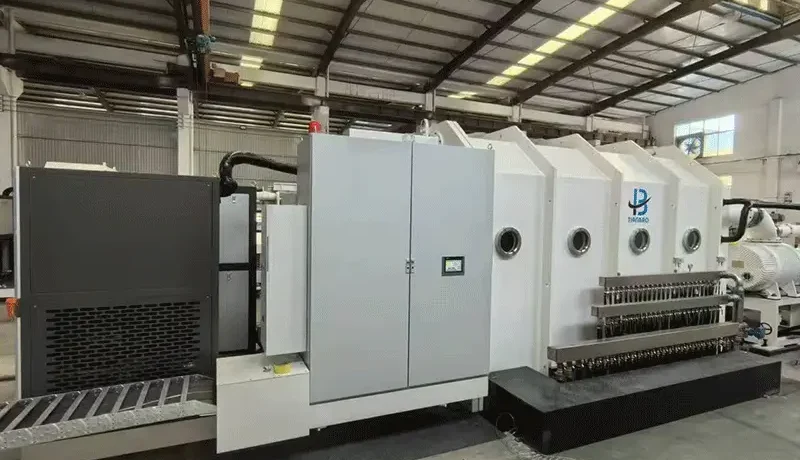
How to Reduce Pinhole Rates in Gold and Silver Wire Coating
In the production of metallic yarn and decorative threads—commonly known as gold and silver wire—the presence of “pinholes” is the most common cause of quality rejection. These microscopic defects not only dull the aesthetic “luster” of the thread but can also lead to structural weakness and oxidation over time.
While traditional resistance heating often struggles with “spitting” (molten metal droplets), the industry has moved toward Graphite Crucible Evaporation Sources as the ultimate solution. Here are the technical tips and best practices for achieving a near-zero pinhole rate in your gold and silver wire production.
1. The Graphite Crucible Advantage: Why It Works
Traditional vacuum metallizing uses ceramic resistance boats that are fed with aluminum wire. This “feed-and-melt” cycle is inherently unstable, often causing tiny droplets of molten metal to splash onto the substrate—creating pinholes.
By switching to an Induction Heating Vacuum Metallized Machine, you utilize a graphite crucible. This design allows for a large, stable pool of molten aluminum. The evaporation happens from a calm surface rather than a turbulent boat, drastically reducing the risk of spitting and ensuring a dense, continuous metallic layer.
2. Technical Tip: Precision Temperature Control
Graphite is an excellent thermal conductor, but its performance depends on temperature stability. If the crucible is too hot, the evaporation rate becomes violent; if it is too cold, the aluminum layer will be too thin and porous.
- The Tip: Use a PID-controlled induction system. Maintaining a constant temperature ensures a steady “vapor cloud.” This consistency is what eliminates the voids and gaps that present as pinholes under a microscope.
3. Aluminum Purity and Wire Feeding
The quality of your raw materials directly impacts the pinhole rate. Impurities in the aluminum wire can cause “outgassing” or bubbling within the molten pool.
- The Tip: Always use high-purity aluminum wire (at least 99.99%). Furthermore, ensure your wire-feeding speed is perfectly synchronized with the evaporation rate. Over-feeding can cause the pool temperature to drop suddenly, leading to uneven deposition.
4. Vacuum Stability and Gas Management
Pinholes are often caused by “gas interference.” If the vacuum chamber has a high level of residual oxygen or moisture, the aluminum atoms will collide with these molecules, preventing them from forming a solid bond with the film.
- The Tip: Aim for a stable vacuum level in the 10−4 Torr range. If you are coating paper-based gold wire or hygroscopic films, ensure your machine is equipped with a high-capacity diffusion pump to handle the additional outgassing.
5. Substrate Preparation: The Role of Plasma Treatment
Sometimes, what looks like a pinhole is actually a “wetting” issue. If the surface of your PET or BOPP film is contaminated or has low surface energy, the aluminum will not spread evenly.
- The Tip: Integrate a Plasma Treatment module into your metallizing process. This “cleans” the substrate at the molecular level just seconds before it enters the evaporation zone, ensuring the aluminum atoms bond uniformly across the entire surface.
6. Crucible Maintenance: The “Clean Pool” Strategy
Over time, slag and impurities can build up on the edges of the graphite crucible. This buildup can disrupt the electromagnetic field and cause uneven heating.
- The Tip: Establish a strict cleaning schedule for your graphite crucibles. A clean crucible ensures a symmetric vapor distribution, which is essential for the uniform “gold” or “silver” finish required in high-fashion textiles.
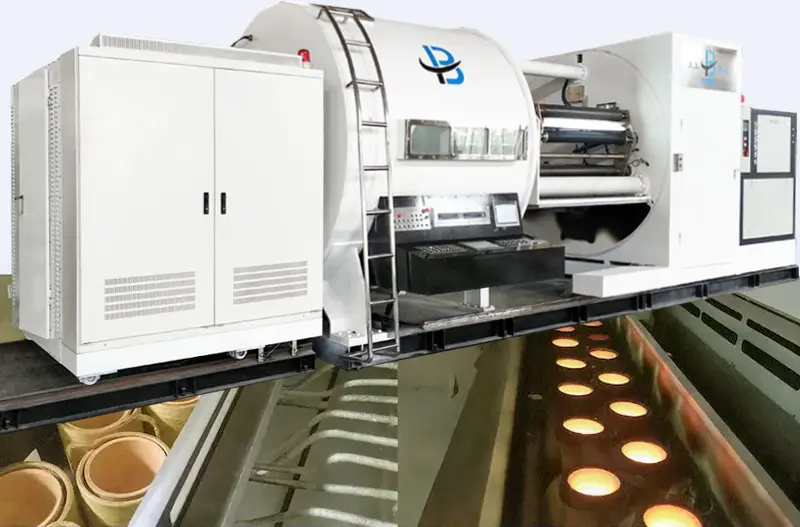
Induction Heating Vacuum Metallized Machine
Conclusion: Quality is a Technical Choice
Reducing pinhole rates in gold and silver wire coating is not a matter of luck; it is a matter of engineering. By leveraging the stability of graphite crucibles and induction heating, manufacturers can produce metallic yarns that meet the highest international standards for luster and durability.
At Vacuum Metallizer Solutions, our induction machines are specifically designed for the delicate task of metallic yarn production. We help you achieve the “Zero-Defect” goal, ensuring your products stand out in the competitive global textile market.
Ready to eliminate pinholes in your production? View our Gold/Silver Wire Coating Solutions or Talk to a Technical Specialist.
