


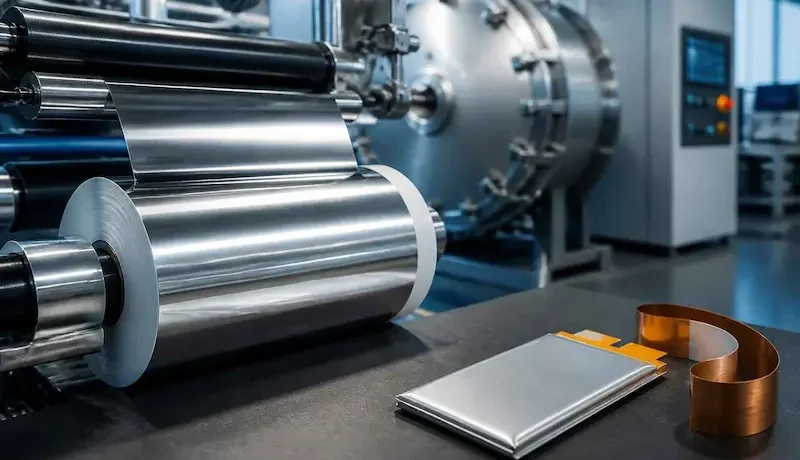
Metallized Film for Lithium-Ion Battery Current Collectors: mPET/Al and mPET/Cu
Electric vehicles, drones, power tools, and grid-storage systems all need lithium-ion cells that charge fast, run far, and stay safe. However, every one of those cells carries two metal-foil current collectors, and those foils add dead weight and cost while conducting far more metal than the job requires. Therefore, battery engineers now replace the foil with metallized film for battery current collectors.
Two variants dominate this shift: mPET/Al and mPET/Cu. In this guide, we explain what each one is, why the battery industry adopts them, and how vacuum metallizing produces a reliable double-sided current collector. Moreover, we cover the machine features and quality checks that turn a promising sample into stable volume production.
What Are mPET/Al and mPET/Cu?
“mPET” stands for metalized polyethylene terephthalate. A converter deposits an ultra-thin metal layer on both sides of a PET film, and the finished material then works as a current collector inside the cell. Battery makers pair two variants:
- mPET/Al — an aluminum layer on both faces. Aluminum resists oxidation at the high positive potential of the cathode, so this variant serves as the cathode current collector.
- mPET/Cu — a copper layer on both faces. Copper stays stable at the low, negative potential of the anode and carries current with low resistance, so this variant serves as the anode current collector.
Researchers at Oak Ridge National Laboratory and their partners report strong results for this approach. Their study in Energy Storage Materials (January 2025) found that mPET current collectors reduce weight by 73%, thickness by 33%, and cost by 85% compared with metal foil. The same work projects an electrode-level energy density of 280 Wh/kg under ten-minute charging at 6C, a 27% energy-density gain at 6C, and stable performance after 1,000 cycles.
Why Battery Makers Are Replacing Metal Foil
Conventional current collectors use 10–15 µm aluminum or copper foil. Notably, manufacturers cannot make that foil much thinner, because a thinner foil tears during the high-speed coating and winding steps that build a cell. Consequently, each cell carries far more metal than the electric current actually needs. Soteria Battery Innovation Group estimates that only about 10% of the foil’s metal serves the day-to-day function of the cell.
Vacuum metallizing solves that mismatch with a metalized polymer current collector. It replaces the heavy foil with a 3–8 µm polymer film coated with a very thin metal layer. Meanwhile, the polymer carries the mechanical load, and the metal layer carries the current.
The Safety Benefit: Metallized Film as an Internal Fuse
Safety drives adoption as much as weight and cost. A traditional foil collector dumps the full energy of the cell into any internal short, and that surge heats the electrolyte and can trigger thermal runaway — the industry term for a battery fire.
In contrast, a thin metal layer on polymer behaves like an internal fuse. When a short raises the local temperature, the metal layer oxidizes and the polymer underneath melts and retreats from the fault. As a result, the small dead spot isolates the short while the rest of the cell keeps working. Soteria Battery Innovation Group and NASA demonstrated this effect in nail-penetration tests on 18650 cells: the conventional cell vented and burned, while the cell built with a metallized-film collector survived the same abuse.
How Vacuum Coating Builds a Double-Sided Current Collector
Vacuum metallizing produces these films through a roll-to-roll process. The machine unwinds a roll of thin PET, evacuates the chamber to a high vacuum, and deposits metal onto the moving web. Because the electrode needs metal on both faces, the line either coats one side per pass or uses a double-side configuration.
The choice of metal changes the deposition method:
- mPET/Al: thermal evaporation works well, because aluminum melts and vaporizes at a manageable temperature. Resistance-heated boats and induction-heated crucibles both handle this job.
- mPET/Cu: copper melts at a much higher temperature, so simple thermal evaporation becomes impractical. Instead, manufacturers turn to electron-beam evaporation or magnetron sputtering. Fraunhofer FEP confirms both routes for double-side copper coating.
Fraunhofer FEP also publishes useful process targets for battery current collectors: a base film below 8 µm, a metal layer above 1 µm, a total stack below 10 µm, and roll-to-roll processing for web widths beyond 400 mm and strip lengths beyond 100 m. These figures explain why this application pushes web handling and deposition control to their limits.
What This Application Demands From a Metallizer
Battery-grade coating rewards precision, because an ultra-thin web punishes every process weakness. Therefore, buyers should evaluate a machine on the following capabilities rather than on generic packaging specifications:
- Stable tension and gentle web handling — films of 3–8 µm wrinkle, stretch, and tear easily, so tension control decides yield, not just appearance.
- Double-side coating capability — the electrode requires metal on both faces with matched thickness.
- Precise thermal management — a chilled coating drum improves layer density and adhesion on delicate webs.
- Inline thickness or resistance monitoring — sheet resistance and optical density both indicate whether the layer stays on target across the full width.
- A clean, high-vacuum chamber — particles and pinholes create weak spots that shorten cell life.
- Evaporation and sputtering options — aluminum and copper demand different deposition sources.
A platform such as Tempo Machinery’s fully automatic suspension vacuum coating machine brings several of these features together: a free-suspension web path that eliminates empty coating lines, double coating-drum cooling, online OD detection, a Siemens PLC with a 12-inch HMI, and four servo motors that hold constant tension. For copper layers, the induction heating metallized machine and our sputtering capability extend the material range. In practice, our standard machines cover 6–150 µm, while battery films run thinner, so we always recommend discussing your exact film and layer specification with our engineers before you order.
Quality Parameters That Matter Most
Battery customers who buy metallized film for battery current collectors care about electrical performance, not appearance. Consequently, the acceptance criteria for a current collector differ sharply from those for packaging film.
Because adhesion and pinholes drive most rejections, our guides to adhesion testing for metallized film and vacuum coating defect troubleshooting help operators set practical limits. For a deeper look at how thin metal layers behave, see our comparison of vacuum metallizing, magnetron sputtering, and CVD.
Market Outlook for Metallized Battery Films
Demand for battery current collectors keeps climbing with electrification. Soteria Battery Innovation Group projects that the lithium-ion industry will need roughly 8.55 billion square meters of aluminum and copper current collector material by 2028, a market worth about $5.6 billion for aluminum and $23 billion for copper. Furthermore, the group notes that lithium-ion consumption has grown at more than 20% per year.
Material suppliers keep moving, too. Toray announced a resin-film anode current collector in August 2026 that cuts battery weight by up to 10%, as SpecialChem reported. Meanwhile, the shift toward metallized film for battery current collectors also eases a supply concern, because it trims demand for scarce copper and aluminum.
Conclusion
Metallized film for battery current collectors offers a rare combination: less weight, lower cost, and better safety. mPET/Al and mPET/Cu deliver that package by replacing solid metal foil with a thin, double-sided coating on PET. However, the application demands precise web handling, stable deposition, and disciplined quality control. Therefore, choose equipment built for thin-film precision, and verify process control before you commit to volume production.
Ready to evaluate a vacuum metallizer for battery current collector film? Contact our team for machine specifications, customization options, and a free consultation on your coating requirements.
FAQ
1. What is the difference between mPET/Al and mPET/Cu?
mPET/Al carries an aluminum layer on both faces and serves as the cathode current collector. mPET/Cu carries a copper layer on both faces and serves as the anode current collector, because copper stays stable at the anode’s low potential.
2. Why does copper coating need sputtering instead of thermal evaporation?
Copper melts at a much higher temperature than aluminum, so simple thermal evaporation becomes impractical. Instead, manufacturers use electron-beam evaporation or magnetron sputtering to deposit copper onto the polymer web.
3. Can a standard packaging metallizer produce battery current collector film?
Rarely, without modification. Packaging lines seldom deliver the sheet-resistance control, double-side consistency, and contamination control that electrodes demand. Battery film also runs thinner than typical packaging stock, so evaluate the machine against your electrical specification, not your packaging specification.
4. How thick is the metal layer on a metallized current collector?
Reports vary with cell design. Soteria describes layers around 500 nm, while Fraunhofer FEP targets metal layers above 1 µm; both keep the total stack below roughly 10 µm.
5. Is metallized film for battery current collectors available commercially?
The technology has moved from the lab toward the factory. Research groups, material suppliers, and equipment makers now produce and supply metallized current collectors, and industry consortia keep expanding the supply base.