


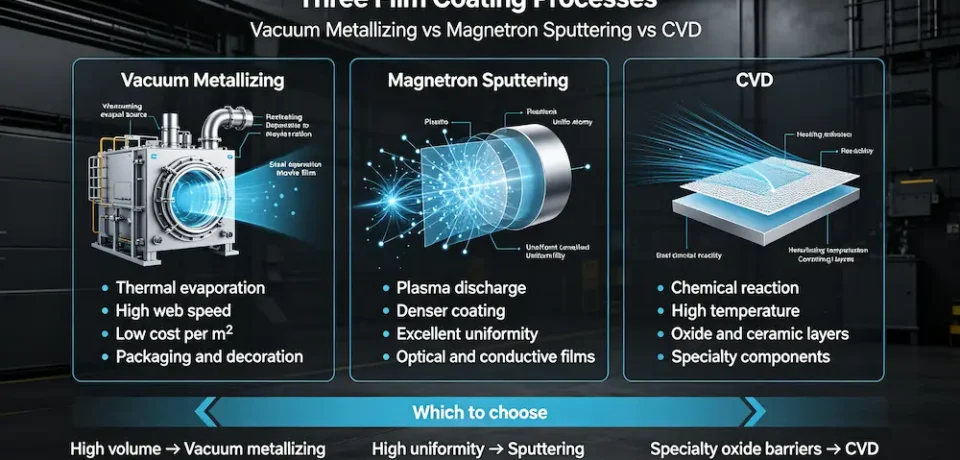
Vacuum Metallizing vs. Magnetron Sputtering vs. CVD: Choosing the Right Coating Process for Your Films
Three coating technologies dominate the film converting industry: vacuum metallizing, magnetron sputtering, and chemical vapor deposition (CVD). Each method deposits a thin functional layer onto polymer film, yet each one delivers a different balance of speed, film quality, and cost. This guide compares the three processes in plain engineering terms, so you can match the right technology to your packaging, decorative, or functional application.
What Is Vacuum Metallizing?
Vacuum metallizing, also called thermal evaporation coating, heats a metal in a high-vacuum chamber until the material vaporizes. The metal vapor then condenses onto the moving web and forms a bright, dense layer. Manufacturers choose this film coating process for food packaging, gift wrap, balloons, and reflective films because it runs fast and costs little per square meter. However, the evaporated atoms travel in straight lines, so coverage on complex three-dimensional surfaces becomes uneven. For flat roll-to-roll films, this limitation rarely matters. Consequently, vacuum metallizing remains the default choice for barrier and decorative packaging worldwide. Modern machines, such as the fully automatic suspension vacuum coating machine from Tempo Machinery, maintain high vacuum stability and deliver consistent optical density across the full web width.
What Is Magnetron Sputtering?
Magnetron sputtering uses a plasma discharge to knock atoms off a solid target, and those atoms land on the substrate to build a film. Because the target material transfers atom by atom, the resulting layer is denser and more uniform than an evaporated coating. Moreover, sputtering works with almost any metal or alloy, including stainless steel, copper, titanium, and nickel. On the downside, the process runs slower than vacuum metallizing and demands a higher capital investment. Therefore, film converters usually reserve magnetron sputtering for functional products where uniformity matters most: transparent conductive films, high-barrier coatings for sensitive electronics, and specialized optical layers. Sputtering does not replace vacuum metallizing for mainstream packaging; the two technologies serve different price points and quality targets.
What Is Chemical Vapor Deposition?
Chemical vapor deposition builds a film through chemical reactions between gas precursors on a heated substrate. Unlike the two physical methods, CVD can produce ceramic, oxide, and silicon-based layers that metal evaporation cannot achieve. These coatings offer excellent hardness and chemical resistance, which suits tooling, semiconductors, and precision components. Still, CVD requires high substrate temperatures, complex gas handling, and slow cycle times, so it rarely fits roll-to-roll polymer film production. In packaging, chemical vapor deposition appears mainly as transparent barrier oxides such as AlOx and SiOx on special high-end films. For most film converters, CVD remains a niche technology rather than a production workhorse.
Side-by-Side Comparison: Which Process Wins Where
Which Process Fits Your Application?
Your substrate, end use, and budget determine which film coating process wins. For food and pharmaceutical packaging, vacuum metallizing delivers the best barrier performance per dollar. Aluminum layers of 400–800 Å block oxygen and moisture effectively; Tempo’s induction heating metallizer reaches beyond 800 Å for medical packaging. For holographic anti-counterfeiting films, vacuum metallizing with a zinc sulfide coating produces the high-refractive-index optical effects that brands need. For decorative films — balloons, sequins, and rainbow film — nothing beats the speed and gloss of aluminum evaporation. Magnetron sputtering earns its keep only where film density and uniformity command a premium, such as transparent conductive or EMI-shielding films. CVD fits rigid substrates and specialty oxide barriers rather than flexible packaging.
The Real Economics: Speed, Uptime, and Cost per Square Meter
Speed drives cost. A roll-to-roll vacuum metallizer processes film at 500–750 m/min in induction-heated configurations, while a sputtering line typically runs a fraction of that speed. As a result, the cost per square meter of evaporated aluminum stays far below sputtered or CVD coatings. Equipment price tells only part of the story; operators should also compare energy consumption, evaporation source life, cleaning time, and spare part availability. Tempo keeps all spare parts in stock and offers 24/7 technical support, which shortens downtime and protects your yield. For a deeper look at the numbers, read our earlier post on what determines the price of a vacuum metallizer machine.
A Simple Decision Framework
Ask four questions before you buy any vacuum coating machine:
- What material do you want to deposit? Aluminum, ZnS, silver, or tin → vacuum metallizing. Exotic alloys → magnetron sputtering. Ceramics or oxides → CVD.
- What substrate temperature can your film tolerate? Heat-sensitive polymer → vacuum metallizing or sputtering.
- What production volume do you need? High volume → vacuum metallizing. Low volume and high value → magnetron sputtering.
- Which quality metric matters most? Optical density and gloss → evaporation. Pinhole-critical barrier and conductivity → sputtering.
In short, most packaging and decorative producers pick vacuum metallizing, while specialized film makers add sputtering capacity for premium lines.
One Supplier for All Three Paths
Qingzhou Tempo Machinery Technology Co., Ltd. builds vacuum coating machines across the spectrum: fully automatic suspension coaters for high-speed packaging lines, induction heating metallizers with graphite crucibles for gold and silver wire, dedicated ZnS metallizers for holographic films, and aluminum paper machines for premium cigarette and wine labels. Beyond selling equipment, Tempo also operates a metallization processing service that uses resistance heating, induction heating, and magnetron sputtering in daily production. That hands-on experience means we can advise you on the right film coating process from real output data, not just theory. You can also customize each machine to your web width, substrate, and coating material.
FAQ
Q1: Which process produces better film quality: vacuum metallizing or magnetron sputtering?
A: It depends on the quality metric. Magnetron sputtering creates denser, more uniform layers with very low pinhole counts, which suits conductive and optical films. Vacuum metallizing delivers excellent gloss and barrier performance at far higher speed, which suits packaging. Most converters run both technologies for different product lines.
Q2: Can magnetron sputtering replace vacuum metallizing in food packaging lines?
A: Technically yes, but economically no. Sputtering runs slower and costs several times more per square meter, while evaporated aluminum already meets the barrier requirements of food packaging. Vacuum metallizing remains the standard film coating process for this segment.
Q3: Why is vacuum metallizing cheaper than sputtering and CVD?
A: Three reasons: the process runs at 500–750 m/min versus a fraction of that speed for sputtering, the equipment costs less, and the operating cost per square meter stays low. CVD adds high energy and gas costs on top of slow throughput.
Q4: Does Tempo Machinery supply sputtering or CVD equipment?
A: Tempo builds high-vacuum metallizing machines as standard products, and our in-house metallization processing service also applies magnetron sputtering for special projects. Tell us your substrate, web width, and target coating, and we will recommend the most cost-effective route.
Q5: Which coating process gives the lowest pinhole rate?
A: Magnetron sputtering achieves the lowest pinhole rate because energetic atoms pack the film densely. However, modern induction-heated vacuum metallizers with graphite crucible sources also reach very low pinhole rates, which fully satisfies gold and silver wire coating and medical packaging requirements.
Ready to Choose Your Process?
Not sure which process fits your product? Send us your substrate, web width, and target coating; our engineers will recommend the right solution within 24 hours. Contact Tempo Machinery today.