


Aluminum Layer Thickness and Barrier Performance
Every metallized film buyer eventually asks the same question: how thick should the aluminum layer be? The answer drives both barrier performance and cost, because thicker coatings consume more aluminum and slow down the line. In this guide, we translate angstrom values into real packaging outcomes, and we show you the exact thickness ranges that food, pharmaceutical, and medical packaging actually need.
What Does “Angstroms” Mean in Metallizing?
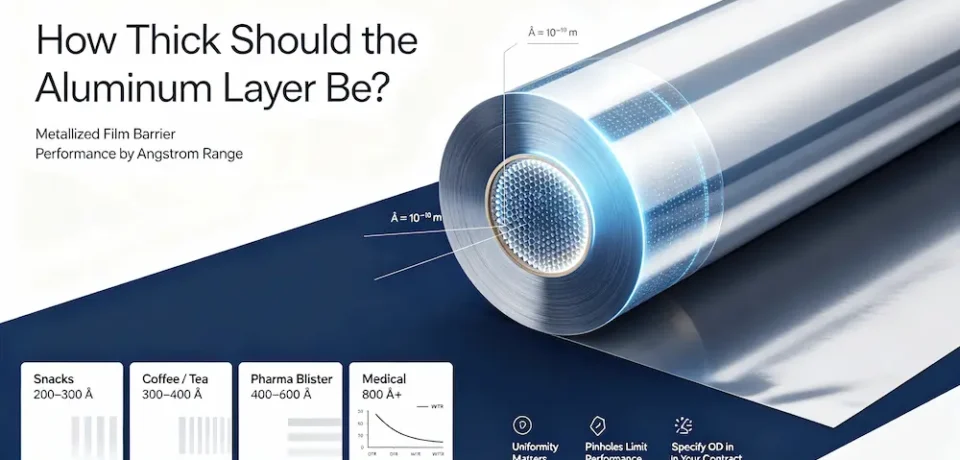
An angstrom (Å) equals one ten-billionth of a meter, roughly the diameter of a single atom. On a vacuum metallizer, aluminum deposits in layers of 100 to 800 angstroms, and manufacturers measure the result as optical density (OD) rather than physical thickness. OD meters work inline; for instance, Tempo’s fully automatic suspension vacuum coating machine features OD online detection that monitors the aluminum layer thickness across the full web in real time. A consistent OD reading means a consistent barrier, while a drifting OD signals a problem in the evaporation source or wire feed.
The Barrier Curve: Why More Aluminum Does Not Always Mean Better
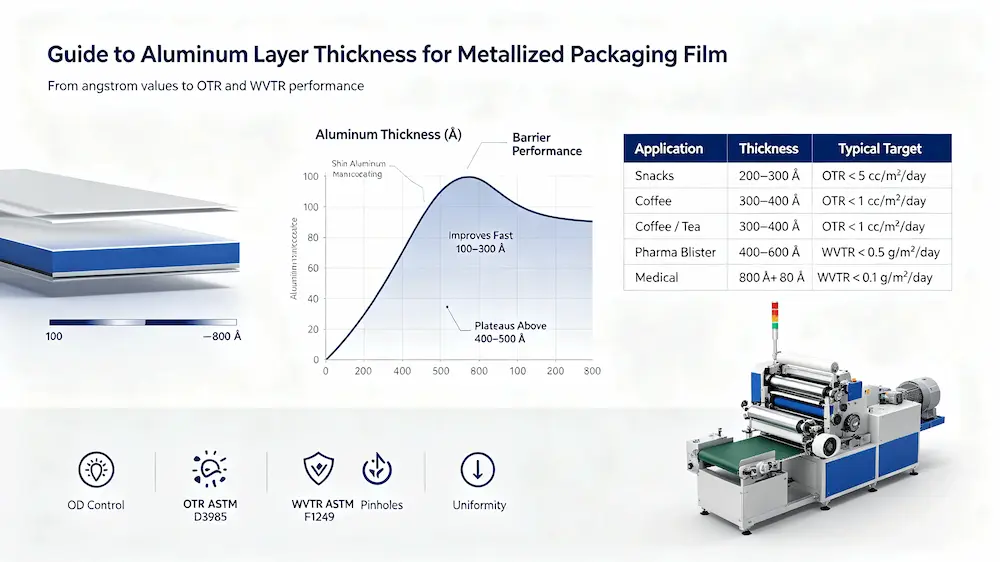
Barrier performance improves sharply as the aluminum layer thickness climbs from 100 Å toward 300 Å. Oxygen and water vapor molecules struggle to cross the metal film once it forms a continuous layer. However, the curve flattens dramatically above roughly 400–500 Å; adding more aluminum delivers little extra protection because residual pinholes and coating defects, not metal thickness, now control the transmission rate. In contrast, a thin 150 Å coating with pinholes performs worse than a uniform 250 Å coating. Uniformity therefore matters as much as thickness.
OTR and WVTR: The Two Numbers That Matter
Two standardized values define barrier performance: the oxygen transmission rate (OTR) and the water vapor transmission rate (WVTR). OTR measures how much oxygen passes through one square meter of film per day, and laboratories determine it under ASTM D3985. WVTR quantifies moisture passage, and testers measure it under ASTM F1249. For example, a typical metallized PET film achieves an OTR below 1 cc/m²/day and a WVTR below 1 g/m²/day, while a plain PET film lets hundreds of times more gas through. When you compare supplier quotes, always ask for OTR and WVTR data measured on the same standards.
Guidelines for the Thickness of Metallized Aluminum Layers
How Much Thickness Does Each Application Need?
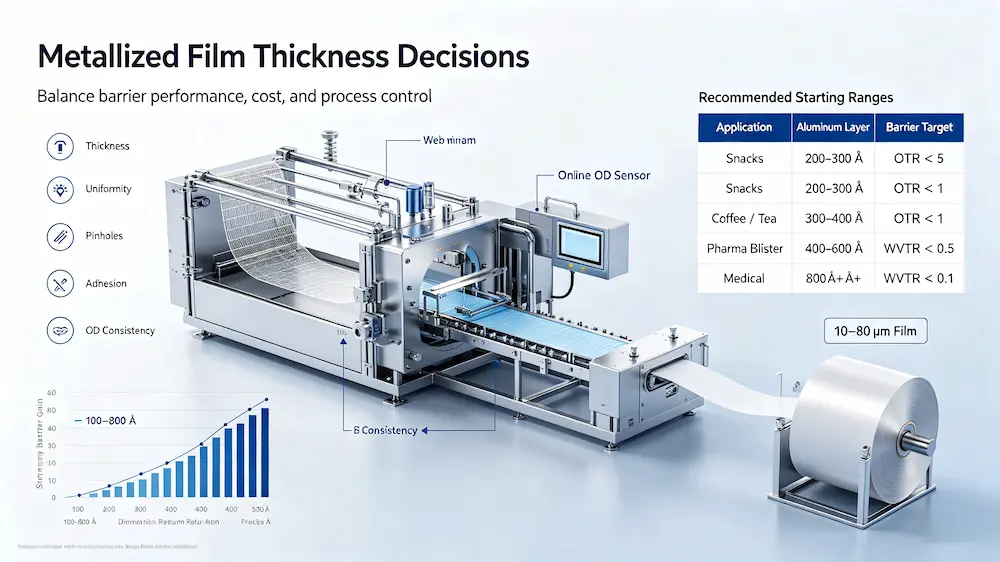
The table gives practical starting points for every metallized film structure, but your sealing layer and laminate also matter. The oxygen transmission rate drives the choice for oxygen-sensitive foods, while the water vapor transmission rate drives the choice for moisture-sensitive pharmaceuticals. For pharmaceutical and medical packaging, the water vapor transmission rate becomes the critical spec, and Tempo’s induction heating metallizer produces aluminum layers beyond 800 Å to meet it. The graphite crucible source keeps pinhole rates low enough for gold-silver wire and high-barrier applications. Notably, this machine handles films from 10 to 80 µm and runs at 500–750 m/min without sacrificing uniformity.
How Metallizers Control Thickness and Uniformity
The production line controls the aluminum layer thickness through three levers: winding speed, evaporation rate, and source design. A faster web spreads the same metal vapor over more film, which thins the coating; the operator balances speed against the desired OD. Consequently, high-speed machines need precise wire feeding and stable vacuum. Tempo’s fully automatic suspension machine reaches 900 m/min, and its free suspension coating design eliminates empty coating lines and edge wrinkles, so the aluminum layer stays uniform from edge to edge. Double coating drum cooling improves brightness and aluminum adhesion, and the top-clamped staggered evaporation boats speed up cleaning and boat changes.
Thickness Is Not Everything: Pinholes and Adhesion
Two hidden factors can ruin barrier performance even with the correct thickness: pinholes and poor adhesion. Pinholes act as microscopic shortcuts for gas molecules, and they usually appear when the substrate surface is rough or dirty, or when the evaporation rate fluctuates. Adhesion fails when the coating drum temperature and cooling run incorrectly. Regular maintenance prevents both; our preventive maintenance checklist covers the cleaning and inspection routines that keep OTR and WVTR stable. In practice, a well-maintained line running a 250 Å coating outperforms a neglected line running 400 Å.
Specify Thickness in Your Purchase Contract
When you buy a vacuum metallizer or outsource metallization, specify the target OD range, the test method, and the acceptance limits in writing. Tempo customizes machines to your web width, substrate, and coating target, and our in-house metallization processing service lets you validate film quality before you invest in equipment. Consequently, you can lock the aluminum layer thickness your product truly needs rather than paying for excess aluminum you cannot use.
FAQ
Q1: What is the ideal aluminum layer thickness for food packaging?
A: Most food packaging works well at 200–400 Å. Snacks need about 200–300 Å, while coffee and tea require 300–400 Å to hold aroma and moisture for months. Thickness beyond 500 Å rarely improves barrier performance further.
Q2: Does thicker aluminum always mean better barrier performance?
A: No. Barrier performance improves quickly from 100 to 300 Å, then plateaus. Above 400–500 Å, pinholes and adhesion defects dominate, so uniformity and process control matter more than raw thickness.
Q3: How do manufacturers measure aluminum layer thickness?
A: They measure optical density (OD) inline during metallizing and confirm the result with laboratory tests such as ASTM D3985 for oxygen transmission rate and ASTM F1249 for water vapor transmission rate.
Q4: Can a metallizer produce more than 800 Å?
A: Yes. Tempo’s induction heating metallizer with graphite crucible sources reaches 800 Å and above, which suits medical packaging and gold-silver wire coating. Standard resistance-heated machines typically stop around 400–500 Å at economical speeds.
Q5: How do I compare metallized film suppliers fairly?
A: Ask for OTR and WVTR numbers measured under the same ASTM standards, plus the optical density range of each roll. A supplier who reports consistent OD values across rolls usually delivers consistent barrier performance.
Ready to Specify Your Coating?
Unsure which aluminum layer thickness your product needs? Send us your substrate, laminate structure, and shelf-life target; our engineers will recommend the right OD range and machine configuration within 24 hours. Contact Tempo Machinery today.