


The Science of Zinc Sulfide (ZnS) Coating: High Refractive Index, Optics and Holographic Applications
Look closely at the security label on a premium liquor bottle or the rainbow sheen on a gift box, and you are seeing zinc sulfide coating at work. This transparent, high-index material creates the shifting colors of holographic films without blocking the light underneath. In this guide, we explain the optics behind zinc sulfide coating, why its high refractive index matters, and what your production line needs to deposit it consistently.
What Makes Zinc Sulfide Special: The High Refractive Index
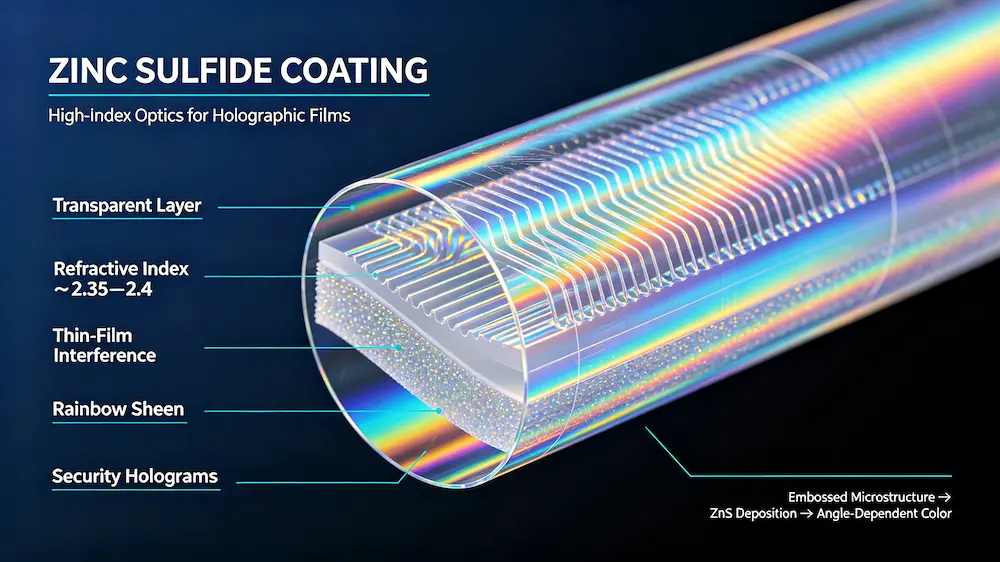
Zinc sulfide stands apart from aluminum because it transmits visible light. Its high refractive index of roughly 2.35–2.4 far exceeds the 1.5 typical of glass and most polymers. Refractive index measures how strongly a material bends light, and a higher value produces stronger reflections at thin-film interfaces. Consequently, a ZnS layer only a few hundred angstroms thick generates vivid interference colors that a much thicker aluminum film cannot produce. Manufacturers exploit this property for rainbow films, holographic labels, and decorative packaging.
How a High-Index Layer Creates Holographic Effects
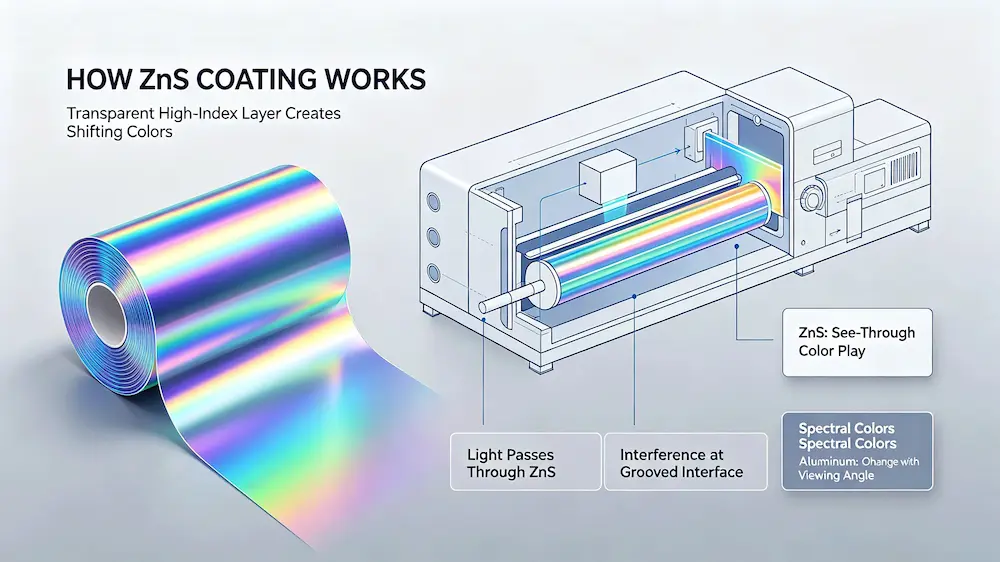
A holographic film starts with an embossed microstructure on the polymer surface — millions of tiny grooves that act like a diffraction grating. When you deposit a transparent high-refractive-index layer on top, light passing through the coating interferes at the grooved interface and splits into spectral colors. The effect shifts as the viewing angle changes, which creates the 3D, rainbow appearance associated with holography. Zinc sulfide coating delivers this effect while keeping the film see-through; an aluminum layer, by contrast, produces an opaque mirror finish. Both versions appear in security holograms, depending on whether the designer wants transparency or metallic shine. The pairing of embossing and high-index coating powers most holographic anti-counterfeiting labels worldwide.
ZnS Coating vs. Aluminum Metallizing: Two Roles in Security Films
ZnS coating and aluminum metallizing play complementary roles in security films. Aluminum provides the mirror-bright metallic look and adds barrier properties; zinc sulfide coating supplies the transparent optical layer that produces color play. Many premium labels combine both: an aluminum-backed holographic layer for maximum visual impact and a ZnS top layer for tamper-evident color shifts. Holographic anti-counterfeiting relies on this pairing because counterfeiters find the optical behavior extremely hard to replicate with print alone. Moreover, ZnS-coated films resist fading and scratching better than printed optical effects.
The Vacuum Process for Zinc Sulfide Film
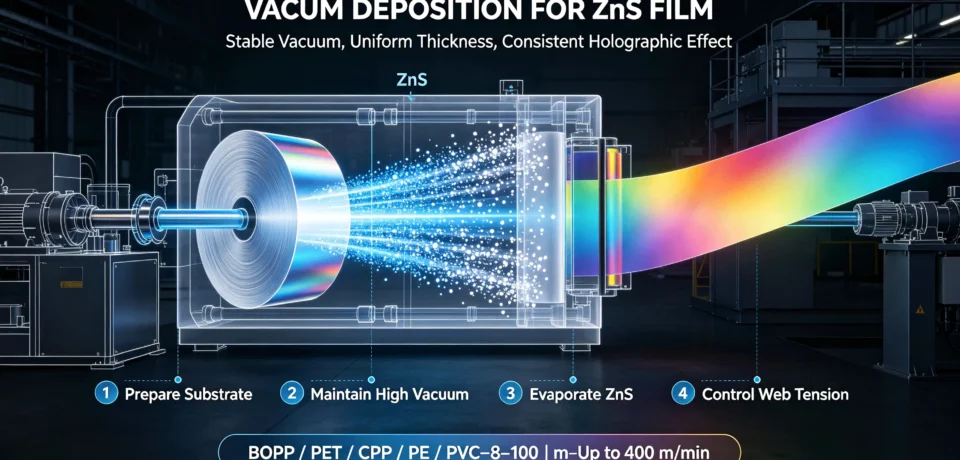
Depositing zinc sulfide film demands precise vacuum conditions. ZnS evaporates at high temperature, and the coating quality depends on maintaining the exact vacuum degree during the whole run. Tempo’s Vacuum Metalizer for Zinc Sulfide film holds that vacuum steady, which enables smooth, fast coating and the ideal ZnS thickness on the web. The machine handles BOPP, PET, CPP, PE, PVC, and other substrates from 8 to 100 µm. Notably, the output shows high brightness, good transparency, and uniform coating without color difference. Automatic constant tension control keeps the web stable at 400 m/min, and the moving evaporation section simplifies cleaning between runs.
What to Demand from a ZnS Metallizer
Not every vacuum coater suits zinc sulfide film, because ZnS behaves differently from aluminum. When you evaluate machines, check four things: vacuum stability during evaporation, cleaning time between batches, tension control accuracy, and maintenance frequency. Tempo’s ZnS metallizer series runs from TB-1000 to TB-2400 with web widths up to 2,400 mm, and the design emphasizes fast cleaning, strong stability, and low maintenance rates. The evaporation and wire-feeding sections move out from the rear of the chamber, which raises pumping speed and shortens boat changes. Explore the full machine specifications to compare parameters across our range.
Applications Beyond Anti-Counterfeiting
Holographic anti-counterfeiting remains the largest market for ZnS-coated films — banknote threads, tax stamps, and brand protection labels all rely on it. However, the decorative market grows faster. Rainbow film and laser color film wrap cosmetics, toys, and confectionery; ZnS coatings add shimmer to stamping foil, home decoration, and circle sequins. Our application gallery shows the full range, and the holographic metallized film page explains how the material combines metallic reflection with dynamic rainbow and 3D effects for packaging, labeling, and security. In short, holographic anti-counterfeiting and decorative shimmer represent two sides of the same ZnS technology.
Getting Started: Specify the Right Coating
Define your target optical effect before you invest. Specify the substrate, web width, coating thickness, and whether you need a transparent or mirror holographic film. Tempo customizes machines to those parameters, and our in-house metallization processing service lets you trial ZnS coating on your own film before buying equipment. Consequently, you validate the visual result first and scale production later with confidence.
FAQ
Q1: Why does zinc sulfide coating look transparent while aluminum looks like a mirror?
A: Zinc sulfide transmits visible light, so the coating stays clear and only produces color through interference. Aluminum reflects almost all light, which creates the mirror appearance. Designers choose ZnS for see-through holograms and aluminum for opaque metallic effects.
Q2: What is the refractive index of zinc sulfide coating?
A: Zinc sulfide coating has a refractive index around 2.35 to 2.4, far above glass and polymers at about 1.5. This high refractive index produces strong thin-film interference, which generates the bright rainbow colors in holographic films.
Q3: Can one machine coat both aluminum and zinc sulfide?
A: Some machines can switch coating materials, but dedicated setups give better results. Zinc sulfide requires precise vacuum control and different evaporation parameters than aluminum, which is why Tempo builds a specific ZnS metallizer series rather than a universal machine.
Q4: Which films accept zinc sulfide coating?
A: BOPP, PET, CPP, PE, and PVC films from 8 to 100 µm accept zinc sulfide coating readily. The machine also coats other roll materials; tell us your substrate, and we will confirm compatibility.
Q5: How do I verify the quality of a ZnS-coated holographic film?
A: Check three things: color consistency across the roll, transparency without haze, and the uniformity of the rainbow effect under different viewing angles. A stable vacuum process produces consistent results, so ask the supplier for roll-to-roll optical density data.
Ready to Build a Holographic Film Line?
Planning a holographic film line? Send us your substrate, web width, and target effect; our engineers will recommend the right ZnS metallizer configuration within 24 hours. Contact Tempo Machinery today.