


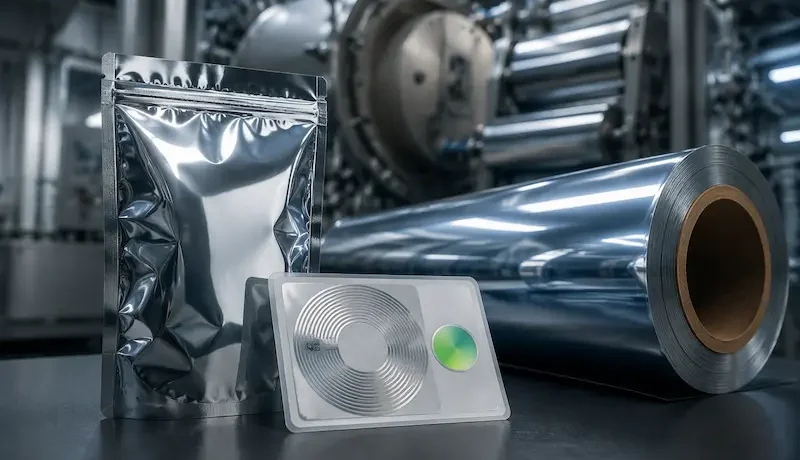
Smart and Active Packaging: NFC Tags, Freshness Sensors and Metallized Surfaces
Packaging used to do one job: protect the product and carry a brand. Now it also talks, senses, and reacts. A label can answer a phone, a patch can change color when food spoils, and an inner liner can absorb the oxygen that shortens shelf life. Together, these functions define smart and active packaging.
Metallized surfaces sit at the center of this shift. They block oxygen and light, they can carry a conductive circuit, and they give brands a premium metallic look. Therefore, this guide explains how NFC tags, freshness sensors, and metallized film combine, and where the physics creates a catch worth understanding before you design.
What Smart and Active Packaging Actually Means
The two terms describe different jobs, and the distinction matters when you specify materials.
Active packaging extends shelf life by removing oxygen or controlling moisture, so it protects the product chemically. Smart packaging, by contrast, gathers or shares data, so it informs the buyer or the supply chain. Many modern packs combine both, and that combination drives demand: Future Market Insights values the active, smart, and intelligent packaging market at $28.8 billion in 2025 and projects $61.5 billion by 2035.
Why Metallized Surfaces Matter Here
Vacuum metallizing earns its place in smart and active packaging through four separate roles:
- High barrier: an aluminum layer blocks oxygen, moisture, and light, which supports oxygen-sensitive food, coffee, and pharmaceutical packs. Our guide to high-barrier food packaging explains the mechanism.
- Conductive layer: the same metal layer can form an antenna or a printed circuit, which turns a label into an NFC tag or a sensing element.
- Functional aesthetics: a metallic finish signals premium quality for cosmetics, spirits, and gift packaging.
- Sensor support: a barrier layer protects printed indicators from moisture and light that would corrupt their reading.
One physical property ties these roles together. Because the metal layer stays extremely thin, it adds function without adding weight, and producers tune its thickness through the same optical-density controls that packaging lines already use. Our article on aluminum layer thickness and barrier performance shows how that trade-off works.
NFC Tags on Packaging: The Metal Problem and Its Fixes
NFC tags let a phone read data from a label at close range, which supports authentication, traceability, and consumer engagement. However, metal fights back, and this is the catch that surprises many designers.
When an NFC antenna sits near a conductive surface, the field induces eddy currents in the metal. Those currents weaken the magnetic field and detune the antenna, so the read range collapses. Consequently, a metallized pouch or a foil-laminated carton can defeat an NFC tag that worked perfectly on paper.
Engineers solve the problem in three ways:
- Ferrite shielding: a thin ferrite sheet between the antenna and the metal absorbs the magnetic flux and suppresses eddy currents. Published work shows that a ferrite sheet placed between an RFID tag and metal extends the communication distance, and manufacturers now sell flexible ferrite sheets for exactly this job.
- Antenna redesign: a smaller, specially shaped antenna tolerates nearby metal better than a large flat coil.
- Placement: moving the tag away from the conductive layer — for example, onto an outer label rather than an inner metallized liner — restores performance at almost no cost.
The lesson is simple. A metallized surface can host an NFC tag, yet the design must respect the metal. Decide early whether the metal serves as a barrier, an antenna, or both, because that choice shapes the whole structure. For a deeper look at conductive layers in packaging, see our article on metallized film for capacitors, which shares the same thin-conductor physics.
Freshness Sensors: Chemistry Meets Printed Electronics
A freshness sensor tells the buyer whether food still deserves trust. Most designs rely on chemistry: an indicator changes color as spoilage markers build up inside the pack.
Research on intelligent packaging identifies the usual targets: ammonia, trimethylamine, carbon dioxide, volatile nitrogen compounds, biological amines, and sulfides. These markers appear as fish, meat, and fruit degrade, so a colorimetric label can report spoilage directly. Commercial history supports the idea, because colorimetric labels that respond to ammonia have monitored fish freshness since the late 1990s.
Modern designs add electronics. A printed electrode can read a chemical change and pass the result to an NFC tag, so a phone displays a freshness score instead of asking the shopper to judge a color. That marriage of chemistry and printed electronics needs three things: a stable indicator chemistry, a conductive layer for the circuit, and a barrier that keeps the chemistry honest. Metallized film can supply the conductive layer, and it can supply the barrier at the same time.
What Metallizing Equipment Must Deliver
Vacuum metallizing film for smart and active packaging rewards precision, because the material usually serves more than one function. Therefore, buyers should weigh these capabilities:
- Tight thickness control — barrier and conductivity both depend on layer thickness.
- Uniform deposition across the width — an uneven layer weakens barrier performance and shifts antenna resistance.
- Multi-metal capability — aluminum covers barrier and cost targets, while copper and other metals serve conductive designs.
- Adhesion and durability — the layer must survive lamination, printing, and converting.
- Clean deposition — pinholes let oxygen and moisture through the barrier.
- Inline monitoring — optical-density or resistance feedback holds the layer on target roll after roll.
A platform such as Tempo Machinery’s fully automatic suspension vacuum coating machine brings a free-suspension web path, double coating-drum cooling, online OD detection, a Siemens PLC, and four servo motors that hold constant tension. For special metal layers, the induction heating metallized machine and our sputtering capability extend the range. In practice, our standard machines cover 6–150 µm, so we always recommend discussing your film, barrier, and conductivity targets with our engineers before you order.
Quality Checks That Protect Both Functions
Because the same film carries barrier and electrical duties, quality control must cover both. Our article on optical density in metallized films explains why the optical route works for barrier film.
Because pinholes and adhesion failures cause most field complaints, our guides to adhesion testing for metallized film and vacuum coating defect troubleshooting help operators set practical limits.
Market Outlook for Smart and Active Packaging
Demand keeps climbing because brands and regulators both want less waste and more traceability. Future Market Insights values the active, smart, and intelligent packaging market at $28.8 billion in 2025 and projects $61.5 billion by 2035. Meanwhile, Dataintelo values the connected packaging technology market at $23.7 billion in 2025 and projects $51.2 billion by 2033, and Spherical Insights expects the smart packaging market to exceed $46.9 billion by 2033 at a 6.20% CAGR.
Those figures rest on a practical driver: consumers and supply chains want proof of freshness, authenticity, and origin. As a result, freshness sensors and NFC tags move from novelty to expectation, and the metallized film that vacuum metallizing produces must deliver barrier and conductivity at the same time.
Conclusion
Smart and active packaging combines protection, sensing, and communication in one structure, and vacuum metallizing supports all three. A metal layer blocks oxygen and light, forms a conductive antenna or circuit, and supplies the premium finish that brands want. However, metal detunes nearby NFC tags unless you add ferrite shielding, redesign the antenna, or reposition the tag. Therefore, plan the metal’s role early, choose equipment built for thin-film precision, and verify both barrier and conductivity before you commit to volume production.
Ready to evaluate a coating line for smart packaging film? Contact our team for machine specifications, customization options, and a free consultation on your coating requirements.
FAQ
1. Can an NFC tag work on metallized packaging?
Yes, with the right design. Metal induces eddy currents that detune the antenna, so you add a ferrite shield, redesign the antenna, or move the tag away from the metal layer. With one of those fixes, an NFC tag reads reliably on metallized packaging.
2. What is the difference between smart and active packaging?
Active packaging changes the environment inside the pack, for example by absorbing oxygen or moisture. Smart packaging senses or communicates information, for example through NFC tags, QR codes, or freshness sensors. Many products combine both.
3. How do freshness sensors detect spoilage?
Most rely on chemistry. An indicator reacts to spoilage markers such as ammonia, carbon dioxide, or biological amines and changes color. Newer designs use printed electrodes that feed a value to an NFC tag, so a phone can display a freshness score.
4. How does metallized film help active packaging?
A vacuum-deposited aluminum layer forms a high barrier against oxygen, moisture, and light, which slows spoilage. That barrier protects both the product and any printed sensor that shares the pack.
5. Does a metallic look interfere with smart packaging?
Only when the metal sits near an antenna. Use the metal as a barrier where it helps, keep antennas clear of it or add ferrite shielding, and the aesthetic and the electronics can coexist.