


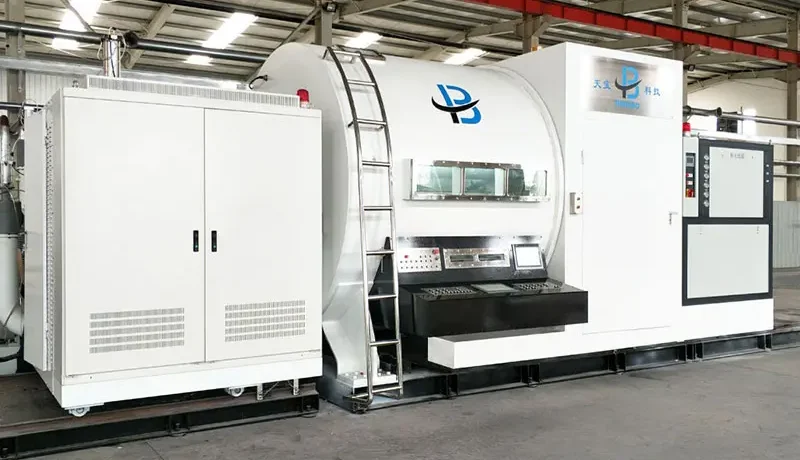
Energy-Saving Innovations in Vacuum Coating Equipment
Electricity is not just an operating expense for vacuum metallizing — it is often the single largest variable cost per square meter of coated film. A typical mid-size metallizer with resistance boat heating draws 250–450 kW of installed power. Run it across three shifts, 300 days a year, and your annual electricity bill easily exceeds $150,000 — and that figure climbs higher every time energy prices spike.
Industry data confirms the urgency. The global vacuum coating equipment market is projected to reach $10.64 billion by 2034, and a growing share of buyer inquiries now prioritize energy efficiency as a top-three purchasing criterion. Manufacturers who ignore this shift will watch their operating costs erode margins while competitors running efficient equipment capture price-sensitive contracts.
At Qingzhou Tempo Machinery Technology Co., Ltd., we have embedded energy-saving design principles across our entire vacuum metallizer product line. This article examines five innovations that deliver measurable reductions in power consumption — and, just as importantly, measurable improvements to your bottom line.
Innovation 1: Induction Heating — The 20–35% Efficiency Jump
Traditional vacuum metallizers use resistance heating: an electric current passes through a boron nitride or graphite boat, which heats up and transfers thermal energy to the aluminum wire. This approach works, but it wastes energy in two ways. First, the boat must reach 1,200–1,500°C before aluminum evaporates — and a significant portion of that heat radiates into the chamber walls rather than into the aluminum. Second, resistance heating produces uneven temperature distribution, forcing operators to run at higher average temperatures to ensure complete evaporation across the entire boat length.
Induction heating flips this model. An electromagnetic coil generates a rapidly alternating magnetic field, which induces eddy currents directly inside a conductive graphite crucible. The crucible heats from within — not from an external resistance element — and transfers energy to the aluminum with far less radiative loss.
How Much Energy Does Induction Save?
The numbers vary by application, but the consensus is clear. Comparative studies show that induction heating achieves over 85% energy efficiency compared to 75–80% for resistance heating. In vacuum metallizing specifically, the gap widens further because induction heating’s targeted energy delivery reduces the total thermal load on the chamber, which lightens the burden on your cooling system.
At Tempo Machinery, our induction heating vacuum metallized machine consistently demonstrates 20–35% lower total power consumption compared to equivalent boat-based systems. For a machine running 24/7, that translates to annual electricity savings of 30,000–50,000 — depending on local energy rates — without sacrificing a single meter of coating speed.
Beyond Electricity: The Productivity Bonus
Induction heating saves money in ways that do not appear on your electricity bill. The graphite crucible produces dramatically less aluminum splatter than resistance boats, which means:
- Operators spend less time on chamber cleaning between runs
- The evaporation source area stays cleaner, reducing the risk of electrical arcing
- Coating uniformity improves because the crucible maintains a stable temperature profile across its entire surface
These productivity gains compound the direct energy savings. A cleaner machine runs more hours per week and wastes less film to coating defects.
Innovation 2: Variable Frequency Drives on Vacuum Pumps
Roughing pumps and backing pumps consume a significant portion of a metallizer’s total electrical load — often 30–40% of installed power. In a conventional setup, these pumps run at fixed speed regardless of what the chamber actually needs. During the initial pump-down phase, full-speed operation makes sense. But once the chamber reaches rough vacuum and the diffusion pump takes over, the roughing pump continues spinning at full RPM — consuming electricity and generating heat for no productive purpose.
Variable frequency drives (VFDs) change this equation. A VFD adjusts the pump motor’s speed to match the real-time demand.
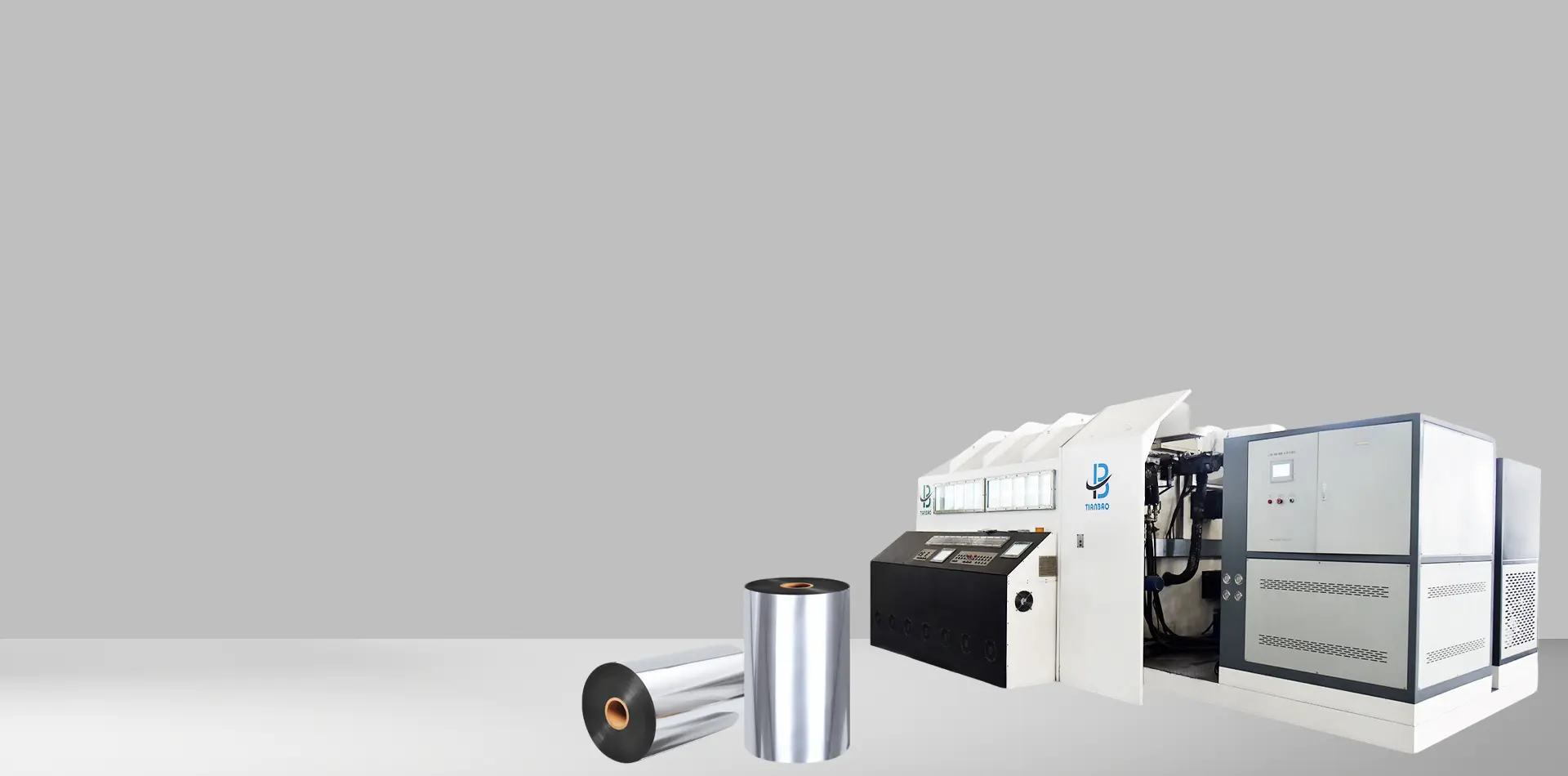
The VFD Savings Curve
The physics of centrifugal pumps follows the affinity laws: power consumption scales with the cube of the rotational speed. This means that even a modest speed reduction delivers outsized energy savings.
In a vacuum metallizer, a VFD-controlled roughing pump can run at full speed during the initial 5–8 minute pump-down, then throttle back to 60–70% speed during the coating phase when only a small backing pump load is needed. Over a full production day, industry data from Rockwell Automation and Yaskawa confirms that VFD-equipped vacuum systems typically achieve 30–50% pump energy savings compared to fixed-speed configurations.
Moreover, VFDs extend pump life. Soft-start ramps reduce mechanical shock on bearings and seals during startup, and lower average operating speeds reduce cumulative wear. This translates to fewer rebuilds and less downtime — a secondary cost saving that compounds over the machine’s 15–20 year service life.
Innovation 3: Optimized Cooling System Design
A vacuum metallizer’s cooling system serves two masters: the coating drum must stay cold enough to prevent film deformation, and the diffusion pumps must stay cold enough to condense pump fluid vapor. Both functions run continuously during production, and both consume electricity through chillers, circulation pumps, and cooling towers.
Smart Cooling: Cool Only What Needs Cooling, When It Needs It
Traditional cooling systems operate on a simple thermostat: the chiller runs whenever the return water temperature exceeds a set point. This leads to frequent cycling — the chiller turns on, overcools the water slightly, turns off, waits for the temperature to creep back up, and turns on again. Each start cycle draws a surge current 3–5 times higher than steady-state operation.
Modern intelligent cooling controllers address this inefficiency in two ways:
-
Proportional cooling output: Instead of simple on/off cycling, the controller modulates the chiller’s compressor speed (via its own VFD) to match the exact heat load in real time. During low-load periods — for example, during roll changes when no evaporation is occurring — the system reduces cooling output rather than cycling on and off.
-
Zone-based cooling: Separate temperature control loops for the coating drum, the diffusion pump, and the chamber walls ensure that each component receives exactly the cooling it needs. No component overcools because another component runs hot.
The Tempo Design Advantage
Our aluminum paper vacuum metallized machine incorporates an optimized cooling architecture that shortens the required compressor working time during each production cycle. By improving the thermal efficiency of the cooling water path and reducing heat soak into non-critical components, the design achieves the same cooling performance with less compressor runtime — directly lowering electricity consumption without any trade-off in film quality or machine speed.
Innovation 4: Smart Automation and Process Optimization
Energy waste often hides in plain sight — in the gaps between production steps that no one thinks to measure. Consider these common scenarios:
- The machine finishes coating a roll, but the operator is busy unloading the previous roll and takes two extra minutes to initiate the next pump-down sequence. The vacuum pumps continue running at full power during this idle period.
- An inexperienced operator runs the diffusion pump heater for 45 minutes before starting production because “that is how the last operator did it” — even though the pump only needed 30 minutes to reach operating temperature.
- The machine processes a thin, heat-sensitive PE film at the same drum temperature as a thick PET film because no one adjusted the recipe.
Smart automation eliminates these invisible energy leaks.
Recipe-Based Operation
Modern PLC control systems — featured on all Tempo Machinery vacuum coating machines — store optimized process parameters for each product. When an operator selects a recipe, the machine automatically configures:
- Evaporation source temperature and power level
- Coating drum temperature set point
- Pump-down sequence timing
- Coating speed and tension settings
- Cooling water flow targets
The result? Every run uses exactly the energy it needs — no more, no less. New operators achieve the same efficiency as veterans because the machine enforces the optimized parameters rather than relying on tribal knowledge.
Automatic Standby and Idle Management
A well-designed automation system also manages idle periods intelligently. When the machine detects that production has paused (for example, beyond a configurable timeout after the coating cycle ends), it can automatically:
- Reduce roughing pump speed to a standby level
- Lower the diffusion pump heater power to a holding temperature
- Reduce cooling water flow to match the reduced heat load
- Dim or power down non-essential control panel displays and auxiliary systems
These small adjustments, applied across hundreds of idle minutes per month, add up to meaningful annual savings.
Innovation 5: Advanced Chamber Design and Thermal Management
The vacuum chamber itself influences energy consumption in ways that many buyers overlook. A poorly designed chamber radiates heat, leaks thermal energy through uninsulated surfaces, and forces the cooling system to fight a battle it should not have to fight.
Multi-Layer Thermal Shielding
On high-temperature metallizers, multi-layer heat shields surrounding the evaporation source reduce radiative heat transfer to the chamber walls by 30% or more. Less heat reaching the walls means less heat that the cooling system must remove — a direct reduction in chiller electricity consumption.
This principle mirrors what the vacuum furnace industry has practiced for years: multi-layer insulation screens can cut furnace heat dissipation by over 30%, and the same physics applies to evaporation sources in coating chambers.
Optimized Chamber Geometry
Chamber volume matters. A chamber that is larger than necessary for your maximum web width contains more “empty” space that the vacuum pumps must evacuate during every cycle. More volume means longer pump-down time, which means more pump electricity consumption per roll.
Similarly, the internal layout of evaporation sources, the coating drum, and shielding affects how efficiently the aluminum vapor reaches the film. A well-designed geometry maximizes the deposition rate — the percentage of evaporated aluminum that actually lands on the film — reducing the amount of aluminum you must evaporate to achieve a given coating thickness.
Our fully automatic suspension vacuum coating machines achieve high deposition efficiency through precisely engineered source-to-drum geometry. The relationship between source spacing, drum diameter, and web path is not guesswork — our engineers optimize it based on decades of coating data.
Real-World Energy Savings: A Cost Calculation
What do these five innovations add up to in real money? Let us model a typical mid-size metallizer running BOPP film at 400 Å coating thickness across three shifts.
The energy-optimized machine achieves a 23% reduction in average operating load through the combination of induction heating, VFD pumps, smart cooling, automated standby management, and efficient chamber design. Over a typical 10-year machine lifespan, that single efficiency delta saves over half a million dollars — enough to pay for a second production line or fund expansion into new markets.
Frequently Asked Questions (FAQ)
Q: Does induction heating require special operator training compared to resistance boat systems?
A: The basic principles are different, but Tempo Machinery builds induction heating controls to be as intuitive as boat-based systems. Operators who have experience with resistance metallizers typically adapt within 3–5 days. The main differences they need to learn include: setting the induction power level rather than boat current, monitoring crucible condition instead of boat wear, and understanding the faster heat-up and cool-down cycles. We provide comprehensive on-site training as part of every machine installation, and our PLC interface uses graphical controls that clearly display power levels, temperatures, and status indicators.
Q: Can I retrofit an existing resistance-heated metallizer with induction heating?
A: In most cases, retrofitting a resistance machine to induction heating is impractical. Induction heating requires a fundamentally different evaporation source assembly — the induction coil, the graphite crucible, the power supply, and the cooling provisions all differ from boat-based systems. Additionally, the chamber geometry around the source area may need modification. For converters who want to capture induction heating’s efficiency benefits, we generally recommend a new machine or adding an induction-capable metallizer alongside your existing equipment. Our sales engineers can help you evaluate the retrofit-versus-new economics based on your specific machine model and production volume.
Q: How quickly do VFD-driven vacuum pumps pay for themselves?
A: The payback period typically falls between 12 and 24 months, depending on your local electricity rate and your machine’s duty cycle. For a machine running three shifts, the savings accumulate rapidly because the pumps consume power during every minute of operation — not just during coating. Even if you operate only a single shift, the idle-time savings from reduced standby pump speed contribute to the return. When you factor in the extended pump service intervals that VFD soft-start provides, the total economic case strengthens further. We can prepare a site-specific ROI analysis using your actual electricity tariff and production schedule.
Q: What is the single biggest energy-saving measure a converter can implement without buying a new machine?
A: Process optimization through recipe standardization delivers the fastest returns with zero capital investment. Review your current production parameters for each product. Many converters discover that they run evaporation sources hotter than necessary, leave pumps at full speed during idle periods, or maintain unnecessarily low coating drum temperatures out of habit rather than technical requirement. By standardizing optimized parameters for each product — and then training operators to follow those recipes consistently — converters typically reduce energy consumption by 8–15% within the first quarter. After you capture these “low-hanging fruit” savings, the next step is adding VFDs to your roughing and backing pumps.
Q: Do energy-saving features add significant cost to a new machine purchase?
A: The upfront cost premium for an energy-optimized machine — including induction heating, VFD pumps, smart cooling, and advanced automation — typically ranges from 10–18% above a baseline configuration. However, the payback math is straightforward. Using the $51,480 annual savings figure from our model above, even at the higher end of the premium range (18% on a $500,000 machine = $90,000), the payback period falls under two years. After that, every dollar of energy savings flows directly to your bottom line. For a machine that will operate for 10–15 years, the lifetime savings overwhelm the upfront premium by a factor of five to seven.
Conclusion: Energy Efficiency Is a Competitive Advantage
Energy-saving technology in vacuum coating equipment has crossed the threshold from “nice to have” to “need to have.” Rising electricity costs, tightening environmental regulations, and margin pressure from low-cost competitors all point in the same direction: the converters who invest in efficiency today will hold a durable cost advantage tomorrow.
The five innovations covered in this article — induction heating, VFD-driven pumps, intelligent cooling, smart automation, and optimized chamber design — work together as a system. Each one contributes individually, but their combined effect is greater than the sum of their parts. A machine that features all five can operate at 20–30% lower energy cost per square meter than a conventional metallizer of equivalent capacity.
At Qingzhou Tempo Machinery Technology Co., Ltd., every machine we ship reflects these principles. Our induction heating metallizers lead the efficiency curve. Our fully automatic suspension coaters incorporate optimized chamber geometry and smart automation as standard. And our aluminum paper metallizers feature cooling architectures that shorten compressor run time and extend equipment life.
If you want to understand what energy-efficient vacuum coating could mean for your production costs, contact our engineering team. We will prepare a customized energy consumption analysis based on your substrate types, coating specifications, target production volume, and local electricity rates — with no obligation and no sales pressure. Because we operate our own film production line, we know exactly what efficient metallizing looks like in practice, not just on a spec sheet.