


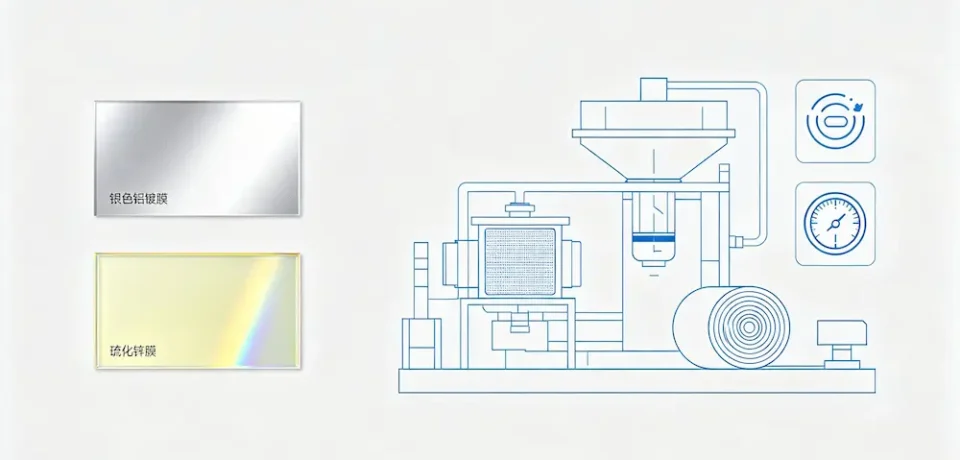
The Rise of Zinc Sulfide Coating: Applications Beyond Traditional Aluminum Metallizing
For decades, aluminum dominated the vacuum metallizing industry. Walk into any flexible packaging plant, and you will see rolls of shiny, silver-coated BOPP and PET film running through slitters and laminators. Aluminum is affordable, effective, and well understood.
But aluminum has a fundamental limitation: it is opaque. It blocks light. It conducts electricity. And for a growing number of high-value applications — from holographic security labels to transparent barrier packaging — these properties are not features. They are deal-breakers.
Enter zinc sulfide (ZnS).
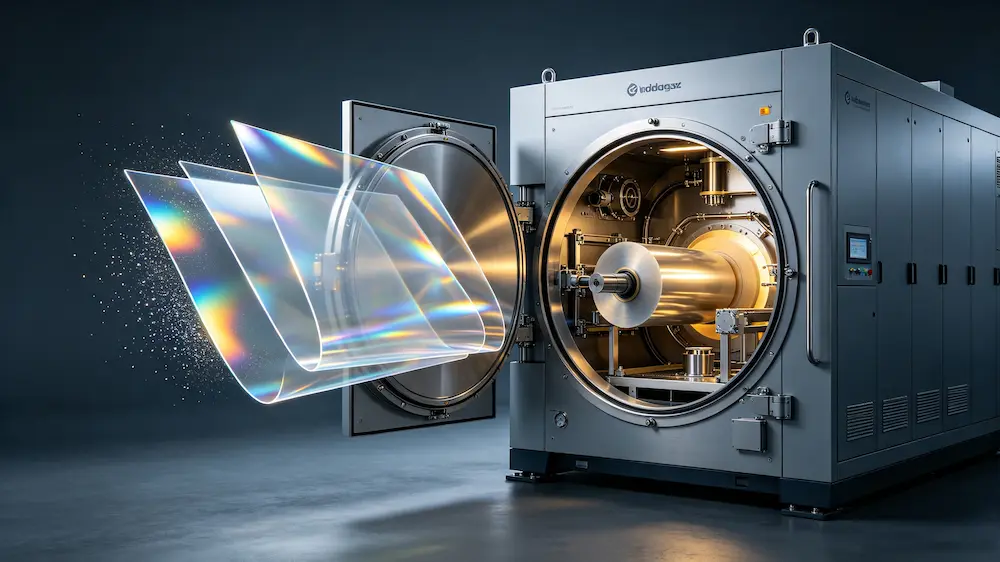
Once a niche material confined to optical laboratories, ZnS now claims a rapidly expanding role in commercial vacuum coating. At Qingzhou Tempo Machinery Technology Co., Ltd., we have responded to this shift by developing our dedicated vacuum metalizer for zinc sulfide film — a machine purpose-built for the unique evaporation characteristics of ZnS.
This article explores why ZnS is gaining ground, which applications drive the demand, and what the trend means for film converters and packaging manufacturers.
What Makes Zinc Sulfide Different from Aluminum?
Before we explore the applications, let us clarify what makes ZnS special at the material level.
Aluminum is a metal. In a vacuum chamber, you heat it to roughly 1,200–1,500°C, and it evaporates as free atoms that condense on the film surface as a continuous, highly reflective, opaque metallic layer. This layer blocks light, reflects heat, and conducts electricity.
Zinc sulfide is a dielectric compound — a II-VI semiconductor material with a high refractive index of approximately 2.20–2.35 in the visible spectrum. When you evaporate ZnS in a vacuum chamber (typically at 800–1,000°C, a lower temperature than aluminum), it deposits as a thin, transparent film with remarkable optical properties.
The table below summarizes the key differences:
These differences unlock applications that aluminum simply cannot address. Let us examine the most important ones.
Application 1: Holographic Anti-Counterfeiting Films
Holographic security features appear on banknotes, passports, pharmaceutical packaging, high-end liquor labels, and brand authentication stickers. These holograms rely on precisely engineered micro-embossed patterns on the film surface, which then receive a thin coating to make the holographic effect visible.
Aluminum works for basic holograms — but it creates an opaque, fully reflective surface that overpowers fine diffraction details. Moreover, aluminum’s opacity means you cannot see through the hologram to verify what lies beneath it.
ZnS solves both problems. Its high refractive index (2.20–2.35) creates brilliant diffraction efficiency without the overwhelming reflectivity of aluminum. Meanwhile, its transparency allows for “see-through” holograms — a critical security feature for document authentication where officials must verify information printed under the holographic layer.
According to Chuyue Materials’ ZnS application guide, ZnS sintered materials serve as the foundational coating for holographic anti-counterfeiting films and decorative coatings across Asia and global markets.
For film converters, this translates to a premium product segment. Holographic security film commands significantly higher margins than standard metallized packaging film. A machine like our ZnS-specific vacuum metallizer allows you to enter this market with purpose-built evaporation control that maintains the ideal vacuum degree for ZnS deposition.
Application 2: Transparent Barrier Packaging
Consumers increasingly demand packaging that lets them see the product before purchase. Fresh produce, baked goods, snack foods, and premium confectionery all benefit from a clear window that communicates freshness and quality.
However, transparent packaging presents a barrier challenge. Clear PET and BOPP films offer poor oxygen and moisture barrier properties on their own. Traditional aluminum metallizing provides excellent barrier performance — but it makes the film opaque.
ZnS offers a compelling middle ground. A thin ZnS coating (typically 300–600 Å) provides measurable improvement in oxygen and water vapor barrier while preserving over 80% visible light transmission. This creates a “clear barrier” film that satisfies both the marketing requirement for product visibility and the technical requirement for shelf-life extension.
The global metallized barrier film market continues to grow, and transparent barrier solutions represent one of its fastest-expanding segments. Food brands increasingly specify clear high-barrier laminates for premium product lines, and ZnS-coated films fit this specification precisely.
Application 3: Optical and Decorative Coatings
Beyond security and packaging, ZnS plays a growing role in optical thin-film stacks. Its high refractive index makes it an excellent partner material for low-index coatings like magnesium fluoride (MgF₂) in anti-reflective and beam-splitter designs.
Key optical applications include:
- Anti-reflective (AR) coatings on glass, plastic lenses, and display screens
- Hot mirrors and cold mirrors that selectively reflect or transmit infrared radiation
- Decorative transparent coatings on cosmetic packaging, electronics housings, and automotive interior trim — where designers want a subtle “ghost metallic” effect without full opacity
The UQG Optics guide to ZnS notes that ZnS serves as a high-index material in thin-film stacks applied to lenses, mirrors, and optical filters across industrial and defense sectors.
For converters, the decorative coating market offers another path beyond commodity packaging. A single multi-material vacuum metallizer that handles both aluminum and ZnS gives you the flexibility to serve packaging customers during the day and decorative coating customers during the next shift.
Application 4: Electronics-Compatible Films
Electronic devices — smart packaging with RFID tags, flexible printed circuits, touch sensors — require functional films that do not interfere with electrical performance. A conductive aluminum coating short-circuits RFID antennas, disrupts capacitive touch sensing, and creates electromagnetic interference.
ZnS, as a non-conductive dielectric, solves these compatibility issues. You can apply a ZnS coating to a film that sits directly adjacent to an RFID inlay, a printed antenna, or a touch sensor without affecting its electrical function.
This property matters especially for:
- Smart packaging with embedded NFC or RFID tags for inventory tracking and consumer engagement
- Flexible electronics substrates where a barrier layer must protect sensitive circuits without shorting them
- EMI-transparent windows on electronic device housings
As the vacuum metallizing equipment market grows at a projected CAGR of 14.6% through 2033, electronics-compatible coatings represent one of the key demand drivers.
Why ZnS Coating Requires Specialized Equipment
ZnS is not simply a “drop-in replacement” for aluminum. Its different evaporation characteristics demand specific machine design considerations.
Lower Evaporation Temperature
ZnS evaporates at roughly 800–1,000°C — significantly lower than aluminum’s 1,200–1,500°C range. However, ZnS is also more sensitive to overheating. If the evaporation source runs too hot, the ZnS decomposes before it deposits, producing a yellowish, hazy coating with degraded optical properties.
A specialized ZnS metallizer, such as our dedicated ZnS coating machine, maintains precise temperature control at the evaporation source to avoid decomposition while sustaining a stable deposition rate.
Vacuum Requirements
ZnS demands a cleaner vacuum environment than aluminum. Residual oxygen or water vapor in the chamber can react with the ZnS during deposition, causing cloudiness and refractive index drift. Our ZnS machines maintain the ideal vacuum degree specifically for ZnS evaporation, providing smooth, fast coating with consistent optical quality.
Deposition Uniformity
Because optical and holographic applications require tight thickness uniformity (±5% or better), the machine must deliver highly consistent deposition across the full web width. This demands careful evaporation source geometry, precise temperature control, and stable web handling — all standard features on Tempo Machinery’s ZnS platform.
Frequently Asked Questions (FAQ)
Q: Can I coat both aluminum and zinc sulfide on the same machine?
A: In many cases, yes. A multi-material vacuum metallizer with exchangeable evaporation sources can handle both aluminum and ZnS. However, you must thoroughly clean the chamber between material changes. ZnS residue mixed with aluminum deposits can create contamination that degrades coating quality for both materials. Tempo Machinery offers machines with quick-change evaporation source modules that reduce cross-contamination risk and speed up material changeover. For converters who want maximum flexibility, we recommend our fully automatic suspension vacuum coating machines, which we can configure for dual-material operation.
Q: How does the cost of ZnS coating compare to aluminum coating per square meter?
A: ZnS coating typically costs 2–4 times more per square meter than aluminum coating, depending on coating thickness and ZnS material purity. The cost driver is the raw material — high-purity ZnS granules or sintered material cost significantly more than aluminum wire. However, ZnS-coated films sell at premium prices, often 3–8 times the price of standard metallized films. For holographic security films in particular, the material cost is a small fraction of the final product price. The profitability equation therefore favors ZnS for converters who target premium market segments.
Q: What substrates work best for ZnS coating?
A: ZnS deposits well on most standard vacuum coating substrates: BOPP, PET, CPP, PE, PVC, and nylon. PET delivers the best results for optical and holographic applications because of its high clarity and thermal stability. BOPP works well for transparent barrier packaging. PE and CPP require lower coating speeds because of their lower heat resistance. Our ZnS metallizer supports all of these substrates with automatic constant tension control, and we help customers optimize parameters for each film type during commissioning.
Q: How thick should a ZnS coating be for different applications?
A: The optimal thickness depends entirely on your application. Holographic films typically need 300–500 Å to achieve strong diffraction efficiency while maintaining transparency. Transparent barrier films usually require 400–800 Å to achieve meaningful oxygen and water vapor barrier improvement. Optical coatings follow precise quarter-wave or half-wave designs based on the target wavelength, with exact thicknesses calculated during the optical design phase. Anti-reflective stacks often use ZnS layers of 400–600 Å alternating with low-index materials. Our technical team helps you determine the right thickness range based on your target application before machine configuration.
Q: Does ZnS coating require different operator skills compared to aluminum metallizing?
A: The basic operational skills are similar — your aluminum metallizing operators can learn ZnS in 1–2 weeks with proper training. The key differences they need to master include: managing the lower evaporation temperature to avoid ZnS decomposition; maintaining the stricter vacuum requirements; and using optical measurement tools (spectrophotometers or haze meters) for quality control instead of the simpler optical density meters used for aluminum. Tempo Machinery provides comprehensive operator training for ZnS processes as part of every machine installation, covering both theory and hands-on operation.
The Market Outlook: Why Now?
Several converging trends make ZnS coating an opportunity that forward-thinking converters should evaluate today:
-
Anti-counterfeiting demand is accelerating. The global anti-counterfeiting packaging market continues to expand as brands fight counterfeit goods in pharmaceuticals, spirits, cosmetics, and electronics. ZnS-coated holographic films are a core technology in this space.
-
Transparent barrier packaging is moving from “premium niche” to “mainstream requirement.” Major food brands increasingly specify clear high-barrier films for premium product lines, and retailers push for packaging that enhances on-shelf visibility.
-
Smart packaging and electronics integration demand non-conductive coatings. As RFID, NFC, and printed electronics proliferate, the need for electrically neutral barrier films grows proportionally.
-
Equipment technology has matured. Purpose-built ZnS metallizers like our Tempo Machinery ZnS machine now offer reliable, high-speed ZnS deposition with the same operational simplicity that converters expect from aluminum lines.
The vacuum coating and metallizing machinery market is projected to reach $9.9 billion by 2034, and ZnS applications will claim an increasing share of that growth.
Conclusion: ZnS Is Not Replacing Aluminum — It Is Expanding the Market
Zinc sulfide coating does not threaten aluminum’s dominance in commodity packaging. Aluminum remains the best choice for standard barrier films, decorative labels, and reflective applications where opacity is an asset, not a liability.
But for converters who want to escape the thin-margin commodity trap, ZnS opens doors to higher-value markets: holographic security, transparent barriers, optical coatings, and electronics-compatible films. These applications demand specialized equipment and technical expertise — and they reward those investments with significantly higher margins and stickier customer relationships.
At Qingzhou Tempo Machinery Technology Co., Ltd., we have invested in ZnS-specific machine development because we see where the market is heading. Our vacuum metalizer for zinc sulfide film combines fast cleaning time, high coating speed, automatic constant tension control, and precise vacuum control — all optimized for ZnS deposition on BOPP, PET, CPP, PE, PVC, and nylon substrates.
If you want to explore whether ZnS coating fits your product portfolio, contact our application engineering team for a technical consultation. We will help you evaluate the opportunity, estimate the economics, and — if it makes sense for your business — configure a machine that delivers consistent, high-quality ZnS coatings from day one.