


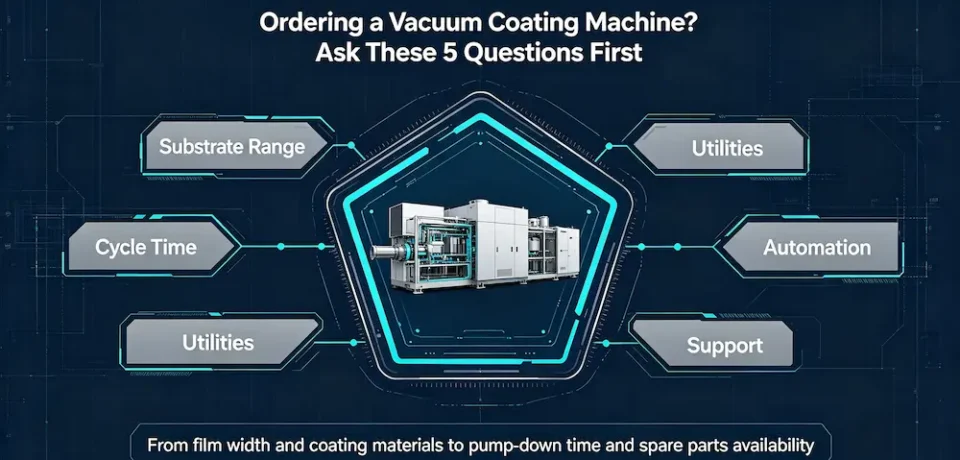
5 Questions to Ask Before Ordering a Custom Vacuum Coating Machine
Ordering a custom vacuum coating machine is not like buying a standard piece of equipment off the shelf. You are committing six figures to a machine that must integrate with your factory layout, match your substrate requirements, and deliver consistent coating quality for years. One overlooked detail during the specification phase can turn into a production bottleneck that haunts your bottom line for a decade.
At Qingzhou Tempo Machinery Technology Co., Ltd., we have guided hundreds of packaging converters, film processors, and label manufacturers through the customization process. Along the way, we have seen which questions separate a smooth commissioning from a painful retrofit.
This article arms you with five questions that every buyer should ask before signing a purchase order. Ask them early, and you will save yourself from expensive surprises.
Question 1: “What Substrates and Coating Materials Does This Machine Handle — and Does It Switch Between Them Easily?”
Most buyers start with one primary substrate in mind — BOPP film for flexible packaging, for example. However, production needs evolve. A year later, a customer may request metallized PET for high-barrier applications, and suddenly your single-purpose machine becomes a limitation.
What to Ask Specifically
- Can the machine process BOPP, PET, CPP, PE, PVC, and nylon film on the same platform?
- If you plan to coat aluminum today but want the option to run zinc sulfide (ZnS) tomorrow, does the machine support multi-material coating?
- How long does a material changeover take? Does it require replacing the evaporation source, or can you simply swap crucibles or boats?
Why This Matters
A machine that handles only aluminum coating locks you into a narrow market. Meanwhile, a multi-material platform — such as our vacuum metalizer for zinc sulfide film — opens doors to holographic anti-counterfeiting, high-barrier pharmaceutical packaging, and specialty decorative films.
Moreover, substrate flexibility matters equally. If your machine only accepts films between 800 mm and 1,200 mm wide, you cannot serve customers who need 1,650 mm jumbo rolls. Always verify the minimum and maximum web width before finalizing the specification.
Key takeaway: Do not design your machine around today’s order book. Design it around where you want your business in five years.
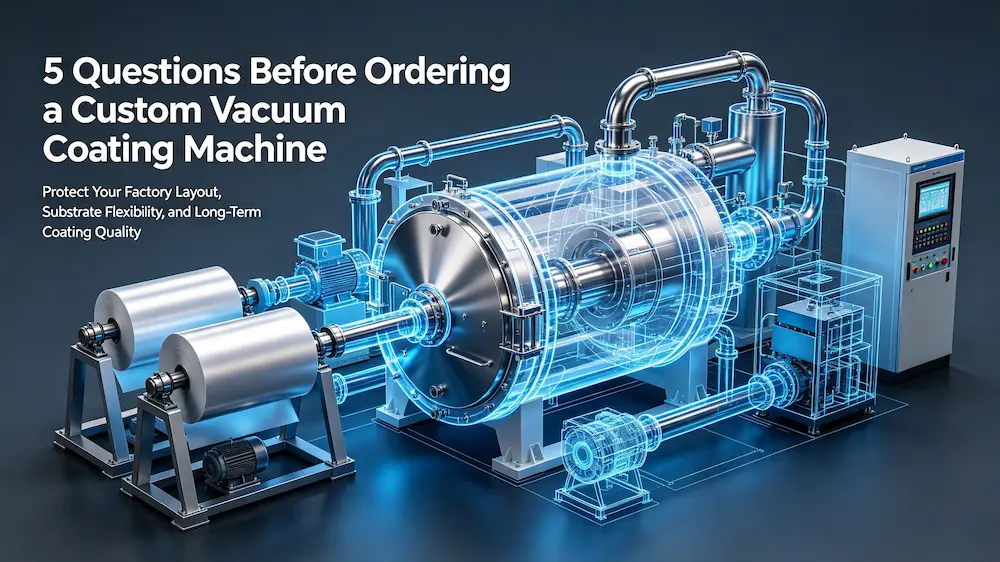
Custom Vacuum Coating Machine Procurement Guide
Question 2: “What Is the Real Production Capacity — Not Just the Theoretical Maximum?”
Every manufacturer quotes an impressive coating speed: 500 m/min, 600 m/min, or higher. However, theoretical maximum speed tells only part of the story. Real production capacity depends on the interplay of several factors, and you need to understand each one.
What to Ask Specifically
- At what coating thickness does the supplier rate their maximum speed? A machine that achieves 600 m/min at 200 Å may only manage 350 m/min at 600 Å — a critical detail if you produce thick-barrier films.
- What is the pump-down time from atmosphere to production vacuum? Every minute spent pumping down is a minute the machine is not producing.
- How long does a full roll change take, including venting, loading, pump-down, and re-establishing coating conditions?
- What is the expected uptime percentage based on real customer data?

Energy-Saving Innovations in Vacuum Coating Equipment
How to Calculate Real Daily Output
A machine rated at 600 m/min with a 1,650 mm web width running 400 Å aluminum on 18-micron BOPP produces roughly:
| Parameter | Value |
|---|---|
| Roll diameter (standard jumbo roll) | 800 mm |
| Film length per roll | ~28,000 meters |
| Coating time per roll | ~47 minutes |
| Overhead (vent, load, pump-down, stabilize) | ~15 minutes |
| Total cycle time | ~62 minutes |
| Output per 8-hour shift | ~7.7 rolls |
| Daily output (3 shifts) | ~23 rolls |
| Total daily length | ~644,000 linear meters |
If pump-down takes 25 minutes instead of 10, you lose three rolls per day — roughly 13% of your potential output. Over a year, that gap represents substantial lost revenue.
At Tempo Machinery, our fully automatic suspension vacuum coating machines achieve fast pump-down times through optimized vacuum system design. We encourage every buyer to request a production simulation based on their specific film type, thickness, and coating target — not just a brochure number.
Key takeaway: Ask for cycle time calculations, not just coating speed. The gap between the two determines your actual profitability.
Question 3: “What Utility Requirements Does the Machine Demand — and Does My Factory Meet Them?”
This question trips up more first-time buyers than any other. A vacuum metallizer is not a plug-and-play device. It demands substantial electrical power, cooling water, and compressed air. If your facility falls short, you face expensive infrastructure upgrades that can add 20–30% to your total project cost.
What to Ask Specifically
- Installed power (kW): What is the total electrical load? Does this include heaters, vacuum pumps, drives, and controls simultaneously? A large metallizer can draw 250–450 kW — verify that your transformer has sufficient spare capacity.
- Cooling water flow rate (m³/h) and inlet temperature: Our machines typically require 20–40 m³/h of cooling water at 15–20°C. If your factory is in a tropical climate and your cooling water arrives at 30°C, you need a higher flow rate or a more powerful chiller.
- Compressed air requirements: Most machines use pneumatic valves and actuators. Confirm the required pressure (typically 6–8 bar) and flow rate.
- Floor space and foundation: A metallizer with a 2,450 mm web width spans 15–20 meters in length. Confirm your factory floor can support the weight and that you have adequate clearance for roll loading from both ends.
A Real-World Example
Last year, a customer in Southeast Asia ordered a machine without first checking their chiller capacity. Their existing chiller delivered 15 m³/h at 25°C — far below the 35 m³/h at 18°C that the machine specification required. Consequently, they had to purchase a new chiller, delaying their production launch by six weeks and adding $40,000 to their project cost.
You can avoid this scenario entirely. Before you sign, ask the supplier to provide a detailed utilities matrix, then walk your facility engineer through every line. For guidance on reading technical specifications, refer to our article on how to read a vacuum metallizer specification sheet.
Key takeaway: Factor utility upgrades into your total investment calculation before you commit. The machine price is only part of the equation.
Question 4: “What Level of Automation Does the Machine Offer — and Who Will Operate It?”
Automation reduces labor costs and improves coating consistency. But the right level of automation depends on your workforce skill level and your production complexity.
What to Ask Specifically
- Does the machine feature automatic tension control throughout the unwind, coating, and rewind zones? Manual tension adjustment leads to wrinkles, stretching, and inconsistent coating thickness — especially on thin films like 12-micron PET.
- Does the control system include recipe storage? If you run multiple products (different films, thicknesses, and coating targets), recipe-based operation lets operators switch between jobs in minutes rather than spending half a shift re-tuning parameters.
- What is the PLC brand and interface language? Operators who struggle with an unfamiliar interface make more errors. Siemens, Mitsubishi, and Delta PLCs are common; confirm the interface supports your local language.
- Does the supplier offer operator training? At a minimum, training should cover machine startup, normal operation, recipe management, safety procedures, and basic troubleshooting.
Why Automation Level Matters
Consider two scenarios:
- Low automation: Your machine comes with basic PID tension control and manual parameter entry. You hire three skilled operators per shift. Coating consistency depends heavily on operator experience. Turnover becomes a major risk.
- High automation: Your machine uses fully automatic tension control, recipe storage for 100+ product profiles, and real-time thickness monitoring. You run the same machine with one skilled operator and one assistant per shift. Product quality stays consistent even when operators change.
Our induction heating vacuum metallized machines feature automatic constant tension control as standard, with an intuitive touchscreen interface. For customers who want maximum automation, we offer optional real-time optical density monitoring and closed-loop thickness control.
Key takeaway: Match the automation level to your workforce reality. A highly automated machine costs more upfront but often pays for itself within 18 months through labor savings and reduced scrap.
Question 5: “What After-Sales Support, Spare Parts Availability, and Warranty Terms Do You Provide?”
A vacuum metallizer is a long-term asset. You will depend on the manufacturer for spare parts, technical support, and troubleshooting for 10–15 years — sometimes longer. The relationship matters as much as the machine itself.
What to Ask Specifically
- Spare parts: Does the supplier maintain a comprehensive parts inventory? What is the typical dispatch time for critical components like evaporation boats, gaskets, vacuum gauge sensors, and PLC modules? Ask for a recommended spare parts list and budget for it as part of your initial order.
- Warranty: What does the warranty cover — and what does it exclude? A standard warranty typically covers 12 months from commissioning for manufacturing defects. However, consumables (boats, crucibles, pump oil, gaskets) and damage from improper operation usually fall outside warranty scope. Get this in writing.
- Remote support: Can the supplier diagnose issues remotely? Modern PLC systems support VPN-based remote access. Our engineers frequently log in from China to troubleshoot machines in the Middle East, Southeast Asia, and South America — resolving issues in hours rather than days.
- On-site service: What is the supplier’s typical response time for on-site service calls? What do they charge for travel and labor after the warranty period?
- Installation and commissioning: Does the supplier send engineers to supervise installation and perform commissioning? How long does this phase typically last?
A Checklist for Comparing Suppliers
Create a simple comparison table when evaluating proposals:
At Tempo Machinery, we operate our own 10,000-ton annual metallized film production line. This means we do not just build machines — we use them ourselves. Our engineers understand real-world production pressures because they face the same challenges daily.
Key takeaway: The cheapest machine often becomes the most expensive when you factor in downtime waiting for spare parts. Evaluate the total supplier relationship, not just the equipment price.
Frequently Asked Questions (FAQ)
Q: How long does it take to manufacture and deliver a custom vacuum coating machine?
A: You should budget 90–120 days from order confirmation to shipment for a standard customized model. Heavily modified designs or large-format machines (web width above 2,450 mm) may require 120–150 days. Add 4–6 weeks for ocean freight, customs clearance, and inland transportation to your factory. You should also allow 7–14 days for on-site installation and commissioning. In total, plan for 5–7 months from order to first commercial production. We always provide a detailed project timeline during the quotation phase so you can align your business planning accordingly.
Q: What documents should I prepare before requesting a custom machine quote?
A: Prepare four things. First, specify your primary substrate types, widths, and thicknesses — for example, “BOPP film, 1,200 mm wide, 18–38 microns.” Second, list your target coating materials (aluminum, ZnS, copper, etc.) and the required coating thickness range in Ångströms. Third, share your expected monthly production volume so the engineer can size the machine correctly. Fourth, provide details about your factory: available floor space, electrical transformer capacity, cooling water temperature and flow rate, and compressed air availability. The more information you provide upfront, the more accurate your quotation.
Q: Can I visit your factory to see the machines in operation before I order?
A: Absolutely. We welcome factory visits at our facility in Qingzhou City, Shandong Province, China. You can see our full range of metallizers in various stages of assembly, watch test runs on our own production line, and discuss technical details face-to-face with our engineering team. We also maintain relationships with existing customers who have agreed to serve as reference sites. A factory visit is one of the best investments you can make before a major equipment purchase. Contact us to arrange your visit.
Q: What happens if my production requirements change after the machine arrives — can you retrofit or upgrade it?
A: In many cases, yes. Common retrofits include upgrading the vacuum pumping system for faster cycle times, adding a second evaporation source for multi-layer coating, installing an online thickness gauge, and expanding the web width through drum and shaft modifications (subject to chamber dimensions). However, you should discuss future upgrade paths during the initial specification phase. Some upgrades — like increasing web width beyond the physical chamber size — require a completely new machine. A small upfront investment in flexibility often saves a much larger retrofit cost later. Our engineering team can advise on which “future-proofing” options offer the best value for your specific market.
Q: How do I compare proposals from different vacuum metallizer manufacturers fairly?
A: Create a standardized comparison matrix with these columns: maximum web width, coating speed at your target thickness, pump-down time, installed power, cooling water requirement, automation features, warranty terms, spare parts availability, training scope, and total delivered cost including freight and commissioning. Then assign scores or rankings to each criterion. Importantly, ask each supplier to provide the same performance data — for example, coating speed specifically at 400 Å on 18-micron BOPP, not at an unspecified thickness. Comparing numbers without standardizing the testing conditions creates a misleading picture. If you need help interpreting competing proposals, our technical team can walk you through the differences objectively.
Conclusion: Ask First, Order Second
The five questions above do not require deep engineering expertise — they require business sense. They force the conversation away from glossy brochures and toward the operational reality of running a vacuum metallizer in your factory, with your team, for your customers.
Before you place your order, make sure you can answer:
- What materials will I actually run — today and in the future?
- How many real, sellable rolls will this machine produce per shift?
- Does my factory have the utilities to support it?
- Can my team operate it effectively?
- Will the supplier stand behind it for the next decade?
If you are evaluating vacuum coating machines and want to discuss your specific requirements, contact Tempo Machinery’s technical team today. We provide detailed, obligation-free consultations with production simulations tailored to your substrates, volumes, and factory conditions. Because we run our own metallizing production line, we understand exactly what you need — not just what looks good on a spec sheet.