


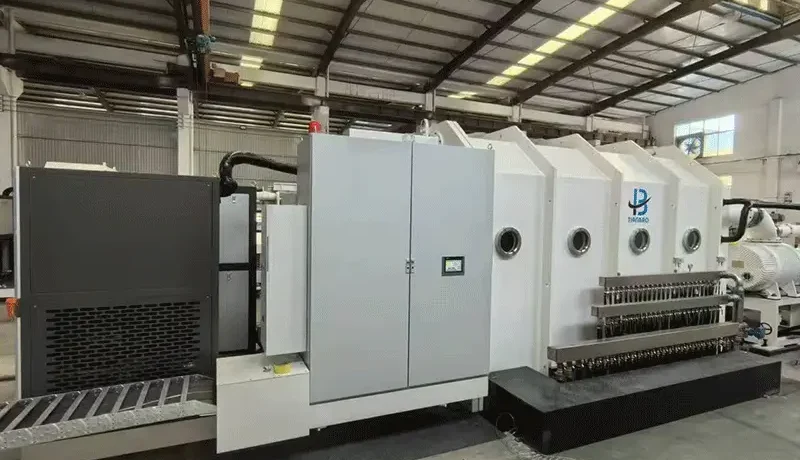
Vacuum Metallizer Maintenance Checklist: Daily, Weekly, and Monthly Tasks
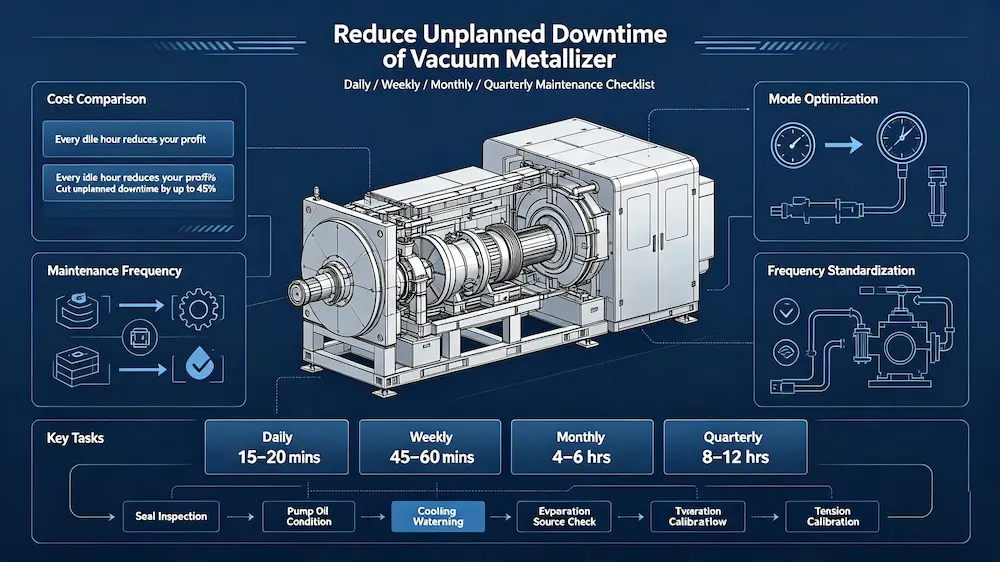
Every hour your vacuum metallizer sits idle costs you money — not just in lost production, but in rush repair fees and scrapped film rolls. Industry data shows that manufacturers who follow a structured preventive maintenance program reduce unplanned downtime by up to 45% compared to those who only fix machines when they break.
At Qingzhou Tempo Machinery Technology Co., Ltd., we design our vacuum metallizer machines for reliability over decades of continuous operation. However, even the most robust equipment needs consistent care. After supporting hundreds of coating lines worldwide, we have distilled the essential checks into this actionable checklist.
This guide breaks down maintenance into four practical frequencies: daily, weekly, monthly, and quarterly. Follow it, and you will catch small issues before they become expensive emergencies.
Why Regular Maintenance Matters More Than You Think
A vacuum metallizer is not a simple piece of equipment. It integrates high-vacuum pumps, precision tension controls, high-temperature evaporation sources, a chilled coating drum, and extensive electrical systems — all working in harmony. When one component drifts out of spec, the entire coating quality suffers.
Consider these real-world scenarios we have seen at customer sites:
- A dirty chamber door gasket added 8 minutes to every pump-down cycle. Over 10 rolls per day, that single oversight wasted over 80 minutes of production time.
- Old mechanical pump oil caused a gradual vacuum degradation that operators did not notice until aluminum adhesion failed on a pharmaceutical packaging order — scrapping 12,000 meters of film.
- Neglected cooling water filters led to drum overheating, which wrinkled heat-sensitive CPP film across three consecutive shifts.
The good news? Operators can prevent all three of these problems with simple, scheduled checks.
If you operate a fully automatic suspension vacuum coating machine, an induction heating metallizer, or an aluminum paper metallizer, the checklist below applies across all models. Where specific machines need extra attention, we call it out.
Daily Maintenance Tasks (Every Shift, Before Startup)
These quick checks take 15–20 minutes but prevent the majority of shift-level failures.
1. Inspect the Chamber Door Gasket
The door gasket forms the primary vacuum seal. Even a single aluminum flake trapped on the sealing surface can create a micro-leak.
- Wipe the entire gasket surface with a clean, dry, lint-free cloth.
- Look for radial cuts, flat spots, or areas where the gasket has hardened.
- If grease is necessary, apply a thin layer of high-vacuum grease — too much attracts debris.
Pro tip: Run your fingertip along the gasket slowly. You will feel a nick or embedded particle long before your eye can see it.
2. Check Mechanical Pump Oil Level and Color
Your mechanical pump’s oil does three jobs: it seals, it lubricates, and it captures contaminants.
- Confirm the oil level sits between the sight glass min and max marks.
- Note the color. Fresh oil looks amber or clear. Dark brown or cloudy oil signals water contamination or particulate buildup.
- If the pump has a gas ballast valve, open it for 20–30 minutes during warm-up to purge absorbed moisture.
According to Midwest Tungsten Service’s metallizer maintenance guide, many mechanical pump problems resolve with a simple oil flush and refill.
3. Sweep the Chamber Floor and Drip Trough
Aluminum flakes accumulate quickly on the chamber floor after each coating run.
- Remove loose debris with a soft brush or vacuum cleaner.
- Clear the drip trough beneath the evaporation source area.
- Check that stray metal particles have not migrated near any seals or feedthroughs.
Leaving debris in the chamber increases the internal gas load because aluminum oxide absorbs moisture from the air. Consequently, your pump-down time gradually creeps upward — and you may not notice the trend until it costs you an extra 10 minutes per batch.
4. Verify Cooling Water Flow and Temperature
Your coating drum and diffusion pumps rely on steady cooling water flow.
- Confirm the flow meter reads within the machine’s rated range (check your specification sheet for exact values).
- Check inlet and outlet temperatures. A delta that is shrinking over time suggests scaled pipes or a clogged filter.
- Listen for unusual pump noise — cavitation often produces a gravel-like sound.
5. Inspect the Viewport (Porthole)
A cloudy viewport forces operators to guess what is happening inside the chamber during coating.
- Wipe the inside face with a soft cloth after each cycle.
- Avoid caustic cleaners — they trap moisture.
- Skip abrasives entirely; they micro-scratch the glass and worsen clouding over time.
- Consider adding a removable plastic shield or louver, which Midwest Tungsten recommends for keeping portholes clean longer.
6. Quick Evaporation Source Visual Check
Before loading a new roll, glance at the evaporation boats or crucibles.
- Look for uneven erosion, deep pits, or cracks forming at the edges.
- Confirm that all electrical connections appear tight and free of arcing marks.
- On induction heating models, verify the graphite crucible sits level and shows no signs of oxidation.
Weekly Maintenance Tasks (Every 40–50 Operating Hours)
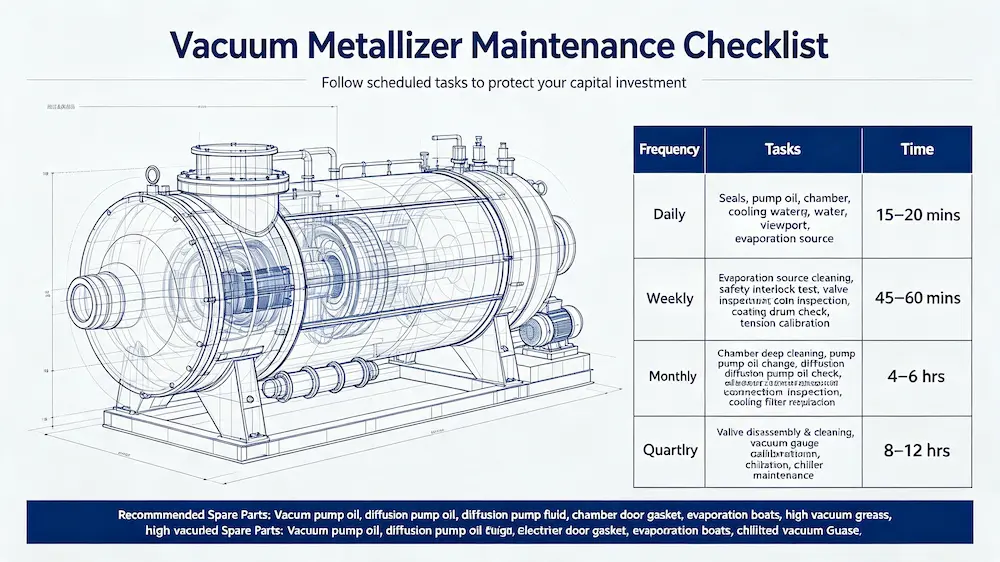
Set aside 45–60 minutes once a week for deeper inspections that catch gradual wear.
1. Deep-Clean the Evaporation Source Area
Aluminum splatter builds up around the boats and clamps throughout the week. On traditional side-clamp designs, this hardened slag often locks the boat in place and complicates replacement.
- Remove loose aluminum deposits with a wire brush.
- On Tempo Machinery’s top-clip evaporation sources, cleaning takes less time because the staggered layout gives you better tool access.
- Wipe electrical contact surfaces with isopropyl alcohol to remove oxidation.
2. Test All Safety Interlocks
Vacuum metallizers use multiple safety systems — door interlocks, emergency vacuum breaks, over-temperature cutoffs.
- Open and close the chamber door to trigger the interlock; confirm the control panel registers the state change.
- Test the emergency stop circuit. The machine should cut power to heaters and close high-vacuum valves immediately.
- Verify that the over-temperature alarm triggers at the set point.
3. Inspect All Valves
High-vacuum and roughing valves open and close hundreds of times per week. Wear accumulates.
- Check that each valve actuator completes its full stroke without hesitation.
- Look for aluminum chips or debris around valve seats that could prevent a complete seal.
- Wipe the plenum area clean with a solvent-moistened cloth, as recommended in the Midwest Tungsten maintenance protocol.
- Listen for hissing during pump-down — it often indicates a valve that is not seating fully.
4. Examine the Coating Drum Surface
The chilled drum contacts every meter of film you produce. Any surface defect transfers directly to your product.
- Run your hand (gloved) across the drum surface slowly. You should feel a uniform smoothness.
- Look for scratches, dents, or areas where the chrome plating is wearing thin.
- Clean the drum with a soft cloth and mild solvent. Avoid anything abrasive.
5. Check Tension Control System Calibration
Film tension that drifts out of specification causes wrinkles, stretching, or uneven coating thickness.
- Run the tension calibration routine on your control system.
- Verify that load cells read zero when the web path is empty.
- Inspect idler rollers for free rotation — a seized bearing in one roller can throw off tension across the entire web.
For machines with automatic constant tension control, the system corrects minor drift automatically. However, you still need to verify the baseline calibration weekly.
Monthly Maintenance Tasks (Every 160–200 Operating Hours)
Monthly tasks dig deeper into components that degrade slowly and require planned downtime.
1. Thorough Chamber Cleaning (Strip-Down)
A metallizer running 8-hour daily shifts needs a full chamber strip-down roughly once a month.
- Remove carriages, shields, and liners.
- Clean the interior walls using caustic solution, wire brushes, or sandblast equipment, following the established industry protocol.
- Rinse all caustic residue completely and dry the chamber thoroughly. Residual moisture extends pump-down time significantly.
- Seal all ports and feedthroughs before cleaning to prevent blast media or caustic from entering sensitive areas.
- Consider applying boron nitride or graphite release coating to clean surfaces — this makes the next cleaning much faster.
If your chamber has removable shields (standard on all Tempo Machinery metallizers), strip and clean those separately.
2. Replace Mechanical Pump Oil
Monthly oil changes keep your mechanical pump running at peak efficiency.
- Run the pump for 15–20 minutes to warm the oil. Hot oil drains faster and carries more contaminants with it.
- Drain completely, then rotate the pump shaft by hand to expel trapped oil from internal cavities.
- Refill with the manufacturer’s specified vacuum pump oil. Do not substitute general-purpose lubricants — they outgas under vacuum and ruin your ultimate pressure.
- Replace the oil mist separator filter if your pump has one.
3. Check Diffusion Pump Fluid and Heaters
Diffusion pumps have no moving parts, which makes them reliable — but not maintenance-free.
- Inspect the sight glass. Slight discoloration is normal; black or gritty fluid means contamination and requires a full fluid change.
- Verify that the heaters draw the correct current. A failing heater element often shows a lower amp reading weeks before it fails completely.
- Check inlet and outlet cooling water temperatures. A narrowing delta suggests flow restriction.
- For a detailed diffusion pump maintenance schedule, refer to Oerlikon Leybold’s vacuum pump guidelines or your specific pump manufacturer’s manual.
Caution: Never expose hot silicone diffusion pump fluid (above 130°F / 54°C) to air. Hot silicone oil gels instantly on contact with oxygen. Always let the pump cool before opening for inspection.
4. Inspect Electrical Feedthroughs and Connections
Electrical problems often start small — a slightly loose terminal, a trace of corrosion — then cascade into arcing and component failure.
- Check all high-current connections for tightness. A thermal imaging camera helps here; hot spots glow bright before they fail.
- Verify that insulation on electrode feedthroughs remains intact.
- Inspect contact faces inside the chamber for pitting or warping. Reface or replace as needed.
- On spring-loaded electrical contacts, test the spring tension. Fatigue or loss of temper reduces contact pressure and increases resistance.
5. Clean or Replace Cooling Water Filters
Scaling and debris in your cooling loop reduce heat transfer efficiency, which forces the chiller to work harder and increases energy consumption.
- Remove and clean mesh filters. Replace any with visible tears.
- If your facility uses hard water, consider installing a water softener upstream of the machine. Scale buildup inside the drum’s internal channels is difficult and expensive to remove.
Quarterly / Semi-Annual Tasks
Some items do not need monthly attention but must not slide past six months.
1. Disassemble and Clean All Valves
- Remove the high-vacuum valve and clean accumulated oil from beneath the valve seat and around the diffusion pump top jet.
- Disassemble roughing and backing valves. Inspect seals, O-rings, and actuator mechanisms for wear.
- Replace all valve seals annually, or sooner if you see cracking or permanent compression set.
2. Replace All High-Vacuum Gaskets
Gaskets harden and develop compression set over time. Industry best practice is annual replacement.
- Replace the main door gasket.
- Replace all O-rings on feedthroughs, flanges, and sensor ports.
- After gasket replacement, perform a helium leak test to confirm vacuum integrity.
3. Calibrate Vacuum Gauges
Vacuum gauges drift. A gauge reading 5 × 10⁻⁴ mbar may actually reflect 1 × 10⁻³ mbar — and your coating quality will suffer without an obvious reason.
- Swap the installed gauge with a recently calibrated unit to compare readings.
- Alternatively, engage a professional gauge calibration service.
- Calibrate Pirani, Penning, and capacitance manometer gauges according to their respective schedules.
4. Inspect and Service the Chiller Unit
- Clean condenser coils.
- Check refrigerant charge.
- Replace compressor oil and filters per the chiller manufacturer’s schedule.
- Verify that the chiller’s set point matches the machine’s cooling water specification.
Spare Parts You Should Always Keep On Hand
Nothing extends a maintenance shutdown like waiting three weeks for a replacement part to arrive from overseas. Based on our experience supporting customers in over 30 countries, we strongly recommend stocking these items:
Contact Tempo Machinery’s spare parts team to build a tailored spare parts package for your specific machine model and production volume. We keep all critical components in our warehouse to ensure rapid dispatch.
Frequently Asked Questions (FAQ)
Q: How do I know if my mechanical pump oil needs changing before the monthly schedule?
A: Three indicators tell you. First, check the color — if it has turned dark brown or black, change it immediately regardless of the calendar. Second, notice your pump-down time. If it gradually increases by more than 20% without other changes, suspect oil degradation. Third, look at your ultimate vacuum reading. A pump that cannot reach its specified base pressure often signals oil that has lost its sealing properties.
Q: What is the single most common cause of vacuum leaks in a metallizer?
A: The door gasket. Across our entire service history, door gasket failures account for roughly 60% of all vacuum leak calls. Fortunately, you can catch most gasket issues with the daily wipe-down inspection. A quick visual check with a strong flashlight, shining along the gasket path, reveals embedded particles and small cuts you might otherwise miss.
Q: Does my induction heating metallizer need different maintenance compared to a resistance boat machine?
A: Some tasks differ. On an induction heating vacuum metallized machine, you do not have boats to replace, but you must inspect the graphite crucible for oxidation and check the induction coil connections for tightness. Additionally, induction machines produce far less aluminum splatter, so chamber cleaning frequency is lower. That said, the vacuum system, cooling loop, and tension control maintenance remain identical across both technologies.
Q: Our operators run three shifts continuously. How should I schedule maintenance?
A: For 24/7 operations, we recommend building a weekly maintenance window of 2–3 hours during a shift handover. Use this window for the daily checks plus one rotating weekly task. Then schedule a full 8-hour shutdown once per month for the monthly strip-down, oil change, and electrical inspection. The quarterly valve rebuild ideally needs a 12–16 hour window, which you can align with a planned production holiday.
Q: Can Tempo Machinery provide on-site maintenance training for my operators?
A: Absolutely. We offer comprehensive technical training and support as part of every machine installation. Our engineers train your team on daily, weekly, and monthly procedures using your actual machine. We also offer remote video support for troubleshooting and periodic refresher training. Reach out through our contact page to discuss a training plan.
Q: What should I do if I notice a gradual increase in pump-down time but cannot find the cause?
A: Start with these steps in order. First, change the mechanical pump oil. This solves roughly 40% of mysterious pump-down slow-downs. Second, inspect the door gasket under magnification. Third, perform a helium leak test around all vacuum connections, feedthroughs, and sensor ports. If none of these reveals the issue, contact our after-sales service team — we can often diagnose the root cause remotely by reviewing your vacuum gauge trend data.
Conclusion: Build the Habit, Protect the Investment
A vacuum metallizer represents a significant capital investment, and its maintenance should reflect that. The difference between a machine that runs reliably for 15 years and one that nickel-and-dimes you with constant repairs often comes down to one thing: consistency.
Print this checklist. Laminate it. Post it on the control cabinet. Make it part of every operator’s shift handover.
If you run a Tempo Machinery vacuum metallizer and want a model-specific maintenance schedule, or if you need spare parts, technical training, or remote troubleshooting support, contact our team today. We stand behind every machine we build — and we are here to help you keep it running at full capacity.