


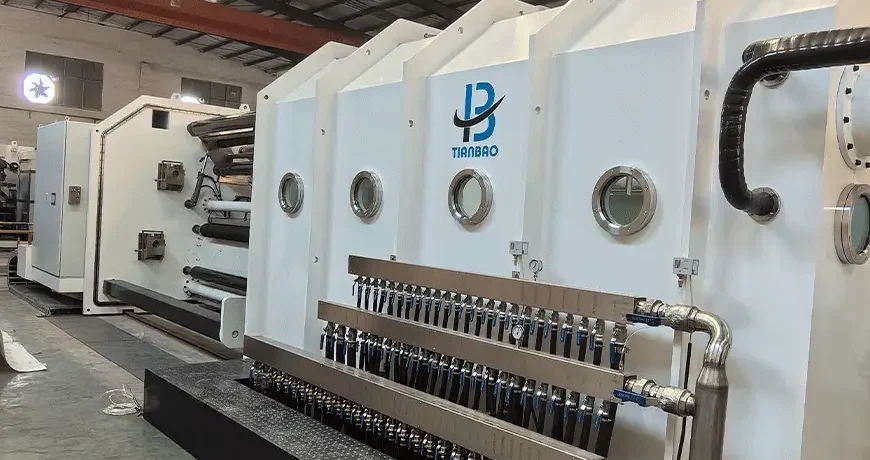
Gold and Silver Yarn Production: How Induction Heating Metallizers Revolutionize the Textile Industry
Walk through a saree weaving workshop in Surat, a zari embroidery unit in Varanasi, or a furnishing fabric mill in Istanbul, and you will see the same material running through the looms: metallized polyester yarn — the shimmering gold and silver threads that give traditional and fashion textiles their brilliance.
What most buyers of these textiles never see is the vacuum coating machine that produced the metallized film from which the yarn is slit. And within that machine, the single component that most determines yarn quality is the evaporation source — the device that turns solid aluminum into a vapor that condenses as a mirror-bright coating on polyester film.
For decades, that source was a ceramic resistance-heated boat. It worked — but with inherent limitations: spatter that created pinholes, temperature instability that caused coating variation, and a practical ceiling on coating thickness. Induction heating with graphite crucible evaporation — the technology at the core of Tempo Machinery’s induction heating metallizers — eliminates these limitations. This article explains how, and why it matters for metallic yarn quality.
1. How Metallic Yarn Is Made: From Aluminum Ingot to Gold Thread
1.1 The Four-Stage Process
Metallic yarn — also called zari, lurex, or metallized thread — is not made by coating individual threads. It is made by coating a wide roll of polyester film, then slitting that film into narrow strips that become the yarn. The process has four stages:
Stage 1: Vacuum Metallizing. A roll of clear PET (polyester) film — typically 12–25 microns thick and 1,600–2,400 mm wide — is loaded into a vacuum metallizer. The chamber is pumped down to high vacuum (below 10⁻³ mbar). Aluminum wire is fed into an evaporation source, heated to approximately 1,200°C, and vaporized. The aluminum vapor condenses on the moving film surface as it passes over a chilled coating drum, forming a uniform, mirror-reflective aluminum layer 300–800 angstroms thick (30–80 nanometers).
Stage 2: Protective Lacquering. The metallized film is coated with a protective epoxy or polyurethane lacquer. This lacquer layer serves three functions: it prevents the aluminum from oxidizing (which would dull the metallic appearance), it provides color (gold-tinted lacquer over aluminum creates the appearance of gold, even though the metal layer is aluminum), and it protects the aluminum during the slitting and weaving processes.
Stage 3: Slitting. The wide metallized film roll is slit into narrow filament tapes — typically 1/69 inch (0.37 mm), 1/100 inch (0.25 mm), or 1/120 inch (0.21 mm) wide. Precision slitting is essential: a width variation of 5 microns in a 250-micron filament creates a visible inconsistency in the woven fabric.
Stage 4: Winding. The slit filaments are wound onto bobbins, spools, or cones — the final form in which metallic yarn is sold to textile weavers and embroiderers.
1.2 Why the Metallizing Stage Determines Everything
Every defect created at the metallizing stage — every pinhole, every thin-coat band, every contamination spot — is permanently embedded in the yarn. The lacquering, slitting, and winding stages can hide some defects (lacquer can fill microscopic pinholes) but cannot eliminate them. And the defects that matter most — pinholes and coating thickness variation — originate entirely in the vacuum chamber.
This is why the choice of evaporation technology is not an incremental decision for a metallic yarn producer. It is the single factor that determines whether the finished yarn will meet the quality standards of the textile industry’s most demanding customers — saree manufacturers, bridal wear designers, and luxury furnishing brands.
2. The Old Way: Resistance-Heated Ceramic Boats — And Why They Limit Yarn Quality
2.1 How Resistance Heating Works
In a conventional vacuum metallizer, aluminum wire is fed onto a ceramic evaporation boat — typically made from a composite of titanium diboride (TiB₂) and boron nitride (BN). A high electrical current (typically 500–1,500 amps at 5–15 volts) passes through the boat. The boat’s electrical resistance generates heat — the same principle as an electric stove element — melting and vaporizing the aluminum wire that contacts its surface.
This technology has been the industry standard for over 50 years. It is well-understood, widely available, and relatively inexpensive. It also has three inherent limitations that directly degrade metallic yarn quality:
2.2 Limitation 1: Spatter and Pinholes
A ceramic boat heats unevenly. The center of the boat — where the aluminum wire makes contact — reaches 1,300–1,400°C. The edges may be 200–300°C cooler. When molten aluminum flows from the hot center to a cooler edge, it can spatter — ejecting microscopic droplets of molten aluminum that land on the film as solid particles. Each particle becomes a pinhole in the coating — a spot where aluminum is absent and the clear PET film shows through.
For a metallic yarn, a pinhole in the coating translates to a visible dark spot in the thread. Under the magnification of a weaving loom or embroidery machine, a single pinhole per meter is barely noticeable. But at 5–15 pinholes per square meter — typical for boat-evaporated film — the cumulative effect in a woven fabric is a speckled, uneven appearance that downgrades the textile from premium to seconds-grade.
For gold and silver yarn producers, pinholes are the #1 quality complaint. A gold-colored thread with dark spots looks defective even to an untrained eye.
2.3 Limitation 2: Coating Thickness Ceiling
Ceramic boats have a practical limit on how much aluminum they can evaporate per unit time. As the wire feed rate increases, the boat struggles to transfer heat fast enough to vaporize the incoming aluminum before it pools. Pooled aluminum creates inconsistent evaporation — vapor bursts followed by lulls — producing alternating thick and thin bands in the coating.
For standard packaging metallization, a coating thickness of 200–400 angstroms is sufficient. For gold and silver yarn, the coating must be thicker — typically 500–800 angstroms — because:
- The lacquer layer absorbs some of the reflected light; a thicker aluminum layer compensates for this optical loss
- During slitting and weaving, the thin aluminum edge at the slit line can oxidize; a thicker coating reduces the visual impact of edge oxidation
- Premium textile buyers expect brilliant, saturated metallic color that can only be achieved with a dense, uniform aluminum base layer
On a conventional boat system, achieving 600+ angstroms with acceptable coating uniformity requires reducing line speed — and therefore productivity — by 30–40%.
2.4 Limitation 3: Boat Degradation and Contamination
Ceramic boats degrade with use. The TiB₂-BN composite erodes under the combined assault of 1,300°C temperature, molten aluminum corrosion, and thermal cycling between runs. As a boat erodes, it releases ceramic particles into the vapor stream. These particles embed in the aluminum coating as solid inclusions — another source of visible defects in the finished yarn.
Boats must be replaced every 8–15 production runs, depending on wire feed rate and boat quality. A production line running 3 shifts per day replaces boats multiple times per week. Each replacement involves: stopping production, venting the vacuum chamber, cooling down, manually replacing the boats, re-evacuating the chamber, and re-qualifying the coating quality. Total downtime: 2–4 hours per boat change event.
3. The New Way: Induction Heating with Graphite Crucible Evaporation
3.1 How Induction Heating Works
Induction heating is fundamentally different from resistance heating. Instead of passing current through the evaporation source itself, an electromagnetic coil surrounds a graphite crucible. When high-frequency alternating current flows through the coil, it generates a rapidly alternating magnetic field. This field induces eddy currents within the graphite crucible — and those currents, flowing through the graphite’s electrical resistance, generate heat directly inside the crucible material.
The system feeds the aluminum wire into the graphite crucible, where the wire melts and vaporizes in a uniformly heated pool. Because electromagnetic induction generates heat throughout the crucible body—rather than conducted from a hot surface—this process produces an inherently more uniform temperature distribution than a resistance-heated ceramic boat.
At Qingzhou Tempo Machinery, our Induction Heating Vacuum Metallized Machine was developed with specialized R&D and the latest innovation design specifically for gold and silver wire coating applications. The graphite crucible evaporation source is the defining feature — and it directly addresses every limitation of the ceramic boat.
3.2 Advantage 1: Near-Zero Pinhole Rate
The uniform temperature distribution in a graphite crucible eliminates the hot-center/cool-edge thermal gradient that causes spatter in ceramic boats. The aluminum pool evaporates from a stable, isothermal surface — no temperature differential, no spatter mechanism, no pinholes.
Tempo Machinery’s induction heating metallizer achieves pinhole rates described by the company as “very low, fully meeting the requirements for gold and silver wire coating.” In production terms, this translates to 1–2 pinholes per square meter or fewer — a 70–90% reduction compared to conventional boat-evaporated film.
For a saree woven with 500 meters of metallic yarn, the visual difference between 10 pinholes per meter (boat) and 1 pinhole per meter (induction) is the difference between a textile that looks uniformly brilliant and one that looks speckled under showroom lighting.
3.3 Advantage 2: Ultra-Thick Coating — 800+ Angstroms
A graphite crucible can hold and continuously evaporate a larger volume of aluminum than a ceramic boat. The induction heating system delivers higher thermal power density — more watts per unit of evaporation surface area — without the risk of localized overheating that would damage a ceramic boat.
The result: the induction system delivers aluminum layer thicknesses of more than 800 angstroms — a coating thickness that would require reduced line speed on a boat system but which the induction system sustains at full production speed. This thickness meets the requirements of medical packaging (where ultra-thick aluminum provides superior barrier properties) and premium gold/silver yarn (where a thicker coating delivers richer color and better oxidation resistance).
3.4 Advantage 3: Cleaner Coating — No Ceramic Particle Contamination
Graphite crucibles do not erode in the same way ceramic boats do. Graphite sublimates at approximately 3,600°C — far above the 1,200–1,400°C aluminum evaporation temperature. At aluminum evaporation temperatures, the crucible is thermally stable — it does not degrade, spall, or release particles into the vapor stream.
This means the aluminum coating deposited on the film contains no ceramic inclusion defects — a contamination source that is inherent to boat evaporation and impossible to eliminate through process control alone.
3.5 Advantage 4: Longer Evaporation Source Life — Less Downtime
A ceramic boat lasts 8–15 runs before replacement. A graphite crucible in an induction heating system can last 50–100+ runs depending on operating conditions and aluminum purity. The crucible still requires periodic replacement — graphite reacts slowly with oxygen at high temperatures — but the replacement frequency is 5–10x lower.
For a production line running 3 shifts, this translates to crucible changes every 2–4 weeks instead of boat changes every 2–4 days. The reduction in downtime directly increases annual production capacity by 5–10% — a significant gain for a capital-intensive metallizing operation.
3.6 Advantage 5: Energy Efficiency
Induction heating inherently outperforms resistance heating in energy efficiency because the system generates heat directly in the crucible rather than conducting it through a boat that then radiates heat to its surroundings. Induction systems typically achieve 70–85% energy transfer efficiency compared to 40–60% for resistance boat systems—this difference reduces electricity consumption per kilogram of aluminum evaporated by 20–35%.
For a metallizer evaporating 5 kg of aluminum per hour, 24 hours per day, 300 days per year, the annual electricity savings can reach $15,000–30,000 depending on local energy prices.
4. Head-to-Head: Ceramic Boat vs. Graphite Crucible Induction
5. The Tempo Machinery Induction Heating Metallizer: Built for Gold and Silver Yarn
The Induction Heating Vacuum Metallized Machine from Tempo Machinery is specifically engineered for the demanding requirements of metallic yarn production. Key specifications include:
- Graphite crucible evaporation source — the core technology that differentiates this machine from conventional boat-based metallizers
- Designed for gold and silver wire coating, gold drawing wire coating, and high-barrier packaging materials — applications where coating quality and thickness directly determine product value
- Ultra-thick coating capability: aluminum layer thickness can reach more than 800 angstroms, meeting the requirements of premium yarn manufacturers and medical packaging converters
- Very low pinhole rate: the graphite crucible evaporation process eliminates the spatter mechanism responsible for the majority of pinhole defects in boat-evaporated film
- Fully automatic operation: PLC-controlled with automatic tension regulation, recipe-based parameter management, and real-time data logging — ensuring that every roll of metallized film meets the same specification regardless of which operator is running the shift
- CE certified: meeting European safety and quality standards for export to global markets
Unlike general-purpose metallizer manufacturers, Tempo Machinery has an unusual advantage: the company owns and operates its own packaging film production enterprise with an annual output of 10,000 tons of aluminum film. This production line serves as a continuous real-world testing environment — every design improvement to the induction heating system undergoes validation under actual production conditions before we release it to customers. The metallizer you buy has already proven itself on the factory floor.
6. The Business Case: Why Yarn Producers Are Switching to Induction
6.1 The Quality Premium
In the metallic yarn market, quality directly determines price. A spool of premium-grade gold yarn with uniform color and zero visible defects commands a 15–30% price premium over standard-grade yarn with visible pinholes or color variation. The premium is most pronounced in three segments:
- Bridal and occasion wear: Sarees, lehengas, and wedding garments are inspected under bright light by buyers who will reject any visible defect. A single pinhole per meter of thread can render a $500 saree unsaleable.
- Export markets: European and North American textile buyers impose stricter quality specifications than domestic markets. Yarn with pinhole rates above 2/m² typically fails export quality inspection.
- High-speed machine embroidery: Computerized embroidery machines running at 800–1,200 stitches per minute are intolerant of yarn defects — a thin spot or weak point in the metallized film causes thread breakage that stops the machine and requires operator intervention.
For a yarn producer converting 5,000 kg of metallized film per month, upgrading from boat-evaporated film (85% premium-grade yield) to induction-evaporated film (95%+ premium-grade yield) increases premium-grade output by 500 kg per month. At a price premium of $3–5/kg for premium grade, this represents $18,000–30,000 per year in additional revenue — from the same raw material input.
6.2 Productivity Gains
Beyond quality, the induction heating system reduces downtime and increases throughput:
- Fewer source changes: Crucible changes every 2–4 weeks instead of boat changes every 2–4 days recovers 60–80 hours of lost production time per year.
- Full-speed thick coating: The ability to run at full line speed while achieving 600–800 Å coating — versus slowing down 30–40% on a boat system — increases throughput on thick-coating orders by a corresponding amount.
- Faster grade changes: The fully automatic PLC control system with recipe management reduces changeover time between different film types or coating specifications.
6.3 Market Context
The global textile yarn market was valued at approximately $10.6 billion in 2025 and is projected to grow at a CAGR of 4.5% (Market Data Forecast). Within this, metallic and fancy yarns represent a high-value niche growing at an estimated 7–8% annually — driven by rising demand for embellished textiles in India, Pakistan, Bangladesh, Turkey, and the Middle East.
India alone — the world’s largest consumer of metallic yarn for traditional textiles — has a textile market valued at $152 billion in 2025, projected to reach $214 billion by 2034 (IMARC Group). The saree, lehenga, and embroidery segments that consume the majority of gold and silver yarn remain culturally resilient — demand is not cyclical but structural.
For yarn producers serving these markets, the quality expectations are rising faster than the market is growing. Buyers who accepted 5–8 pinholes per meter five years ago now demand under 2. The induction heating metallizer is the technological response to this escalating quality requirement.
7. Frequently Asked Questions (FAQ)
Q: Is the induction heating metallizer suitable for producing both gold and silver yarn from the same machine?
A: Yes. The metallizer deposits an aluminum coating that appears silver. A protective lacquer applied after metallizing creates the gold color — a clear lacquer tinted with gold-colored dye or pigment. The same aluminum-coated film can become gold, silver, copper, or any custom color, depending on the lacquer formulation. The metallizer itself deposits only aluminum; downstream processes add the color. This means a single induction heating metallizer can serve an entire metallic yarn product line regardless of color variety.
Q: What film types and thicknesses can the induction heating metallizer handle?
A: The Tempo Machinery Induction Heating Vacuum Metallized Machine accommodates PET, BOPP, CPP, PE, PVC, nylon, and twisted PET films — the full range of substrates used in metallic yarn production. It handles standard film thicknesses from 10 to 30 microns, and we offer custom configurations for thicker or thinner films upon request. Film width options range from 1,600 mm to 2,400 mm depending on the machine model. For yarn producers using 12μm or 15μm PET film as the base substrate — the most common choice for metallic yarn — the machine features pre‑configured optimized tension profiles for these materials.
Q: How does the graphite crucible compare to ceramic boats in terms of aluminum consumption per square meter of film?
A:The desired coating thickness, not the evaporation technology, determines the aluminum consumption per square meter. Both induction and boat systems deposit the same amount of aluminum to achieve the same optical density. However, the induction system achieves higher material utilization efficiency because: (1) it loses less aluminum to spatter (spattered aluminum never reaches the film), and (2) its more uniform coating reduces the need for over-deposition to compensate for thin spots. In practice, this typically saves 5–8% less aluminum consumption per roll of equivalent optical density, yielding material cost savings that partially offset the induction system’s higher capital cost.
Q: Can the induction heating metallizer also run standard packaging films, or does it serve only gold/silver yarn?
A: The machine serves as a multi-application platform. Although the company specifically developed it for gold and silver wire coating—where pinhole requirements are most demanding—it performs equally well for: high-barrier packaging films (where ultra-thick aluminum coating delivers superior oxygen and moisture barrier), medical packaging (where regulatory requirements mandate pinhole-free coating), decorative films and holographic applications (where coating uniformity determines optical quality), and standard flexible packaging metallization. The recipe-based PLC control system stores separate parameter sets for each application—the operator selects the product, and the machine configures itself accordingly.
Q: What is the typical payback period for switching from a boat-based metallizer to an induction heating system?
A: For a metallic yarn producer running 3 shifts, the combined impact of higher premium-grade yield (10+ percentage points), reduced boat/crucible replacement downtime (60–80 hours per year recovered), faster thick-coating throughput (30–40% speed gain on 600+ Å orders), and aluminum material savings (5–8%) typically delivers payback in 24–36 months based on the machine price premium. For producers serving export-quality markets where the premium-grade price differential is larger, payback can be 18–24 months. Tempo Machinery provides a customized ROI projection based on your current production volume, yield rate, product mix, and target market — contact our team to request one.
Q: How does the induction heating system handle the aluminum wire feed — is it automatic?
A: Yes. A servo motor drives the aluminum wire feed under PLC control and synchronizes it to line speed and the desired coating thickness setpoint. The operator enters the target optical density or coating thickness (in angstroms) on the HMI touchscreen, and the PLC automatically calculates and maintains the required wire feed rate. If the machine includes an optional inline optical density gauge, the system provides closed‑loop feedback—the gauge measures actual coating thickness, and the PLC makes micro‑adjustments to the wire feed rate in real time, compensating for any process drift.
Q: Does Tempo Machinery provide installation and training support for the induction heating metallizer?
A:Yes. Our service includes on‑site installation supervision, commissioning, operator training, and ongoing technical support. Because Tempo Machinery operates its own 10,000‑ton/year film production line, our engineers—who have hands‑on experience running the same equipment in production, not just theoretical knowledge from a manual—deliver the training. The training covers: machine operation (startup, shutdown, grade changes), PLC recipe management, routine maintenance (crucible replacement, vacuum system care), troubleshooting common issues, and quality optimization (adjusting parameters for specific film types and coating specifications). We also provide remote technical support for post‑installation questions.
8. Conclusion
Gold and silver yarn is a product where appearance is the entire value proposition. The thread exists to be seen. Every pinhole, every thin spot, every color variation is not a hidden technical defect — it is a visible flaw that degrades the finished textile.
For decades, metallic yarn producers accepted the inherent limitations of ceramic boat evaporation — pinholes, coating thickness ceilings, and contamination — as unavoidable characteristics of the metallizing process. The induction heating graphite crucible system changes that equation. By replacing uneven resistance heating with uniform electromagnetic induction, it eliminates the spatter mechanism that causes pinholes. By supporting higher thermal power density, it enables 800+ angstrom coating thickness at full production speed. And by using a thermally stable crucible material, it removes the ceramic particle contamination that creates inclusion defects.
The result for yarn producers is straightforward: higher premium-grade yield, fewer customer returns, higher production uptime, and the ability to meet the quality specifications of export and luxury textile markets.
Qingzhou Tempo Machinery Technology Co., Ltd. — with its team of senior coating experts, mechanical engineers, and electrical automation engineers, backed by a 10,000-ton/year operating film production line — supplies induction heating vacuum metallizers to customers across India, Turkey, Bangladesh, Vietnam, Iran, Russia, Europe, and Central Asia. Our machines carry CE certification and are supported by installation, training, and ongoing technical service.
Contact our team to discuss your gold and silver yarn production requirements, request a customized ROI analysis, or arrange a visit to our production facility in Qingzhou, Shandong, China.