


The Role of Vacuum Metallized Films in Pharmaceutical Packaging: Barrier Performance and Compliance
A tablet sitting in a blister pack on a pharmacy shelf in Mumbai during monsoon season faces an invisible assault. Oxygen molecules from the air are trying to oxidize the active pharmaceutical ingredient. Water vapor — 30 grams per cubic meter in 85% humidity — is trying to penetrate the packaging and hydrolyze the drug. UV light is degrading light-sensitive compounds. And the packaging has one job: stop all of it, for 24–36 months, under fluctuating temperature and humidity conditions that range from desert-dry to tropical-wet.
This is the barrier problem in pharmaceutical packaging. And for a large class of drugs — those packaged in blister packs, strip packs, and high-barrier flexible pouches — the solution involves vacuum-metallized aluminum film: a polyester or polypropylene substrate coated with a layer of aluminum so thin it is measured in angstroms, yet so effective that it reduces oxygen transmission by a factor of 100 and water vapor transmission to near-zero.
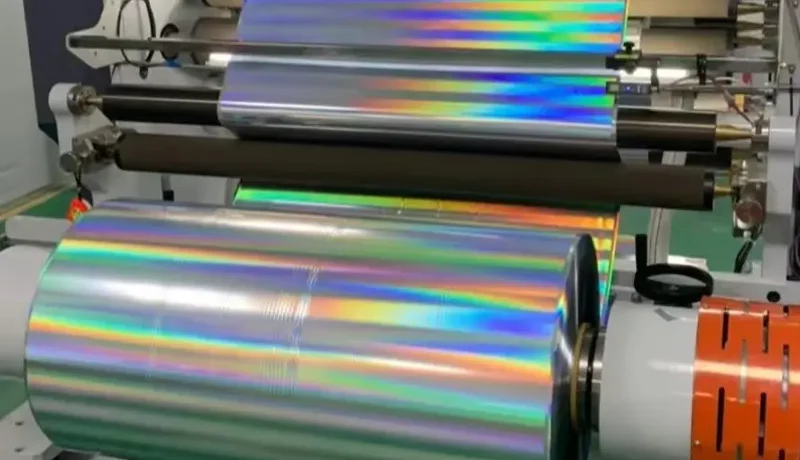
At Qingzhou Tempo Machinery, our Induction Heating Vacuum Metallized Machine produces aluminum coatings up to 800+ angstroms — the thickness range required for the most demanding pharmaceutical applications. This article explains why coating thickness matters, how it translates to barrier performance, and what pharmaceutical packaging converters need to know about compliance.
1. The Pharmaceutical Barrier Challenge: Why Ordinary Packaging Fails
1.1 The Three Enemies of Drug Stability
Pharmaceutical products degrade through three primary mechanisms, all of which involve substances that packaging must block:
A packaging material that blocks oxygen and water vapor but transmits light protects against two of the three mechanisms. A metallized film — which is opaque to visible and UV light — protects against all three.
1.2 Barrier Metrics: OTR and WVTR
Barrier performance is quantified by two standard measurements:
- OTR — Oxygen Transmission Rate: The volume of oxygen gas that passes through one square meter of film per 24 hours, measured at 23°C and 0% relative humidity. Units: cc/m²·day or cc/100 in²·24 hr. Lower OTR = better oxygen barrier.
- WVTR — Water Vapor Transmission Rate: The mass of water vapor that passes through one square meter of film per 24 hours, measured at 38°C and 90% relative humidity. Units: g/m²·day. Lower WVTR = better moisture barrier.
Different drug products require different barrier levels. The USP (United States Pharmacopeia) classifies pharmaceutical packaging into barrier performance categories based on WVTR:
The global pharmaceutical packaging market was valued at $142 billion in 2025 and is projected to reach $339 billion by 2034, growing at a CAGR of 10.1% (Custom Market Insights). Blister packaging alone — the largest consumer of metallized barrier films in pharma — represents a $30.6 billion market (Fortune Business Insights). As drug formulations become more complex and stability requirements more stringent, demand for high and extreme barrier packaging is growing faster than the overall market.
2. How Vacuum Metallized Films Create the Barrier
2.1 The Physics: Why a 30-Nanometer Aluminum Layer Blocks More Than a 25-Micron Polymer Film
A 25-micron (25,000 nm) PET film without metallization has an OTR of approximately 100–150 cc/m²·day and a WVTR of 15–25 g/m²·day. It is a poor barrier because polymer chains contain microscopic free volume — gaps between molecules through which small gas molecules (O₂ diameter: ~0.3 nm; H₂O diameter: ~0.28 nm) can diffuse.
When a 30–80 nanometer aluminum layer (300–800 Å) is vacuum-deposited onto that same PET film, the OTR drops to 0.01–0.11 cc/100 in²·24 hr (approximately 0.15–1.7 cc/m²·day) — a reduction of 98–99.9% (Pilcher Hamilton). The WVTR drops to below 1 g/m²·day, and with thick coatings (800+ Å), to below 0.1 g/m²·day.
The mechanism is straightforward: aluminum atoms, deposited under vacuum, form a continuous, non-porous metal layer. Gas molecules cannot diffuse through solid aluminum — the atomic lattice is too dense. The only pathways for gas transmission in a metallized film are defects in the aluminum layer: pinholes, micro-cracks, and thin spots where the coating is discontinuous.
This is why coating quality — thickness, uniformity, and pinhole density — is the single variable that determines barrier performance. A metallized film with 1 pinhole per square meter has dramatically better barrier properties than one with 15 pinholes per square meter, even if both have the same average coating thickness.
2.2 Barrier by Coating Thickness: What Changes at 400, 600, and 800 Angstroms
The relationship between coating thickness and barrier performance is not linear. Increasing coating thickness from 400 Å to 800 Å (2x) reduces OTR by approximately 5–10x. This is because the dominant transmission mechanism shifts: at 400 Å, gas molecules find pathways through thin spots and micro-voids. At 800 Å, the aluminum layer is thick enough that these pathways are sealed by overlapping aluminum crystal grains — the coating behaves more like a continuous metal foil than a thin film.
3. Why 800+ Å Matters: The Case for Ultra-Thick Aluminum Coatings
3.1 Effervescent and Highly Hygroscopic Drugs
Effervescent tablets — aspirin, vitamin C, electrolyte formulations — contain sodium bicarbonate and citric acid that react violently with moisture. A single drop of water reaching the tablet through the packaging initiates a chemical reaction that produces CO₂ gas, causing the tablet to swell, crumble, and lose its effervescent property. WVTR must be below 0.05 g/m²·day for these products — a specification that can only be met by thick aluminum foil (20–25 microns) or by metallized films with 800+ Å aluminum coating in a multi-layer laminate structure.
3.2 Dry Powder Inhalers (DPIs)
DPI formulations — used for asthma and COPD medications — consist of micronized drug particles (1–5 microns) mixed with a lactose carrier. These formulations are extremely moisture-sensitive: water vapor causes particle agglomeration, reducing the fine particle fraction that reaches the lungs. The packaging — typically a foil-foil blister — must maintain WVTR below 0.1 g/m²·day throughout the product’s 24–36 month shelf life. Achieving this with metallized film laminates requires a thick, pinhole-free aluminum coating.
3.3 Zone IV Stability Requirements
The ICH (International Council for Harmonisation) defines Climatic Zone IV as hot and humid conditions: 30°C / 75% RH for long-term stability testing, applicable to countries in Southeast Asia, South Asia, parts of Africa, and Central/South America — regions that represent a large and growing share of global pharmaceutical consumption. A drug packaged for Zone IV conditions faces a 24–36 month assault by warm, moisture-saturated air. The packaging barrier must withstand conditions that would cause a standard 400 Å metallized film to fail WVTR specifications within 12–18 months.
3.4 The Pinhole Factor
Research on pinhole effects in metallized barrier films confirms that pinhole density, not average coating thickness, is the dominant variable controlling WVTR at thicknesses below 600 Å (Tampere University). Each pinhole acts as a direct pathway for water vapor — one 10-micron pinhole can transmit more moisture than an entire square meter of intact aluminum coating. At 800+ Å, the aluminum crystal structure becomes dense enough that pinhole formation during metallization is dramatically reduced — the statistical probability of a gap that penetrates the full coating thickness drops exponentially as thickness increases.
This is the fundamental reason why pharmaceutical converters specify thick coatings: not because 400 Å is “too thin” in theory, but because at 400 Å, the pinhole density in commercially produced metallized film is too high to meet extreme-barrier WVTR specifications. At 800 Å, the pinhole density is low enough — and the remaining pinholes are small enough — that the barrier requirements are met with a comfortable safety margin.
4. Regulatory Compliance: What Pharmaceutical Packaging Must Prove
4.1 Key Global Standards
Pharmaceutical packaging is among the most heavily regulated packaging segments. Key standards that apply to metallized barrier films include:
4.2 The Compliance Chain: From Metallizer to Pharmacy Shelf
For a pharmaceutical packaging converter, compliance does not come from a single test report — it comes from a chain of documented evidence that traces from the raw PET film resin through the metallizing process to the finished blister pack or pouch:
Incoming material qualification: PET film must meet specifications for thickness, surface treatment, and extractables profile. The film supplier must provide a Certificate of Analysis (CoA) and, for critical applications, file a Drug Master File (DMF) with the FDA.
Metallizing process control: The vacuum metallizer must produce consistent coating thickness (measured as optical density or direct angstrom measurement), low and consistent pinhole density, and uniform aluminum adhesion. Every production run requires documented process parameter logs — vacuum pressure, wire feed rate, line speed, coating drum temperature — that demonstrate the process remained in control.
Barrier testing: Samples from each production batch must undergo OTR and WVTR testing using the standardized methods listed above. Test results must fall within the specification limits agreed with the pharmaceutical customer.
Stability testing: The complete packaging system — metallized film laminated to the sealing layer, formed into blisters, and filled with product (or placebo) — must pass accelerated and long-term stability testing per ICH guidelines before the packaging can serve commercial product.
Change control: Any change to the metallizing process — different aluminum wire supplier, different vacuum pressure setpoint, different coating thickness target — requires evaluation for impact on barrier performance and notification to the pharmaceutical customer for re-validation.
5. Induction Heating Metallizing: The Technology That Enables 800+ Å Pharma-Grade Coatings
5.1 Why Conventional Boat Evaporation Falls Short
Standard ceramic boat evaporation — the most common metallizing technology — struggles to produce the thick, pinhole-free coatings required for pharmaceutical barrier films. As discussed in our article on gold and silver yarn production, ceramic boats have inherent limitations: spatter that creates pinholes, temperature non-uniformity that causes coating thickness variation, and a practical ceiling on evaporation rate that forces speed reductions for thick coatings.
For pharmaceutical applications — where pinhole density directly determines WVTR, and WVTR directly determines whether a drug product passes stability testing — these limitations are unacceptable.
5.2 The Induction Heating Advantage
The Tempo Machinery Induction Heating Vacuum Metallized Machine addresses these limitations through graphite crucible evaporation with electromagnetic induction heating:
- Near-zero pinhole rate: The uniform, isothermal aluminum pool in the graphite crucible eliminates the hot-spot/cold-edge thermal gradient that causes spatter in ceramic boats. The result is a coating with dramatically fewer pinholes — the single most important quality variable for pharmaceutical barrier films.
- 800+ Å thickness at full production speed: The induction heating system delivers higher thermal power density than resistance boats, enabling thick coatings without speed reduction. For a pharmaceutical converter, this means extreme-barrier film can be produced at the same throughput as standard-barrier film — a significant economic advantage.
- No ceramic particle contamination: Graphite crucibles do not erode at aluminum evaporation temperatures, eliminating the inclusion defects that create weak points in the barrier coating.
- Fully automatic process control with data logging: Every run parameter — vacuum pressure, coating thickness (via optical density or inline measurement), wire feed rate, line speed, tension — is continuously recorded at 1-second intervals. This data provides the documented process control evidence required for pharmaceutical packaging compliance and customer audit readiness.
Tempo Machinery operates its own 10,000-ton/year film production enterprise, meaning the induction heating metallizer’s pharmaceutical-grade coating capability has been validated under real production conditions — not just in a laboratory.
6. Frequently Asked Questions (FAQ)
Q: What is the difference between metallized PET film and aluminum foil in pharmaceutical packaging?
A: Aluminum foil (typically 20–25 microns thick for pharmaceutical blister lidding) provides absolute barrier — WVTR and OTR are effectively zero because the foil is a continuous metal sheet with no polymer substrate. Metallized PET film is a high-barrier but not absolute-barrier material — the aluminum layer is 0.03–0.08 microns thick (300–800 Å), deposited on a PET substrate. The PET substrate itself has some permeability, and the aluminum coating contains microscopic pinholes. However, metallized film offers advantages in cost, flexibility, and formability that make it the preferred choice for many pharma applications — particularly the forming web in blister packs, where aluminum foil would crack during the forming process. The choice between foil and metallized film depends on the drug’s moisture sensitivity and the required WVTR specification.
Q: How do I know if my drug product needs 400 Å, 600 Å, or 800+ Å metallized film?
A: Stability testing per ICH guidelines determines the required barrier level, not a rule of thumb. The process: (1) accelerated stability studies determine the drug’s moisture sensitivity; (2) calculate the maximum allowable WVTR that keeps the drug within specification for the target shelf life; (3) apply a 2x safety factor per pharmaceutical industry practice; (4) select a packaging material whose measured WVTR falls below the safety-factored limit. As a general guideline: 400–500 Å film adequately protects non-moisture-sensitive drugs in temperate climates; moisture-sensitive drugs, products for tropical markets, and effervescent or DPI formulations typically require 600–800+ Å film combined with a multi-layer laminate structure for additional barrier redundancy.
Q: Does the induction heating metallizer require different settings for pharmaceutical-grade vs. standard packaging film?
A: Yes. The key differences are: lower line speed (to allow thicker aluminum deposition), higher wire feed rate (to increase the mass of aluminum evaporated per unit time), tighter vacuum control (pharma-grade coatings are more sensitive to residual gas contamination that can affect aluminum adhesion and pinhole formation), and more frequent optical density measurement (pharma specifications typically require inline or at-line OD measurement on every roll, not just spot checks). Tempo Machinery’s PLC-based recipe system stores separate parameter sets for pharmaceutical-grade and standard production — the operator selects the product category, and the machine loads the appropriate settings.
Q: What documentation does Tempo Machinery provide to support pharmaceutical packaging compliance?
A: We provide: machine qualification documentation (IQ/OQ — Installation Qualification / Operational Qualification — protocols and reports to support the converter’s cGMP equipment qualification program), process parameter data logs (complete run data in CSV format for every production batch, serving as the batch record for the metallizing step), material certificates for aluminum wire (purity, source, lot traceability), and technical support for customer validation (our engineering team can assist with developing the metallizing process parameters that achieve the required barrier specifications for a specific film type and coating thickness). Note that the pharmaceutical company’s regulatory filing and stability testing are the converter’s responsibility — Tempo Machinery provides the equipment and process capability; the converter provides the validated packaging system.
Q: Can the same induction heating metallizer produce both pharmaceutical barrier film and standard packaging film?
A: Yes — the machine is a multi-application platform. The same metallizer can produce pharmaceutical high-barrier film during the day shift and standard flexible packaging film during the night shift, with recipe-based changeover between product types. However, pharmaceutical converters should implement cleaning and line clearance procedures between pharmaceutical and non-pharmaceutical production runs to prevent cross-contamination, as required by cGMP. This typically involves a documented chamber cleaning, aluminum wire change, and a qualification run to verify that barrier specifications are met before resuming pharmaceutical production.
Q: What substrate films are compatible with pharmaceutical-grade metallizing on Tempo Machinery equipment?
A: The induction heating metallizer is compatible with PET (polyester), BOPP, CPP, PE, and nylon films — the full range of substrates used in pharmaceutical flexible packaging. PET is the most common substrate for pharmaceutical metallizing due to its thermal stability (important during heat-seal lamination), mechanical strength, and clarity for quality inspection. Film thickness from 12 to 30 microns is standard. For pharmaceutical applications, the PET film must meet pharmacopoeia requirements (Ph. Eur. 3.1.15 or USP <661.1> for plastic packaging materials) — this is the film supplier’s responsibility, but Tempo Machinery can recommend approved suppliers from our customer network.
Q: How does Tempo Machinery support pharmaceutical converters entering the metallized barrier film market?
A: We provide a complete support package: application consultation (assessing your target pharma applications, barrier specifications, and substrate film selection), machine configuration (selecting the appropriate metallizer model, coating thickness measurement system, and data logging options for pharma compliance), on-site commissioning and operator training (conducted by engineers with hands-on production experience from our own 10,000-ton/year film line), process development support (assistance with establishing the parameter settings that achieve your target coating thickness and barrier specifications), and ongoing technical support for troubleshooting and process optimization. Contact our team to discuss your pharmaceutical packaging requirements and request a customized proposal.
7. Conclusion
Pharmaceutical packaging is not just a container — it is a stability system. The metallized barrier film inside a blister pack or pouch is actively protecting a chemical compound from degradation for up to three years under conditions that range from air-conditioned pharmacies to tropical warehouses. If the barrier fails, the drug fails — and the consequences range from reduced therapeutic efficacy to patient harm.
More than any other single factor, the quality and thickness of the vacuum-deposited aluminum coating determine the performance of that barrier. A coating that is too thin, or too riddled with pinholes, will allow enough oxygen and moisture through to degrade the drug — even if the rest of the packaging system is perfectly designed.
The induction heating graphite crucible technology in Tempo Machinery’s vacuum metallizers directly addresses these requirements: near-zero pinhole rates for low WVTR, 800+ angstrom coating capability for extreme-barrier applications, fully automatic process control for documented compliance, and the production-proven reliability that comes from a manufacturer who operates its own film production line.
For pharmaceutical packaging converters, the choice of metallizing technology is a choice about which drugs you can serve and which markets you can enter. A boat-evaporated metallizer producing 400 Å film with 10 pinholes/m² can serve the medium-barrier segment. An induction-heated metallizer producing 800 Å film with 1 pinhole/m² can serve the extreme-barrier segment — effervescent tablets, dry powder inhalers, tropical-climate products, and the growing portfolio of complex generics and biologics that require the highest level of packaging protection.
Contact Tempo Machinery to discuss your pharmaceutical packaging metallizing requirements, request barrier performance data, or arrange a visit to our production facility in Qingzhou, Shandong, China.