


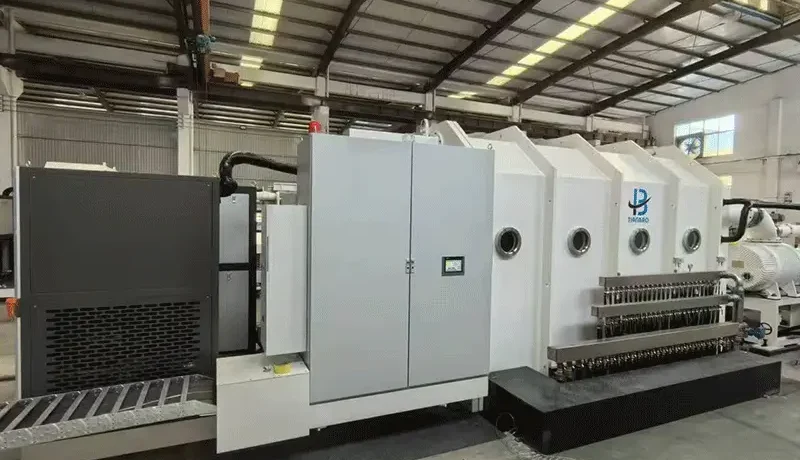
Tempo Vacuum Metallizer Lineup: Which Model Fits Your Production Profile?
Walk onto a metallized film production floor, and the machine dominating the space will look very different depending on what it produces. One line runs 12-micron PET at 600 meters per minute, depositing a standard 400-angstrom aluminum layer for snack food packaging. Next to it, another machine — visually similar but running at half the speed — deposits 800 angstroms of aluminum onto the same film, producing pharmaceutical-grade barrier material. A third line, smaller and more specialized, coats paper rather than plastic film. A fourth, the most specialized of all, evaporates zinc sulfide instead of aluminum.
These are not different brands. They are different models within the same manufacturer’s lineup — and each model exists because the customers who buy them run fundamentally different businesses. The snack packaging converter and the pharmaceutical barrier producer do not need the same machine, even though both are “vacuum metallizers.”
At Qingzhou Tempo Machinery Technology Co., Ltd., we manufacture four core vacuum metallizer models. This article compares them across the four dimensions that matter most when selecting a machine: substrate compatibility, production capacity, coating thickness capability, and budget range. Use this guide to identify which model matches your production profile.
1. The Four Models at a Glance
2. Model 1: Fully Automatic Suspension Vacuum Coating Machine — The Generalist
2.1 What It Does
The Fully Automatic Suspension Vacuum Coating Machine is Tempo Machinery’s workhorse — the model that produces the vast majority of the world’s metallized flexible packaging film. It uses resistance-heated ceramic evaporation boats to vaporize aluminum wire, depositing a uniform reflective layer onto a continuously moving plastic film web inside a vacuum chamber.
The machine comes in rectangular and round vacuum chamber configurations, with film widths spanning 650 mm to 2,450 mm — covering the full range from small specialty runs to wide-web, high-volume production.
2.2 Substrate Compatibility
This model handles the broadest range of substrates in the Tempo lineup:
- BOPP (biaxially oriented polypropylene) — the most common flexible packaging film
- PET (polyester) — higher-temperature applications, microwaveable packaging, thermal lamination
- CPP (cast polypropylene) — high-clarity, heat-sealable packaging
- PE (polyethylene) — flexible, tough, low-temperature packaging
- PVC (polyvinyl chloride) — decorative films, labeling, shrink sleeves
- Nylon — high-barrier, high-strength packaging for meat, cheese, medical products
- Twisted PET — specialty film for decorative and textile applications
- Holographic and anti-counterfeiting films — base film for embossed holographic patterns
If your product mix includes multiple film types, or if you expect to diversify into new substrates over the machine’s 15–20 year service life, the suspension model’s substrate flexibility provides valuable future-proofing.
2.3 Production Capacity
Throughput depends on film width, line speed, and coating thickness — but as a general reference:
The wide-web (2,050–2,450 mm) configuration represents the highest-throughput option in the Tempo lineup. Converters serving large-volume commodity packaging markets typically choose this configuration for its low cost per kilogram of metallized film produced.
2.4 Coating Thickness
The suspension model delivers 200–500 angstroms of aluminum coating — the standard range for flexible packaging, decorative films, and general-purpose metallizing. This thickness range provides adequate barrier properties for snack foods, confectionery, and non-critical moisture-barrier applications.
If your product requires coating thickness above 500 Å — for pharmaceutical barrier, medical packaging, or gold/silver yarn — this model can achieve thicker coatings by reducing line speed, but the productivity trade-off becomes significant. At 600+ Å, the machine runs at 60–70% of its rated speed, and the cost per kilogram of output increases proportionally.
2.5 Budget Range
As the most popular model in the lineup, the suspension machine benefits from production volume efficiencies. Indicative FOB price range: $150,000–350,000, depending on chamber size, automation level, and optional features (inline optical density measurement, plasma treatment, shaftless rewind).
2.6 Best For
Flexible packaging converters producing standard aluminum-metallized film; companies with diverse substrate requirements; high-volume producers where cost per kilogram of output drives machine selection; general-purpose metallizing operations.
3. Model 2: Induction Heating Vacuum Metallized Machine — The Premium Specialist
3.1 What It Does
The Induction Heating Vacuum Metallized Machine replaces the ceramic resistance boat with a graphite crucible heated by electromagnetic induction. This single change fundamentally alters the machine’s performance profile — and the markets it can serve.
The induction system generates eddy currents directly in the graphite crucible, creating a uniformly heated aluminum pool with no hot-spot/cold-edge thermal gradient. The result: dramatically lower pinhole rates, the ability to deposit ultra-thick coatings (800+ Å) at full production speed, and the elimination of ceramic particle contamination from boat erosion.
Tempo Machinery developed this machine with specialized R&D and the latest innovation design, specifically targeting applications where standard boat-evaporated film cannot meet the quality requirements.
3.2 Substrate Compatibility
The induction model primarily runs PET and BOPP films — the substrates used in its target premium markets. It handles the full range of film thicknesses (10–30 microns) and widths up to 2,450 mm.
However, unlike the suspension model, the induction machine is not the right choice for a broad, mixed-substrate production profile. If your daily production shifts between PET, CPP, PE, PVC, and nylon — each requiring different tension profiles, coating parameters, and handling characteristics — the suspension model’s broader substrate flexibility serves you better. The induction model optimizes for quality on a narrower substrate range.
3.3 Production Capacity
Throughput is comparable to the suspension model for standard coating thicknesses — but the induction machine’s defining advantage is its ability to maintain full production speed at coating thicknesses that force the suspension model to slow down.
For a 600–800 Å pharmaceutical barrier film order, the induction model runs at its rated speed while the suspension model runs at 60–70% speed. Over a year of production, this speed advantage on premium products can translate to 30–40% higher output — and revenue — from the same machine hours.
Additionally, the graphite crucible lasts 50–100+ production runs compared to 8–15 runs for a ceramic boat. This 5–10x longer source life reduces downtime for boat/crucible replacement, recovering 60–80 hours of lost production time per year.
3.4 Coating Thickness
This is the induction model’s defining capability: aluminum layer thickness up to 800+ angstroms at full production speed — with near-zero pinhole rates. The combination of ultra-thick, pinhole-free coating is what the premium markets demand, and what the boat-based suspension model cannot consistently deliver at competitive throughput.
Key applications that require this capability:
- Gold and silver yarn film: Thick coating (600–800 Å) for brilliant reflectivity; near-zero pinholes because each pinhole is a visible dark spot in the finished thread
- Pharmaceutical barrier film: Ultra-thick coating (800+ Å) for extreme-barrier WVTR below 0.1 g/m²·day; pinhole-free for drug stability over 24–36 month shelf life
- Medical packaging: Pinhole-free aluminum layer required for sterile barrier systems
3.5 Budget Range
The induction heating system — including the high-frequency power supply, copper induction coil, and precision-machined graphite crucible assembly — increases the machine cost compared to the suspension model. Indicative FOB price range: $250,000–500,000+.
However, the higher capital cost typically recovers through three mechanisms: (1) significantly higher processing margin per ton on premium products, (2) longer crucible life reducing downtime and consumable cost, and (3) 20–35% lower electricity consumption from the more efficient induction heating system.
3.6 Best For
Gold and silver yarn metallizers; pharmaceutical and medical packaging barrier film producers; converters targeting premium market segments where pinhole rate and coating thickness directly determine product grade and selling price; operations where the ability to run thick coatings at full speed justifies the capital premium.
4. Model 3: Aluminum Paper Vacuum Metallized Machine — The Paper Specialist
4.1 What It Does
The Aluminum Paper Vacuum Metallized Machine deposits aluminum onto paper substrates — a fundamentally different challenge than coating plastic film. Paper is porous. It outgasses water vapor under vacuum, extending pump-down time. Its surface is rougher than film, requiring a thicker aluminum layer to achieve uniform reflectivity. And it is more sensitive to heat — excessive coating drum temperature can scorch or dry out the paper, causing brittleness and converting problems.
Tempo Machinery designed this model specifically for paper, with features that address these challenges: an optimized evaporation source design (top-clip, staggered boat arrangement for higher aluminum evaporation rate), a paper-specific web handling system (lower tension, wider roller spacing, gentler web path), and an energy-efficient cooling and vacuum system that shortens compressor working time and extends equipment service life.
4.2 Substrate Compatibility
Primarily paper and cardboard substrates — the base materials for cigarette packaging, wine and spirit labels, cosmetic packaging, gift wrap, and premium printed materials. Standard paper weights range from 40–120 g/m².
This model also handles lightweight card stock and label face stock — the materials that become metallic-finish wine labels, high-end product tags, and decorative packaging components. Some configurations can run thin plastic films as well, but a customer who primarily coats paper should choose this model over the general-purpose suspension machine because the paper-optimized features (evaporation source, web handling, vacuum cycle) directly affect productivity and quality on paper substrates.
4.3 Production Capacity
Paper metallizing runs at lower speeds than film metallizing — typically 200–400 meters per minute, depending on paper weight, width, and desired coating thickness. The slower speed reflects the paper’s greater thermal sensitivity and the need for a thicker aluminum layer to achieve uniform reflectivity on the rougher paper surface.
Annual output for a mid-size machine (1,300–1,650 mm width, 2 shifts, 300 days) ranges from approximately 400–900 tons per year, varying with the paper weight and speed combination.
The new evaporation source design also improves productivity in a secondary way: easier cleaning and faster boat replacement “save time” between production runs, increasing the number of productive coating hours per shift.
4.4 Coating Thickness
Paper requires 200–600 angstroms of aluminum — thicker than the 200–400 Å typical for film packaging, because the paper’s surface roughness demands a thicker coating to achieve uniform visual reflectivity. A 300 Å coating that looks perfectly mirror-like on smooth PET film will appear dull and patchy on uncoated paper stock.
The top-clip, staggered boat arrangement in this model’s evaporation source improves the aluminum evaporation rate, enabling the thicker coating without proportionally reducing line speed — a key productivity advantage over running paper through a standard film-configured suspension metallizer.
4.5 Budget Range
The paper-specific design features add cost compared to a standard film-configured machine of the same chamber size, but the paper model is typically less expensive than the induction heating model. Indicative FOB price range: $180,000–350,000.
4.6 Best For
Cigarette packaging converters; wine and spirit label metallizers; premium paper packaging and gift wrap producers; any operation where the primary substrate is paper — not film — and the machine should be optimized for paper’s specific handling, coating, and vacuum requirements.
5. Model 4: Vacuum Metalizer for Zinc Sulfide Film — The Specialty Coater
5.1 What It Does
The Vacuum Metalizer for Zinc Sulfide Film is fundamentally different from the other three models: it evaporates zinc sulfide (ZnS) rather than aluminum. ZnS is a dielectric material — transparent in the visible spectrum but with a high refractive index — used to create the transparent optical layers that produce holographic effects, anti-counterfeiting features, and specialty optical coatings.
This is not a machine for standard flexible packaging. It is a specialty coater for converters who supply the security printing, brand protection, holographic packaging, and optical film industries.
5.2 Substrate Compatibility
The ZnS model handles the same plastic film substrates as the suspension model — BOPP, PET, CPP, PE, PVC — but the end use is completely different. The film serves as a carrier for the ZnS optical layer, not as a barrier packaging material.
The key substrate requirement: the film must accept the ZnS coating uniformly without surface defects that would disrupt the optical properties of the dielectric layer. Surface-treated (corona or plasma) film grades improve ZnS adhesion and coating uniformity.
5.3 Production Capacity
ZnS coating runs at speeds comparable to or slightly slower than standard aluminum metallizing — the limiting factor is not the evaporation rate but the need to maintain the ideal vacuum degree for ZnS evaporation. ZnS evaporates at a different temperature and pressure than aluminum, and the vacuum system must maintain conditions that produce a smooth, uniform optical coating rather than a simple reflective metal layer.
Tempo Machinery’s ZnS model features fast cleaning time and high coating speed as design priorities — the cleaning time between runs is shorter than for some competing ZnS machines because the evaporation source geometry allows easier access. However, absolute output (tons per year) is typically lower than an aluminum metallizer of equivalent chamber size because ZnS coating is a lower-volume, higher-value product.
5.4 Coating Thickness
ZnS coating thickness is specified in optical thickness (nanometers of optical path length, accounting for the material’s refractive index) rather than physical angstroms. The target thickness depends on the desired optical effect — a quarter-wave optical thickness for anti-reflection, a specific interference color, or a holographic grating depth.
The machine delivers automatic constant tension control and maintains the ideal vacuum degree for ZnS evaporation, ensuring “smooth and fast coating” with “an ideal thickness of Zinc Sulfide on the film surface.”
5.5 Budget Range
As the most specialized model in the lineup, the ZnS metallizer occupies a higher price bracket than a standard aluminum machine of equivalent chamber size. The specialized evaporation source, vacuum system optimization for ZnS, and lower production volume all contribute to a higher unit cost. Indicative FOB price range: $300,000–600,000+, heavily dependent on chamber size and customization.
5.6 Best For
Holographic film producers; security and anti-counterfeiting label converters; brand protection packaging suppliers; specialty optical coating operations. Not suitable for standard aluminum metallizing — the machine is configured for ZnS and would require significant modification to run aluminum at production scale.
6. Four-Dimension Selection Matrix
Use this matrix to identify which model matches your production profile across all four dimensions:
7. Selection Flowchart: How to Choose
Rather than comparing specifications in isolation, work through these questions in order:
1: What are you coating?
- Primarily paper → Aluminum Paper Metallizer
- Primarily plastic film → Continue to Question 2
- Zinc sulfide or dielectric material → ZnS Vacuum Metalizer
2: What does your customer demand from your coated product?
- Standard barrier for snacks, confectionery, decorative packaging → Suspension Model
- Ultra-thick coating (600+ Å), near-zero pinholes, pharmaceutical/medical grade, or gold/silver yarn → Induction Heating Model
3: What is your annual production volume?
- Under 500 tons per year → Small-chamber (650–850 mm) suspension or aluminum paper model
- 500–1,500 tons per year → Mid-size chamber (1,300–1,650 mm) — any model
- Over 1,500 tons per year → Wide-web (2,050–2,450 mm) suspension or induction model
4: What is your available capital budget?
- $150K–200K → Small-chamber suspension or aluminum paper model
- $200K–350K → Mid-size suspension or aluminum paper; entry-level induction
- $350K+ → Large-chamber suspension; mid-to-large induction; ZnS specialty
8. Frequently Asked Questions (FAQ)
Q: Can I use the Induction Heating model for standard packaging film, or does it only make sense for premium products?
A: You can — the induction model will metallize standard packaging film at the same speed and quality as the suspension model. However, you pay a capital premium for the induction system that you may not recover if your product mix consists entirely of standard-margin packaging film. The induction model’s economic advantage comes from its ability to produce premium products (pharma barrier, gold/silver yarn) that the suspension model cannot produce efficiently. If your current product mix is 100% standard packaging film, the suspension model is the more cost-effective choice. If you plan to enter premium markets within the machine’s service life, the induction model provides that capability from day one.
Q: Does Tempo Machinery offer smaller, entry-level versions of these models for companies starting metallizing operations?
A: Yes. All four models are available in compact chamber configurations with film widths from 650 mm — suitable for companies entering the metallizing market, testing product feasibility, or serving regional niche markets with lower volume requirements. A compact suspension model represents the most accessible entry point into vacuum metallizing, with a lower capital investment and a shorter learning curve than larger, more complex configurations. As your volume grows, you can add larger machines while the compact unit continues producing specialty or short-run products. Contact our team to discuss the right entry-level configuration for your market and budget.
Q: How interchangeable are the models — can I start with a suspension model and upgrade it to induction heating later?
A: The evaporation source — ceramic boat vs. induction crucible — represents a fundamental machine design choice, not a field-upgradeable component. The induction system requires a different power supply, cooling system, and crucible assembly that integrate into the machine’s structure and control architecture. You cannot “upgrade” a suspension model to induction heating. However, you can add a second machine — an induction model for premium products — alongside your existing suspension model for standard production, creating a complementary two-machine operation that covers the full market spectrum. Tempo Machinery’s technical team can advise on the optimal two-machine configuration for your product mix and growth plan.
Q: Can the ZnS model also run aluminum for standard metallizing?
A: The ZnS model is configured specifically for zinc sulfide evaporation — the evaporation source geometry, vacuum system optimization, and process control parameters are tuned for ZnS. While it is technically possible to run a small amount of aluminum through the same chamber for testing or limited production, the machine is not designed for efficient aluminum metallizing at production scale. The evaporation source that works best for ZnS (controlled, uniform evaporation at the material’s specific temperature) differs from the source optimized for high-volume aluminum evaporation. If you need both ZnS and aluminum capability, we recommend two separate machines — a ZnS model for dielectric coating and a suspension or induction model for aluminum metallizing.
Q: How do I decide between the rectangular and round chamber options for the suspension model?
A: The chamber geometry affects pump-down time, internal access for cleaning, and web path configuration. Rectangular chambers provide easier internal access for cleaning and maintenance — important for frequent product changeovers where cross-contamination must be avoided. Round chambers offer slightly faster pump-down times (better volume-to-surface-area ratio) and inherent structural strength under vacuum (the cylindrical shape naturally resists atmospheric pressure). For most flexible packaging applications, the rectangular chamber is preferred for its maintainability. For high-throughput, single-product operations where the machine runs the same film type day after day, the round chamber’s faster pump-down can increase productive coating time per shift. Tempo Machinery offers both configurations — discuss your production profile with our team to determine which geometry suits your operation.
Q: Can Tempo Machinery provide a customized machine configuration that does not exactly match any of these four standard models?
A: Yes. Tempo Machinery has a dedicated OEM/ODM and custom engineering capability with senior coating experts, mechanical design engineers, and electrical automation engineers on staff. We have produced custom configurations for copper coating, multi-source sequential coating, non-standard film widths and chamber geometries, and specialized substrate handling requirements. Additionally, Tempo Machinery operates its own 10,000-ton/year packaging film production line — this real-world production environment allows us to test custom configurations under actual production conditions before delivering them to customers. Contact our engineering team with your specific requirements to discuss custom configuration feasibility.
9. Conclusion
The four Tempo vacuum metallizer models do not compete with each other — they serve different markets. The suspension model is the right choice for the converter who runs 1,500 tons of standard packaging film per year and needs a machine that handles every film type the customer requests. The induction model is the right choice for the converter who serves pharmaceutical, medical, or gold/silver yarn customers and needs ultra-thick, pinhole-free coatings that a standard boat system cannot deliver. The aluminum paper model is the right choice for the converter whose business revolves around paper — cigarette packaging, wine labels, premium gift wrap — and who needs a machine optimized for paper’s unique handling and coating requirements. The ZnS model is the right choice for the specialist converter who produces holographic and security films — a fundamentally different product from aluminum-metallized packaging.
Qingzhou Tempo Machinery Technology Co., Ltd. — with its own 10,000-ton/year film production line, CE-certified machines, and customers across India, Europe, Turkey, Southeast Asia, and the Middle East — provides detailed application consultation to match the right model to your production profile. Our team includes senior coating experts who can evaluate your substrate types, target markets, volume projections, and budget to recommend the optimal configuration.
Contact our team to discuss your production requirements, request machine specifications, or arrange a visit to our production facility in Qingzhou, Shandong, China.