


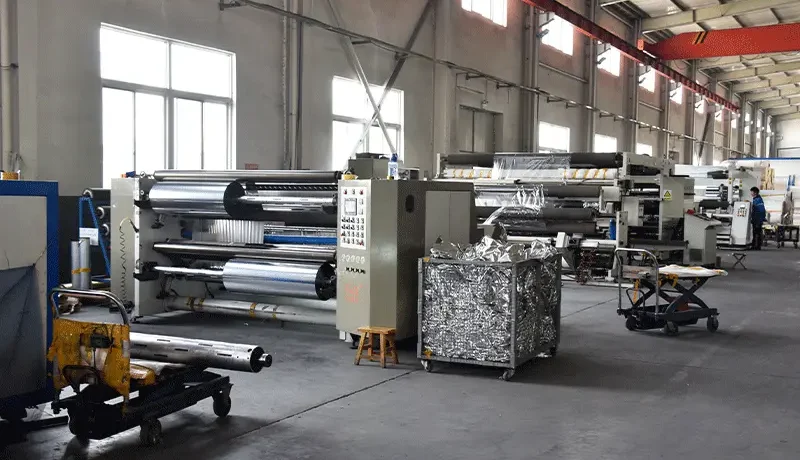
Web Tension Control in Roll-to-Roll Metallizing: Setting Tension for PET, BOPP and Thin Substrates
You can buy the widest chamber, the fastest pumps, and the best evaporation source on the market. Then one mis-set tension profile turns every roll into scrap. Wrinkles appear, the web necks down, the aluminum layer drifts thick and thin, and the slitter inherits the problem. Consequently, experienced metallizer operators judge a machine by its web tension control before they judge anything else.
A metallizer removes material in a vacuum, so your operators cannot reach in and fix a wandering web. The machine must hold tension correctly across the entire roll, from the first metre off a full unwind to the last metre at a bare core. That demand makes tension control the single most consequential process setting in the line.
Therefore, this guide gives you the physics, the starting setpoints for the substrates you actually run, and a practical procedure for dialing the profile in.
Why Tension Decides Whether You Get Salable Film
Tension does more than keep the web moving. It determines whether the web sits flat against the coating drum, and that contact decides how evenly aluminum condenses onto the surface.
Set tension too low, and the web wanders, goes slack, and folds over itself. Set tension too high, and you stretch the web, distort its structure, neck it down, induce wrinkles, and eventually break it. Both failure modes waste film, and both show up downstream as customer complaints.
Moreover, tension interacts with every other process variable. It changes the web length, which changes the optical density you achieve at a fixed evaporation rate. It shifts the contact pressure on the cooling drum, which changes how quickly the film cools. Furthermore, it feeds directly into wrinkles, curl, and roll defects.
The Physics in One Line: Tension Equals Torque Divided by Radius
Engineers express the relationship simply: tension equals torque divided by radius, as the tension control specialists at Montalvo put it. Because the roll radius changes constantly, a controller must adjust torque continuously to hold a constant tension setpoint.
The consequence differs between the two ends of the machine:
- On the unwind, a fixed torque produces rising tension as the roll diameter falls. A nearly empty roll therefore runs much tighter than a full one unless the controller compensates.
- On the rewind, a fixed torque produces falling tension as the roll diameter grows. Without compensation, the outside of the roll ends up loose and the inside grippy.
Therefore, you cannot set tension once and walk away. You set a profile, and the control system maintains it against a changing diameter.
One more physical detail matters here. Tension relates to strain through the material’s elastic modulus, so a web’s stiffness changes with temperature and humidity. Because the chamber and the cooling drum expose the film to different conditions, the effective stiffness shifts during the pass. Robust tension systems tolerate that drift rather than fighting it.
Map the Tension Zones Before You Touch a Setpoint
Industry practice divides a coating line into tension zones, where each zone is the web span between two successive driven rollers — a convention that web handling research describes in detail for roll-to-roll systems. A typical metallizer runs four functional sections:
- Unwind section. Pays out material and holds back-tension. Here, the controller fights a shrinking diameter.
- Master speed section. Sets the line speed reference. Consequently, this roller becomes the speed anchor for every other drive.
- Process / coating section. Carries the web across the evaporation source and the cooling drum. Tension here decides web flatness, and web flatness decides coating uniformity.
- Rewind section. Accumulates finished material. Here, the controller fights a growing diameter and manages roll quality.
Tension typically differs between zones. Operators often run tighter tension in the internal zones than at the unwind, because the coating section demands the most control. Understand your machine’s zone layout before you change anything, and then record the setpoint for each zone separately in your recipe.
Starting Setpoints for PET, BOPP, and Thin Substrates
Industry reference tables express film tension per mil of thickness, then you scale by the web width. The table below draws on the widely cited TAPPI-based ranges for web materials, and it gives you a defensible starting point rather than a guess.
Next, convert the range into an actual number for your web. Multiply the per-mil figure by the film thickness in mils, then multiply the result by the web width in inches. The worked examples below assume a 1400 mm web, which equals about 55 inches.
Finally, two sanity checks keep you honest. First, the majority of webs run between 0.3 and 3.0 PLI, so a calculated setpoint far outside that band deserves a second look. Note that very thin films legitimately sit near the bottom of that band, so the 0.24 PLI figure for 12 µm PET is normal rather than suspicious. Second, treat these figures as starting points only. Every supplier’s resin, every surface treatment, and every roll build behaves slightly differently, so plan on a short trial to confirm the number.
For paper, reference tables use a different basis and express a maximum tension per unit width rather than per mil. A 50 g/m² paper sits around 1.0 lb per linear inch, and a 130 g/m² grade sits around 2.5 lb per linear inch. You can cross-check your own figures against the published running tension recommendations for common web materials. Since a machine like the TB-Y handles paper from 38 g to 150 g, expect a wide tension range across your product mix, and store a separate recipe for each grade.
The Safety Factor That Prevents Breaks
Above all, protect the web from damage. Web handling specialist Tim Walker recommends running at roughly 10 percent of the tension that would break or yield the material, which gives you a 10:1 safety margin. If you do not know your film’s yield point, ask the supplier for a tensile-elongation curve, because that single data point anchors every setpoint you will ever calculate.
How to Set the Tension Profile: A Step-by-Step Procedure
Follow this sequence on a new substrate, and you will reach a workable profile in one shift instead of one week.
- Calculate the starting setpoint. Use the per-mil range and the actual width as shown above. Write the number down before you touch the HMI.
- Start at the low end. Run at the bottom of the calculated band first. Then increase tension in small increments, because damage from over-tensioning shows up immediately while a slightly loose web merely runs unevenly.
- Confirm web flatness at the coating drum. Watch the web where it wraps the drum. A flat, wrinkle-free wrap tells you the tension holds; a rippled edge tells you it does not.
- Check the crossweb profile. Measure optical density at the left edge, the center, and the right edge. Tension variation across the width produces a density gradient.
- Log the profile, not just the number. Record unwind, process, and rewind setpoints together, plus the taper setting and the roll diameter range.
- Re-verify at each speed step. Ramp to your target speed and re-check, because tension variation grows substantially during acceleration.
Afterward, store the profile as a named recipe in the PLC. Our machines use a Siemens PLC with a 12-inch color HMI and one-touch factory parameter restoration, so a well-labeled recipe library turns substrate changeovers into a routine rather than a research project.
Open Loop or Closed Loop: Choosing the Control Architecture
Three control architectures exist, and the right choice depends on your tolerance for variation.
- Manual control. An operator watches the web and adjusts by feel. You get constant up-and-down tension swings, plus results that vary from operator to operator. Reserve this approach for trials.
- Open loop control. The controller measures or calculates the roll diameter with an ultrasonic or proximity sensor, then adjusts torque accordingly. This approach delivers consistent results at lower cost, though it never verifies the actual web tension.
- Closed loop control. Load cells or a dancer position sensor feed real tension data back to the controller, which corrects the torque device continuously. This architecture holds the tightest tolerance.
A metallizer benefits enormously from closed loop control, because operators cannot see or touch the web inside the chamber. Our TB-F suspension machines use four Siemens AC servo motors for synchronized tension control and a swing frame that adjusts the rewind automatically as the roll diameter grows. That combination keeps tension stable across the full speed range.
Consequently, ask one question when you compare quotations: which closed-loop feedback devices does the machine include, and where do they sit? The specification sheet guide shows you where that detail appears in a proposal.
Tension Taper on the Rewind
On the rewind, you usually want less tension than the unwind zone, and you want it to decline as the roll builds. Operators call this declination taper, and controllers express it as a percentage reduction from the core to the outer wrap.
Three reasons justify taper:
- Core crushing prevention. High tension at the core damages thin cores and leaves the inner wraps distorted.
- Roll defect avoidance. Excessive rewind tension produces starring, telescoping, and blocked rolls.
- Unwind behavior downstream. A roll wound too tight blocks, so your customer fights the same web you just finished.
Typical industrial practice reduces rewind tension modestly across the build rather than dramatically. Start conservatively, inspect the finished roll, then adjust. Squeeze the roll face and check the end walls, because a soft center and firm outer wraps tell you the taper works.
How Tension Shows Up in Coating Results
Unfortunately, tension rarely announces itself directly. Instead, it disguises itself as a coating defect. Therefore, learn the signatures.
- Varying optical density across the width. Crossweb tension variation changes contact pressure on the drum, so aluminum condenses unevenly. Our article on the top five factors affecting coating uniformity ranks tension high among them.
- Wrinkles and curl. Wrinkles mean too much tension somewhere, or a diameter mismatch between zones. Curl often points to tension that differs between the two roller faces.
- Poor adhesion. A web that lifts slightly off the drum stays warmer, so the aluminum layer bonds less firmly. Run a tape or cross-hatch adhesion test to confirm.
- Pinholes. Slack web plus a dusty environment creates pinholes, because particles sit between the film and the coating. Meanwhile, tension changes also shift static behavior, which our guide to static control in roll-to-roll metallizing covers.
- Web breaks. Always a tension problem, though the root cause may sit in a misaligned roller rather than the setpoint.
If you see a mix of symptoms, work through the diagnostic table below before you change any numbers, and cross-check the result against our operator’s guide to troubleshooting coating defects.
Reading the Symptoms: A Tension Fault Diagnosis Table
Common Tension Mistakes on a Metallizer
Beyond individual faults, a handful of habits cause most recurring problems.
- Copying a setpoint from a different substrate. PET and BOPP differ by a factor of two in tolerance. Therefore, always recalculate rather than reuse.
- Ignoring roller condition. A worn or misaligned roller defeats the best controller. Inspect rollers at every major maintenance stop.
- Chasing symptoms in the recipe. Operators often change tension when the real problem sits in the cooling drum temperature or the evaporation rate.
- Skipping the crossweb check. A single center-line measurement hides a density gradient that your customer will find.
- Forgetting the environment. Tension targets drift with temperature and humidity, so recheck after a seasonal change.
Frequently Asked Questions
1. What is web tension control, in simple terms?
Web tension control maintains a preset pulling force on a moving web so the material keeps its shape and quality between two points. The controller adjusts torque continuously, because tension equals torque divided by radius and the roll radius changes constantly.
2. What tension should I set for PET and BOPP film?
Start from the published per-mil ranges. Polyester typically tolerates 0.5–1.5 lb per linear inch per mil of thickness, while BOPP sits lower at 0.3–1.0. Multiply by your film thickness in mils, then by the web width in inches, and confirm the result on a short trial.
3. How fine does tension control need to be on a metallizer?
Tighter than most people assume. Research on roll-to-roll systems treats a tension error within 10 percent as the working requirement, and crossweb variation can reach 2:1 across a wide web. Consequently, closed-loop feedback matters more on wide, fast machines.
4. Can I run a metallizer without closed-loop tension control?
You can, and some older machines do. However, open-loop control only estimates tension from roll diameter, so it cannot detect a slippage event or a roller problem. If you plan to run thin substrates or high speeds, invest in load cells or dancer feedback.
5. Why does tension matter more inside the vacuum chamber?
Because nobody can intervene there. A press operator can adjust a wandering web by hand, but a metallizer operator cannot reach the coating zone. Therefore, the tension profile must hold on its own across the whole roll, including during acceleration.
6. Does tension affect the metallized film’s barrier performance?
It does, though indirectly. Tension controls web flatness, web flatness controls coating uniformity, and coating uniformity controls barrier performance. Our guide to aluminum layer thickness and barrier performance explains that chain.
7. Does web tension control differ for PET, BOPP and CPP substrates?
Yes, and the differences are large enough to demand separate recipes. Explore the material options on our metallized PET, metallized BOPP, metallized CPP, and metallized PE pages, and set a dedicated tension profile for each one.
The Bottom Line
Sound web tension control rests on three habits: calculate a starting setpoint from published ranges, verify it with crossweb measurements, and store the result as a recipe so you never guess twice.
Then check the mechanical side regularly, because rollers, alignment, and web bagginess defeat any controller. A machine that has run for years without a roller inspection will eventually break webs for reasons no recipe can fix. Consequently, schedule a tension audit during every preventive maintenance stop, and revisit the profile whenever you introduce a new substrate.
Need help matching a tension system to your film? Send us your substrate type, thickness, and web width, and our engineering team will recommend the right drive and feedback configuration. Contact us or review our fully automatic suspension metallizers to see how we build tension control into the machine.