


Circle Sequin Production: How Metallized Film Becomes Glittering Sequins
Shiny circle sequins are everywhere — on party dresses, festival costumes, craft decorations, and premium gift packaging. What most buyers never see is the sophisticated manufacturing chain behind every single disc. Interestingly, the journey begins not with the sequin itself, but with a roll of plain plastic film that is transformed inside a high-vacuum chamber. In this guide, we walk through every stage of circle sequin production, explain why metallized film is the ideal starting material, and show you what determines sparkle, color, and durability.
What Exactly Is a Circle Sequin?
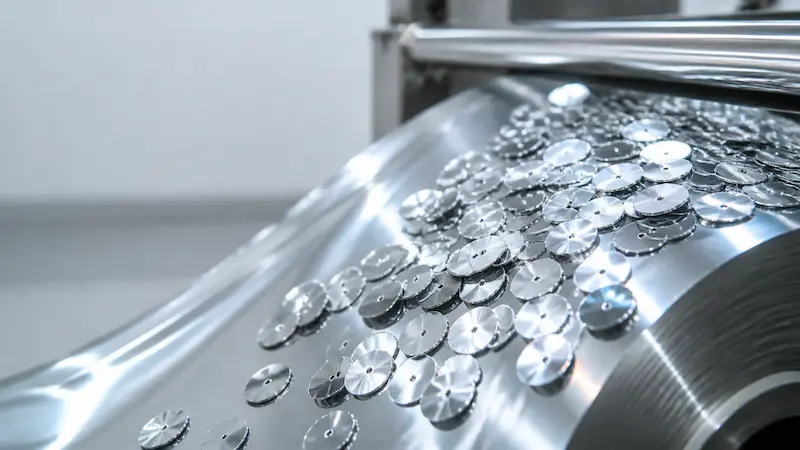
A circle sequin is a thin, round disc with a highly reflective surface and a small center hole for sewing or gluing. Manufacturers punch it from a pre-metallized web, which means the metallic layer must be applied before the film is cut into circles. Therefore, the quality of the sequin is decided long before the punching step — it is decided by the vacuum coating process that deposits a microscopic layer of aluminum onto the base film.
To put it simply, a sequin is only as good as the metallized film it comes from. For this reason, converters who want consistent gloss, uniform color, and low reject rates need to control the entire upstream process carefully.
Step 1: Start With the Right Base Film
Most high-quality sequins start with biaxially oriented PET (polyester) film, typically between 12 and 50 microns thick. PET offers the stiffness, dimensional stability, and heat resistance that thinner films simply cannot match. Consequently, it survives both the vacuum chamber environment and the high-speed punching process without warping or tearing.
In addition to PET, some decorative products use BOPP or CPP, although these materials are less common for circle sequins because they are softer. For the best results, manufacturers choose a film with high clarity, uniform thickness, and a properly treated surface that maximizes aluminum adhesion. Our metallized PET film page covers the typical thickness range, mechanical properties, and adhesion data you should expect from a reliable substrate.
Step 2: Vacuum Metallizing — The Core of Sequin Shine
This is the heart of circle sequin production. The base film is loaded into a vacuum metallizer, where the chamber is evacuated to a high vacuum of around 5 × 10⁻² Pa. Inside this near-airless environment, aluminum wire is melted and vaporized by heated evaporation boats. The aluminum vapor then condenses onto the moving film in a molecular, atomic state, creating a brilliant metallic layer that is typically just a few hundred angstroms thick.
Because the film passes over chilled coating drums at high speed — up to 900 m/min on modern machines — the aluminum layer solidifies quickly, which improves both brightness and adhesion. Modern systems also use online optical density (OD) detection to monitor the coating in real time, ensuring the aluminum layer remains uniform across the entire web. This uniformity is precisely what gives sequins their consistent, mirror-like reflection.
For this stage, the fully automatic suspension vacuum coating machine is a popular choice among sequin film producers. Its free-suspension design avoids edge wrinkles and aluminum slag sputtering, while the double coating drum cooling enhances film brightness and layer firmness. Notably, the top-tightening evaporation boat design speeds up boat changes, which directly improves uptime for high-volume sequin film production.
Step 3: Color and Protection: From Silver to Rainbow
Plain silver sequins are the market standard, but colorful variants dominate fashion and craft applications. Converters achieve these colors in one of two ways: by laminating a dyed or coated film layer, or by coating the metallized film with translucent inks and lacquers.
For rainbow, holographic, and laser-effect sequins, manufacturers emboss a fine micro-pattern onto the film before or after metallizing. This diffraction structure splits light into spectral colors, producing the eye-catching iridescent effect popular in apparel and decorations. If you need pre-colored substrates, our metallized colored film range offers a convenient starting point.
A protective topcoat is also essential in circle sequin production at this stage. It guards the aluminum layer against scratching during punching, handling, and washing, and it can be tinted to shift the final shade. Moreover, the lacquer improves the sequin’s resistance to oxidation, so the shine lasts longer on finished garments.
Step 4: From Film to Sequins: Slitting and Punching
Once the metallized, colored, and coated web is ready, it moves to the converting line. First, the wide roll is slit into narrower widths that match the punching tooling. Then, high-speed die-cutting or punch presses stamp out thousands of circles per minute, each with a clean center hole.
This step sounds simple, but it is surprisingly demanding on material quality. A single bubble, pinhole, or weak spot in the aluminum layer can cause a punch to tear the film, which stops the line and increases waste. In fact, studies of conventional sequin production highlight that a significant share of sequin film is wasted during the making process — some estimates put material wastage at around one-third. As a result, converters increasingly demand higher-grade metallized film with fewer defects and tighter thickness tolerances.
Step 5: Quality Control That Keeps Sequins Consistent
Consistency is the difference between a premium sequin and a reject. Consequently, responsible producers test the metallized film before punching using standard methods:
- Optical density (OD): Confirms the aluminum layer is thick enough and uniform from edge to edge.
- Adhesion testing: Tape and cross-hatch tests verify that the aluminum layer will not peel off during washing or sewing.
- Pinhole inspection: Detects micro-defects that would show up as dark spots on the sequin surface.
Our guide to metallized film adhesion testing explains how to perform tape tests and cross-hatch tests and, more importantly, what the results actually mean for end-use performance. For a deeper look at how coating defects arise and how to fix them, see our practical vacuum coating defects troubleshooting guide.
Common Defects in Circle Sequin Production
Even experienced producers occasionally face the same handful of issues. Here are the most common ones and their typical root causes:
Sustainability in Circle Sequin Production
Sustainability is a growing concern in the embellishment industry. Metallized film offers a genuine advantage here: it delivers the metallic look with a fraction of the material used by traditional metal foil or electroplating processes. Additionally, metallized PET can be recycled when properly separated, and modern vacuum coating machines are designed with energy-saving features such as shorter compressor working cycles.
For a broader look at how metallized films are manufactured and why the process matters, the metalized film manufacturing process guide from CloudFilm is a useful external reference. Meanwhile, industry commentary on sustainable sequin production highlights why reducing material wastage should be a priority for every converter.
Conclusion
Circle sequin production is a fascinating blend of vacuum technology, material science, and precision converting. To summarize, the sequence runs from base film selection, through vacuum metallizing and coloring, to slitting, punching, and rigorous quality control. Every step matters — but none more than the metallizing stage, where the aluminum layer is born and the sequin’s shine is decided.
If you are planning to start or upgrade your own sequin film line, the right vacuum metallizer makes all the difference. For example, our fully automatic suspension vacuum coating machine is engineered for the high-speed, uniform coating that sequin-grade film demands. To learn more about how metallized film is made, you can also read our related article on how metallized balloon film is made.
Ready to turn plain film into glittering sequins? Contact our team today for machine specifications, customization options, and free consultation on your circle sequin production line.