


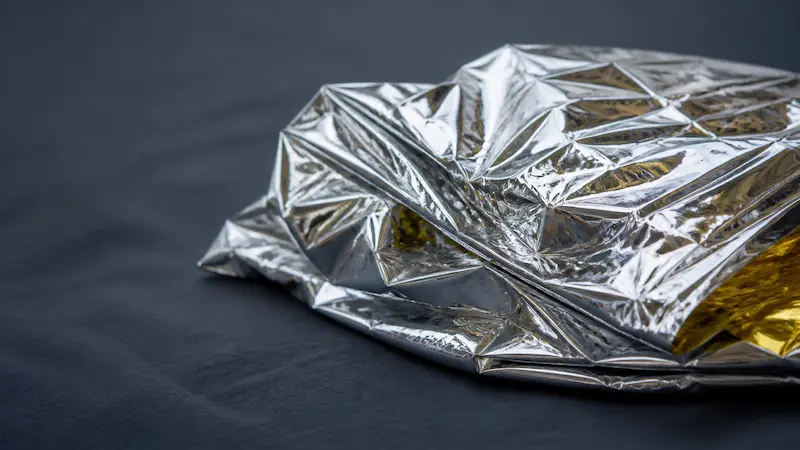
Emergency Blanket Film: The Metallizing Technology Behind Life-Saving Heat Retention
A crumpled sheet of shiny film weighing just a few dozen grams can mean the difference between survival and hypothermia. Indeed, emergency blankets — also called space blankets or rescue blankets — are standard equipment in first-aid kits, mountain rescue packs, and marathon finish lines around the world. However, most people never stop to ask what makes this ultra-thin emergency blanket film so effective at holding in body heat. The answer lies in a remarkable manufacturing technology: vacuum metallizing, the same process used to create decorative packaging and metallized balloons, applied here with life-saving precision.
What Is an Emergency Blanket (and Why Is It So Thin)?
An emergency blanket is a sheet of polyester (PET) film, typically around 12 microns thick, coated on one or both sides with a microscopically thin layer of aluminum. The result is a product that weighs almost nothing, folds into a pocket-sized pack, and yet reflects the majority of a person’s radiated body heat back toward them.
To put this in perspective, 12 microns is roughly one-eighth the thickness of a human hair. Furthermore, the aluminum layer itself is measured in angstroms — a unit equal to one ten-billionth of a meter. Consequently, a single roll of metallized film can produce thousands of blankets, which explains why these life-saving tools are so affordable and widely distributed.
The Physics of Heat Retention: How a Thin Film Saves Lives
The human body loses heat through four mechanisms: conduction, convection, evaporation, and radiation. A standard blanket slows the first three by trapping a layer of still air, but only a reflective surface can stop the fourth. In fact, radiant heat loss is the dominant threat once a person is sheltered from wind and wetness, which is exactly where emergency blanket film earns its reputation.
The aluminum layer acts as a radiant barrier: it reflects infrared radiation back toward the body instead of letting it escape. Scientific studies confirm that rescue blankets can reflect up to about 90 percent of radiated heat under ideal conditions, with the reflective surface oriented correctly. For example, a peer-reviewed study published in MDPI’s Coatings journal examined the transmission and reflectivity of rescue blankets and highlighted how their metallized surfaces perform under realistic conditions. The concept traces its roots to NASA’s spacecraft insulation, which used the same aluminized film to reflect solar radiation in the vacuum of space.
So, the heat-retention story is not magic — it is physics, made practical by vacuum coating technology.
Vacuum Metallizing: The Core Technology Behind the Shine
The manufacturing journey of emergency blanket film begins in a vacuum metallizer. The PET substrate is loaded into a sealed chamber, which is then evacuated to a high vacuum of around 5 × 10⁻² Pa. Inside this near-airless environment, aluminum wire is melted in evaporation boats and vaporized into a cloud of metal atoms. These atoms travel upward and condense onto the moving film, forming a uniform, mirror-like layer just a few hundred angstroms thick.
Why does this happen in a vacuum? Because at such low pressure, aluminum atoms can travel freely without colliding with air molecules, and the molten aluminum does not oxidize. As a result, the coating bonds cleanly to the film surface, achieving the high reflectivity that emergency applications demand.
Modern metallizers take this further with online optical density (OD) monitoring, which measures the aluminum layer’s thickness and uniformity in real time. For life-safety products, this level of control is essential — a thin spot in the coating means a weak spot in the blanket’s reflectivity. The fully automatic suspension vacuum coating machine is well suited to this task, thanks to its double coating drum cooling and OD online detection, which together deliver a bright, uniform, and firmly bonded aluminum layer.
Film Thickness and Coating Thickness: What Really Matters
Two thicknesses define the quality of an emergency blanket: the base film thickness and the aluminum layer thickness.
The base film is almost always PET because it offers the right balance of strength, flexibility, and heat resistance. Our metallized PET film page shows the typical thickness range — from 12 to 100 microns — along with tensile strength and heat shrinkage data, which matter when a blanket must withstand rough handling in the field.
The aluminum layer, by contrast, is optimized for reflectivity and durability rather than thickness. Standard emergency blanket film carries an aluminum layer in the range of a few hundred angstroms. Interestingly, some applications call for much thicker coatings: the induction heating vacuum metallized machine can deposit aluminum layers exceeding 800 Å, a capability originally developed for medical packaging requirements. For an in-depth look at how layer thickness relates to performance, see our article on aluminum layer thickness and barrier performance.
Gold vs. Silver: Why Emergency Blankets Have Two Colors
Most emergency blankets are silver on one side and gold on the other. This is not mere branding — the colors reflect different coating choices. The silver side is bare aluminum, optimized for maximum infrared reflectivity. The gold side uses a slightly different alloy or an additional tinting layer, which some manufacturers claim improves reflectivity in specific conditions or simply aids identification in the field.
For users, the practical guidance is simple: face the reflective side toward the body to reflect heat back, and use the outer side to shield against solar radiation in hot environments. Regardless of the color, the coating must be continuous and uniform — which brings us to quality control.
Quality Control for Life-Safety Films
A decorative film with a small coating defect ends up in the reject bin. An emergency blanket film with the same defect could fail when a life depends on it. Therefore, responsible producers apply strict quality checks:
- Optical density (OD): Verifies coating thickness and edge-to-edge uniformity.
- Adhesion testing: Confirms the aluminum layer will not flake off when the blanket is folded, unfolded, and stretched repeatedly.
- Pinhole inspection: Detects microscopic voids that would let radiant heat escape.
- Physical testing: Validates tensile strength, tear resistance, and puncture resistance of the finished film.
Our guide to metallized film adhesion testing explains how tape tests and cross-hatch tests work, and what the results reveal about coating durability — knowledge that matters when a film must survive years of storage and sudden deployment.
Beyond Blankets: The Same Film, Many Lifesaving Uses
The technology behind emergency blanket film extends far beyond the classic rescue blanket. The same vacuum-metallized PET is used for:
- Thermal wraps for premature infants in hospitals, which conserve body heat in critical care.
- Reflective sleeping bags and bivvy sacks for mountaineering and disaster response.
- Heat shields for electronics and survival gear, drawing directly on the NASA heritage of radiant barriers.
- Emergency thermal insulation in automotive and outdoor first-aid kits.
Notably, NASA’s Spinoff program documents how radiant-barrier technology — the same reflective-film principle — continues to protect everything from spacecraft to consumer electronics. This shared heritage is why manufacturers of emergency blanket film take coating quality so seriously: the physics is proven, but only flawless production delivers the promised performance.
Conclusion
To summarize, the humble emergency blanket is a showcase of vacuum metallizing at its most meaningful. A 12-micron PET film, coated with an angstrom-thin aluminum layer inside a high-vacuum chamber, can reflect roughly 90 percent of radiated body heat — a capability born from space exploration and refined by modern coating machines. The base film, the coating thickness, the adhesion, and the uniformity all determine whether the blanket performs when it matters most.
If you produce emergency blanket film, medical packaging, or other high-barrier metallized products, the choice of coating equipment directly affects your output quality and your customers’ safety. Contact our team today to discuss machine specifications, customization options, and coating trials. And if you enjoyed this deep dive, you may also like our related article on how metallized balloon film is made, which explores the same technology through a different end product.