


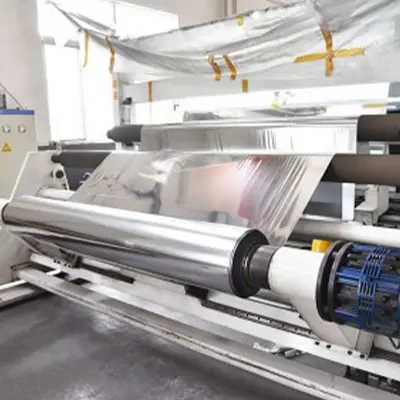
Metallized Film for Capacitors: How Vacuum Coating Builds the Heart of Film Capacitors
Inside almost every modern inverter, electric vehicle, solar power station, and household appliance sits a film capacitor — and at the heart of that capacitor lies a roll of metallized film for capacitors. The metal layer that works as the electrode is only tens of nanometers thick, yet it decides the capacitor’s energy density, reliability, and service life. In this guide, we explain why vacuum coating is the only practical way to build that electrode, what makes capacitor-grade coating different from packaging metallizing, and which machine features actually matter. To begin with, let’s look at what a film capacitor needs from its film.
Why Film Capacitors Depend on Metallized Film
A film capacitor stores energy in an electric field between two conductive electrodes separated by a thin polymer dielectric, usually BOPP or PET. In traditional wound capacitors, manufacturers used separate metal foils as electrodes. However, foil electrodes brought a serious weakness: a single microscopic defect in the dielectric caused a permanent short circuit and total failure.
Vacuum-metallized film solved this problem through a phenomenon called self-healing. When a fault occurs, the ultra-thin metal layer around the defect vaporizes instantly, isolating the weak point while the capacitor keeps operating. As Wikipedia explains on metallized film, this self-healing property makes vacuum-coated electrodes far more forgiving than solid foil. Consequently, virtually all modern high-energy film capacitors use vacuum-deposited electrodes rather than foil.
Manufacturers deposit aluminum for most applications because it offers low cost and excellent conductivity. Moreover, some producers use zinc or aluminum–zinc alloys for humid or corrosive environments, where zinc resists oxidation better than pure aluminum. Capacitor Connect’s overview of capacitor film metallization describes these material choices and their trade-offs in useful detail. For the rest of this article, we focus on the dominant process: vacuum-deposited aluminum.
What Makes Capacitor-Grade Coating Different from Packaging
Anyone familiar with packaging metallizing might assume that capacitor coating follows the same rules. In practice, the two applications diverge in almost every control parameter.
- Measurement target: Packaging converters monitor optical density (OD) to judge barrier and appearance. Capacitor producers care about electrical resistance, measured as sheet resistance in ohms per square, because this value directly determines capacitance and losses. Our article on optical density in metallized films explains why OD suits packaging, while capacitor film demands a completely different yardstick.
- Coating thickness: Capacitor electrodes typically measure only a few hundred angstroms (tens of nanometers). This thin layer enables self-healing, whereas a thick layer would defeat the safety mechanism.
- Substrate: Capacitor film runs extremely thin — often 2.5 to 6 microns of PET or 3 to 8 microns of BOPP. Such delicate webs wrinkle, tear, or stretch easily, so tension control becomes a matter of yield, not just quality. See how automatic tension control systems achieve consistent metal thickness to understand why this matters.
- Cleanliness: Any particle, pinhole, or slag spatter in the chamber can create a weak spot in the dielectric or the electrode. Therefore, capacitor-grade lines demand scrupulous chamber hygiene and high-purity aluminum wire. Our troubleshooting guide for vacuum coating defects covers the common culprits and how to prevent them.
How Vacuum Coating Builds the Electrode Layer
The production of metallized film for capacitors follows the same fundamental sequence as any vacuum metallizing process, which we describe step by step in our guide to how a vacuum coating machine works. In short, the process works like this:
- Operators load a roll of thin capacitor-grade PET or BOPP into the chamber.
- The pumping system evacuates the chamber to a high vacuum, removing air and water vapor that would oxidize or scatter the metal vapor.
- A heated evaporation source — usually resistance-heated boats or induction-heated crucibles — melts aluminum wire and turns it into a vapor stream.
- The web passes over a chilled coating drum, where aluminum atoms condense into a dense, uniform metallic layer.
- The finished metallized roll rewinds, and online instruments measure electrical or optical properties before the roll leaves the machine.
Capacitor lines typically run more slowly and with tighter control than packaging lines because the film is thinner and the tolerance for variation is smaller. Notably, Converting Quarterly’s technical review of roll-to-roll metallization for capacitor applications highlights how ultra-thin polymer webs push the limits of web handling and deposition control. Stable evaporation, precise wire feed, and constant tension all combine to hold the layer uniform across the full web width.
Segmented and Safety Films: Coating with a Pattern
Many high-voltage and high-energy capacitors do not use a continuous metal layer at all. Instead, manufacturers pattern the coating into small electrode segments separated by narrow uncoated or thin “fuse” lines. These segmented or safety films limit the energy released during a fault: if one segment fails, its fuse clears and disconnects that segment, protecting the rest of the capacitor.
Producing this structure requires controlled pattern metallizing, where the machine applies the aluminum only in defined areas — sometimes through masking, sometimes through registered coating techniques. As Converting Quarterly notes, these interrupted structures are well known in the industry as segmented or safety films. Consequently, a capacitor metallizer must offer far more than steady evaporation: it needs precise pattern definition and repeatable registration from roll to roll.
The Quality Parameters That Matter Most
For buyers evaluating capacitor-grade metallizing, the table below summarizes the parameters that separate a reliable electrode from a costly reject:
These checks differ fundamentally from packaging QC, which explains why capacitor producers rarely convert a standard packaging metallizer without significant modification. Comparing vacuum metallizing with alternative processes such as magnetron sputtering helps clarify when evaporation makes sense and when producers choose sputtering for specialty alloys.
Choosing a Metallizer for Capacitor Film
If you plan to produce metallized film for capacitors, evaluate machines against the specific demands above rather than generic packaging specifications. Look for these features:
- High-vacuum capability and a clean chamber design that minimizes contamination and outgassing.
- Ultra-stable tension and web handling for films below 6 microns, with low-friction rollers and precise dancer control.
- Chilled drum temperature management, since rapid condensation improves layer density and adhesion.
- Precise evaporation control with automated wire feed and closed-loop regulation of layer resistance.
- Pattern metallizing options if you intend to make segmented or safety film.
- Process automation that holds parameters constant across shifts and rolls.
A platform such as Tempo Machinery’s fully automatic suspension vacuum coating machine offers the double chilled drum, stable free-suspension web path, and high-speed automation that suit thin, sensitive films. That said, capacitor-grade output depends on your exact film type, thickness, and coating pattern, so we always recommend discussing your specification with our engineers before ordering. In addition, thin polymer webs generate static electricity easily, and uncontrolled static attracts dust and disturbs coating; our article on static control in roll-to-roll metallizing explains why this matters on every high-speed line.
Conclusion
A film capacitor lives or dies by the quality of its electrode, and that electrode comes from metallized film for capacitors produced under carefully controlled vacuum coating conditions. Self-healing thin layers, precise sheet resistance, clean chambers, stable tension, and — for many designs — accurate segmentation patterns all separate capacitor-grade output from ordinary packaging film. To summarize, start from your electrical specification, choose equipment built for thin-film precision, and verify process control before you commit to volume production.
Ready to evaluate a vacuum metallizer for your capacitor film line? Contact our team for machine specifications, customization options, and a free consultation on your coating requirements.
FAQ
1. Can a standard packaging metallizer coat capacitor film?
It can deposit aluminum on thin film, but packaging machines rarely deliver the sheet-resistance control, pattern capability, and contamination control that capacitor-grade electrodes demand. Evaluate the machine against electrical specifications, not optical density.
2. Why do capacitor films use segmented or patterned electrodes?
Segmentation limits the energy released during a fault. If one segment fails, its fuse clears and isolates the defect, so the rest of the capacitor keeps working instead of failing completely.
3. What is self-healing in metallized capacitors?
Self-healing means the ultra-thin metal layer around a dielectric fault vaporizes instantly, clearing the defect while the capacitor continues to operate. This behavior only works when the electrode stays thin enough to vaporize cleanly.