


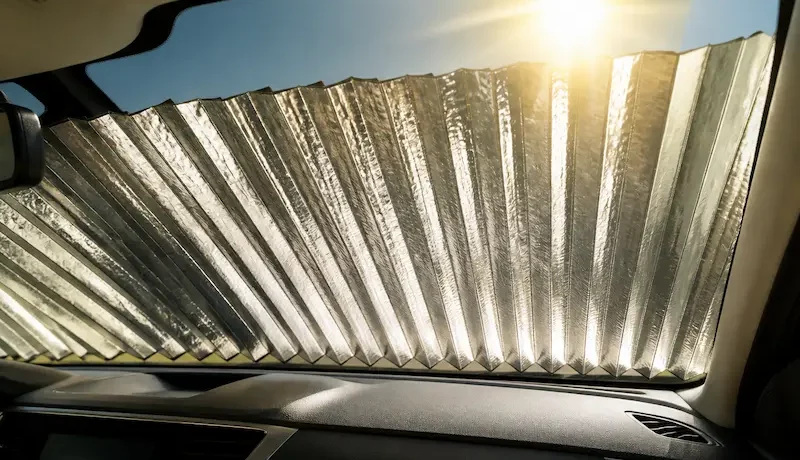
Car Sun Shade Film: How Vacuum-Metallized Film Reflects Heat and UV
Anyone who has returned to a car parked under summer sun knows the problem: the steering wheel burns, the seats radiate heat, and the cabin feels like an oven. A good car sun shade film solves this at the source. Instead of absorbing sunlight and letting the interior heat up, the reflective surface sends most of the solar energy straight back out through the windshield. In this guide, we explain how vacuum-metallized film achieves that mirror-like reflection, why the aluminum layer also blocks UV, and what manufacturers should look for when sourcing or producing shade film. To begin with, let’s look at why a parked car heats up in the first place.
Why a Parked Car Becomes a Greenhouse
Sunlight reaches the earth in three broad bands: ultraviolet (UV), visible light, and infrared (IR). Roughly half of the solar energy we receive arrives as infrared, which we cannot see but feel as heat. When this radiation passes through glass and strikes the dashboard and seats, those surfaces absorb it and re-emit longer-wavelength heat. The glass then traps that heat inside the cabin, which is why interior temperatures can climb far above the outside air on a sunny day.
A reflective barrier changes the equation. If the material sitting against the glass has a shiny metallic surface, it reflects the incoming solar radiation before the interior can absorb it. In short, the shade does not block heat so much as bounce it away. As LLumar’s technical overview of metallized automotive films explains, metallized layers reflect heat, which keeps the vehicle noticeably cooler and reduces the load on the air conditioner.
How Vacuum Metallizing Creates the Reflective Layer
The reflective heart of a car sun shade film starts as plain plastic film — usually PET — which then enters a vacuum chamber for metallizing. Inside the chamber, aluminum wire melts and vaporizes, and the metal atoms condense onto the moving film to form a continuous, mirror-bright aluminum layer. We walk through every stage of this process in our article on how a vacuum coating machine works, from pump-down to the finished roll.
Interestingly, the same technology that makes snack wrappers shine also creates the most effective solar barriers. The key lies in the smoothness and purity of the deposited aluminum. A dense, clean metallic surface reflects both visible light and infrared radiation, which is precisely what a shade product needs. Machines with stable evaporation control and uniform coating — such as Tempo Machinery’s fully automatic suspension vacuum coating machine — help producers hit that consistency roll after roll.
Reflection and Emissivity: The Physics of Staying Cool
To understand why metallized film outperforms dark or dyed materials, we need two concepts: reflectivity and emissivity. Reflectivity describes how much radiation a surface throws back, while emissivity describes how much heat a surface re-emits after it warms up. Fi-Foil’s guide to reflective insulation explains both terms clearly in the context of building insulation, and the same physics applies inside a car.
Polished aluminum has outstanding numbers on both counts. It reflects most of the solar spectrum, and its emissivity sits very low — typically around 0.05 or below, meaning the surface itself re-emits almost no heat. Consequently, a metallized shade stays relatively cool under the sun, while a dark fabric shade absorbs energy and slowly radiates it into the cabin. This contrast explains why shiny shades feel dramatically more effective on hot days. For a deeper look at how the same reflective principle serves buildings, see our article on vacuum-metallized film in solar-reflective construction applications.
Blocking UV: Protecting Interiors and Skin
Heat is only half of the story, because the aluminum layer also shields the cabin from UV radiation. Although UV makes up only a small fraction of sunlight, it causes dashboard cracking, seat fading, and leather deterioration over time. Moreover, UV exposure inside a car affects passengers too, especially on long journeys.
The metallized coating absorbs and reflects almost all UV that reaches the film, so very little passes into the cabin. This protection comes free with the heat-reflecting layer, which is one more reason why manufacturers choose vacuum-metallized film rather than simple printed or dyed alternatives. The same heat- and radiation-blocking behavior appears in another everyday product: our article on metallized film in emergency blankets shows how a similar reflective layer protects the human body from heat loss in the opposite direction.
Aluminum Thickness: Balance Between Shine and Flexibility
Producing good car sun shade film requires the right aluminum layer thickness. If the layer is too thin, reflection drops and pinholes let light through. If it is too thick, the film becomes stiff and more prone to cracking when the shade folds and unfolds thousands of times. Therefore, converters typically specify a layer that balances optical reflection with mechanical flexibility.
Layer quality also depends on adhesion between the aluminum and the PET base. Poor adhesion leads to flaking at the crease lines, which ruins both appearance and performance. Our guide to metallized film adhesion testing explains the tape and cross-hatch methods producers use to verify this property before converting. Meanwhile, the relationship between aluminum thickness and real-world performance is covered in our article on aluminum layer thickness and barrier properties.
From Film Roll to Finished Sun Shade
Most windshield and side-window shades start from the same metallized web, then follow a simple converting path: slitting to width, laminating or coating a protective layer, and cutting to shape. Many products use an accordion or roll-up design, which demands a film that survives repeated bending. Manufacturers often laminate the metallized PET to a fabric or a softer film layer, both to protect the aluminum and to give the shade body and stiffness.
For product designers, the comparison below summarizes how metallized shade film differs from common alternatives:
Sourcing and Producing Metallized Shade Film
If you manufacture shades or plan to add a shade line, start by defining the film specification: base substrate (PET is the standard), coating width, aluminum thickness target, and whether you need a protective topcoat or lamination. Then match those requirements to a metallizing machine with stable tension control, clean vacuum conditions, and consistent evaporation — the same criteria we discuss in our guide to reading a vacuum metallizer specification sheet. For smaller production runs, Tempo Machinery also offers contract metallization processing services, which let you validate your shade film without buying a full coating line first.
Conclusion
A car sun shade film performs a simple job with elegant physics: a vacuum-deposited aluminum layer reflects solar radiation, blocks UV, and re-emits almost no heat, keeping parked vehicles cooler and interiors safer. To summarize, the metallizing step decides everything — layer density, smoothness, adhesion, and thickness all influence how well the finished shade works. Whether you are sourcing film for a shade brand or evaluating equipment for your own production, focus on those coating fundamentals first. Ready to discuss a metallized film project? Contact our team for specifications, samples, and technical advice on your car sun shade film line.
FAQ
1. Why does a shiny sun shade work better than a dark one?
A shiny metallized surface reflects solar radiation, while a dark surface absorbs it and re-emits heat into the cabin. Polished aluminum also has very low emissivity, so it stays cooler under direct sun.
2. Does the aluminum layer really block UV?
Yes. The vacuum-deposited aluminum layer absorbs and reflects almost all UV radiation that reaches the film, protecting dashboards, upholstery, and passengers from sun damage.
3. Can metallized shade film survive repeated folding?
Yes, when the manufacturer specifies the right aluminum thickness and applies a protective coating or lamination. Good adhesion between the aluminum and the PET base is essential to prevent flaking at crease lines.
4. What base film do manufacturers use for car sun shades?
PET is the standard choice because it offers clarity, dimensional stability, and the heat resistance needed for vacuum metallizing. Some designs add a fabric or foam lamination layer for extra body and protection.