


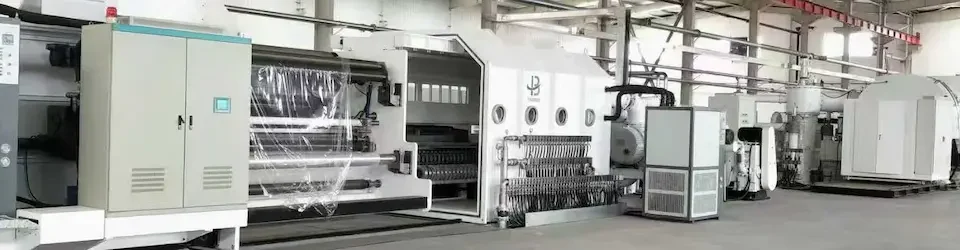
Chill Roll Temperature in Vacuum Metallizing: Why Drum Temperature Decides Coating Quality
Ask an operator how to improve cooling and you will hear the same answer every time: run the drum colder. That instinct is wrong, or at least half wrong. When you push a chill roll temperature down, the water vapor trapped in the microscopic gap between the film and the drum can drop out of the conduction regime that carries heat away, and your web actually runs hotter.
Aluminum condenses onto the web with real energy. That energy must leave through the drum, and the drum removes it through a gap thinner than a human hair. Understanding that gap turns drum temperature from a guessed number into a designed value.
This article explains the mechanism, gives you the heat-transfer values the research literature reports, and translates them into practical targets you can set on the HMI.
The Heat Problem in One Sentence
Condensation releases heat, and the vacuum metallizing process dumps nearly all of that heat into your film.
A metallizing source delivers heat to the web through two channels: the latent heat released as aluminum vapor condenses into a solid film, and the radiant heat radiating from the evaporation boats. The condensation term usually dominates. Because evaporated atoms arrive with far less kinetic energy than sputtered atoms, total evaporation heat loads run roughly an order of magnitude below sputtering loads — but almost the entire remaining load comes from condensation rather than from radiation.
That single fact explains why the drum matters so much. Radiation you can partly control by geometry. Condensation you cannot avoid, because condensation is the coating step.
The consequence is direct. A high coating rate means a high latent heat flux, and that flux must balance against an equally large heat flux from the web into the cooling drum. When it does not balance, polymer substrates respond the way they always do to thermal stress: they develop wrinkles, they crease, and in extreme cases they change structure.
The Gap Model: Heat Leaves Through Trapped Water Vapor
Now, here is the part most operators never learn. The film does not actually touch the drum in any meaningful thermal sense.
A polymer web and a polished metal drum meet across an irregular gap. Research on web-to-drum heat transfer, presented at a Society of Vacuum Coaters technical conference, describes the mechanism with a gap model, and it explains the numbers you see in practice.
In short, three findings define the model:
- Direct contact conducts almost nothing. After thorough outgassing of the web in vacuum, the physical contact conductance between film and drum stays at or below 100 W/m²K. That figure sits at the bottom of the useful range.
- The gap carries the heat. Conduction through gas trapped in the gap accounts for the bulk of heat removal. That gas is almost entirely water vapor, because water dominates the residual atmosphere of a vacuum chamber and because every polymer film carries absorbed moisture.
- The gap is tiny. Proposed gaps run from 1 to 5 microns. Web surface features measure 0.5 to 10 microns depending on film quality, while drum surfaces receive finishes of 0.1 to 0.2 microns.
Pressure inside that gap also changes as the web travels. Measurements and calculations suggest a few tenths of a Torr where the web first meets the drum, rising to tens of a Torr as the web separates. That pressure rise matters, because pressure and temperature together decide which flow regime governs the water vapor.
Why Over-Chilling Backfires
Now connect the gap model to temperature, and the counterintuitive result appears.
Water vapor conducts heat differently depending on its flow regime. At cold temperatures the molecules travel far between collisions, the gas behaves in the molecular regime, and it carries less heat. At warmer temperatures the vapor enters the transition regime, where conduction works far better.
The changeover points reveal how sharp the effect is. For a 0.5-micron gap, the transition from molecular to transition flow occurs near 56 °C. For a 10-micron gap, it occurs near 2 °C. Consequently, gap distance and temperature interact, and a rougher surface shifts the whole behavior.
Experimental work confirms the practical outcome. Several authors observed that heat transfer out of the web decreases as drum temperature falls, and the flow-regime explanation accounts for it.
Therefore, drum temperature becomes an optimization rather than a maximization. You need the drum cold enough to absorb heat and to protect the rewind roll, and warm enough to keep the gap gas conducting efficiently. Chasing the coldest possible drum wastes refrigeration and can make thermal defects worse.
The Heat Transfer Values the Literature Reports
The numbers below come from published measurements and models developed for vacuum coating processes, and they show how widely the effective heat transfer coefficient varies with conditions.
Two patterns stand out. First, speed helps enormously, because faster webs trap vapor and sustain the transition regime. Second, tension helps, and that link deserves its own section.
Moreover, film chemistry matters. Researchers observed that PET transfers heat better than OPP, and attributed the difference to water content: roughly 0.8 percent absorbed water in PET against about 0.03 percent in OPP. A wetter film feeds more vapor into the gap, and more vapor carries more heat.
The Levers That Actually Move Chill Roll Temperature
Once you accept the gap model, you stop treating drum temperature as an isolated coolant setpoint. Several factors change the effective heat transfer, and operators control more of them than they realize.
Web Tension
This lever surprised researchers as much as operators. Experimental work on vacuum web coaters demonstrated that web tension significantly influences the interfacial conductance between the polymer film and the cooling drum. Higher tension raises the transfer coefficient, because it presses the film flatter against the drum and makes it harder for vapor to escape from the sides of the gap, which lets pressure build and conduction improve.
Therefore, a tension change shows up as a temperature change. If you reduce tension to fix a wrinkle, you also reduce cooling. Our guide to web tension control in roll-to-roll metallizing covers how to balance those competing demands.
Surface Finish and Gap Distance
A smoother drum reduces the gap, and a smaller gap raises the high-temperature limit of the heat transfer coefficient. Our machines use double coating drum cooling and a polished drum surface, because surface quality affects thermal performance as much as mechanical smoothness.
Wrap Angle and Drum Diameter
The drum removes heat over the contact time you give it. Diameter and wrap angle set that dwell time, and therefore set how much of the heat load leaves before the web departs. Where the process allows, a larger wrap is cheaper than a colder drum.
Source Geometry
Source geometry forces a tradeoff. A wider aperture increases film temperature rise because the web sees the source longer, yet it reduces radiant intensity and cuts tangential metal loss. Therefore, you cannot optimize heat load and metal efficiency independently.
Post-Cooling Rollers
A post-cooling roller reduces rewind roll temperature without touching the coating zone. That addition costs far less than over-chilling the process drum.
Free-Span Coating
Watch this one closely. Where no drum supports the web, heat rejection falls to zero, and the film absorbs the entire source heat load. Free-span coating therefore raises film temperature sharply, and it demands a lower line speed or a lighter coating load.
Practical Targets That Keep You Safe
Published modeling of film temperature control in vacuum web coaters gives concrete targets rather than vague guidance.
Finally, one more nuance deserves attention. Rewind temperature does not rise in proportion to unwind temperature. A modelled machine showed an overall roll temperature rise of 5 °C when unwinding at 25 °C, but only 1 °C when unwinding at 35 °C. Heat extraction simply works better across a larger temperature gradient, so a warm starting roll sometimes yields a cooler finished roll than intuition suggests.
How Chill Roll Temperature Shows Up in Coating Quality
Unfortunately, thermal problems rarely announce themselves as thermal problems. They disguise themselves as quality defects, and that disguise costs operators weeks of misdirected troubleshooting.
- Blocking and wound roll defects. A hot rewind roll pressurizes the wraps and glues them together. Blocking is the classic signature of insufficient cooling, and it shows up days later at your customer’s plant rather than on your line.
- Optical density variation. Film temperature changes how aluminum nucleates and condenses. A drifting drum temperature therefore drifts your optical density across the roll.
- Wrinkles and creases. Thermal stress buckles a web. Research on vacuum web coating explicitly links thermally induced stress to wrinkle formation, and our article on wrinkles and curl in metallized film covers the field diagnosis.
- Weak adhesion. A web that stays warm when it should cool condenses aluminum under the wrong conditions. Confirm the result with a tape or cross-hatch adhesion test.
- Pinholes. Thermal stress and outgassing both create pinholes, and a poorly cooled web outgasses more. Our guide to reducing pinhole rates explains the mechanism.
- Barrier loss. Because barrier performance follows coating integrity, thermal problems ultimately reach your customer as a barrier failure.
- Curl after lamination. Residual thermal strain contributes to curl once a converter bonds your film to another web.
A Practical Setup Procedure
Follow this sequence when you commission a new substrate or chase a cooling complaint.
- Measure before you change anything. Record drum surface temperature with a contact thermometer, cooling water inlet and outlet temperatures, rewind roll temperature, and film temperature if you can access it. Our installation and commissioning guide places these measurements in the ramp-up phase.
- Confirm your drum finish. Compare the drum surface condition against the 0.1–0.2 micron specification, because a scuffed drum widens the gap and quietly cuts your heat transfer.
- Check tension at the coating drum. Tension drives interfacial conductance, so verify it against the published per-mil ranges rather than a remembered value.
- Set the drum for heat removal, then stop. Increase cooling until the rewind roll stays below 30 °C, and then resist the urge to go colder. Beyond that point you buy nothing and risk pushing the gap gas toward molecular flow.
- Add cooling where it is cheapest. Where rewind temperature still runs hot, a post-cooling roller delivers results more efficiently than extra refrigeration on the process drum.
- Recheck after every recipe change. A higher optical density raises the condensation load, so a drum setting that worked at 2.2 OD may fail at 2.5 OD.
Troubleshooting Table: Thermal Symptoms and Their Causes
Common Misconceptions
Three beliefs cause more cooling problems than any equipment fault.
“Colder coolant always means cooler film.” The gap model contradicts this. Below the transition regime, extra refrigeration reduces conduction.
“Drum temperature is a coolant problem.” Tension, surface finish, wrap angle, and film moisture all change the effective heat transfer. Consequently, a coolant adjustment often treats a symptom that another lever caused.
“Every substrate behaves the same.” Water content differs sharply between polymers, so PET and OPP respond differently to identical drum settings. Store a separate thermal recipe for each substrate, and check the material pages on metallized PET and metallized BOPP for the substrate characteristics that drive it.
Frequently Asked Questions
1. What chill roll temperature should I run on a vacuum metallizer?
Start with a drum setting that holds your rewind roll below 30 °C, then stop. Published modeling for a 20 µm film line used a drum chilled to −30 °C, but that figure reflects a specific machine, film, and deposition rate rather than a universal rule. Measure your own rewind temperature and adjust from there.
2. Why does running the chill roll colder sometimes make things worse?
Because heat leaves through water vapor trapped in a micron-scale gap, not through metal contact. At cold temperatures that vapor falls into the molecular flow regime, where it conducts less heat. Therefore, chilling below the useful range reduces heat transfer instead of improving it.
3. What is a normal heat transfer coefficient between web and drum?
It varies enormously with conditions. Contact conductance alone stays at or below 100 W/m²K. Measured values around 500 W/m²K appear at web speeds above 150 m/min on PET, rising to 800 W/m²K under high tension. Low-speed measurements range from 0 to 300 W/m²K.
4. Does web tension really affect drum cooling?
It does, and experimental work confirmed it. Higher tension presses the film flat and traps more vapor in the gap, so pressure builds and conduction improves. That link means a tension change always produces a thermal change, which is why you should adjust one at a time.
5. What causes blocking in a metallized film roll?
Blocking comes from a rewind roll that stays too warm, which pressurizes the wraps and makes them adhere. A modelled packaging machine predicted blocking at a rewind temperature of 36 °C, and the same study concluded that reducing rewind temperature below 30 °C required substantial design changes.
6. Why does free-span coating run hotter?
Because an unsupported web has no path for heat removal, so heat rejection falls to zero and the film absorbs the full source heat load. Consequently, free-span sections demand lower line speeds or lighter coating loads than drum-supported sections.
7. Does drum cooling affect energy consumption?
It does, and over-chilling wastes energy twice. You pay for refrigeration capacity you do not need, and you can reduce heat transfer while doing it. Read our overview of energy saving innovations in vacuum coating equipment for the wider picture.
The Bottom Line
Chill roll temperature looks like a simple coolant setting. In practice, it governs a microscopic heat transfer problem that decides whether your film leaves the chamber flat, cool, and coated evenly.
Therefore, treat drum temperature as an optimization with a stop point. Cool your drum until the rewind roll stays safe, verify the surface finish and the tension that feed into interfacial conductance, and then stop adding refrigeration. Beyond that point, you spend energy to reduce cooling.
Finally, record the numbers. A thermal recipe that captures drum temperature, rewind temperature, tension, and deposition rate turns the next substrate change into a calculation rather than a guess.
Need help sizing drum cooling for your coating load? Send us your substrate, coating thickness, target line speed, and web width, and our engineering team will recommend the right drum and cooling configuration. Contact us or review our fully automatic suspension metallizers to see how we integrate double coating drum cooling into the machine.