


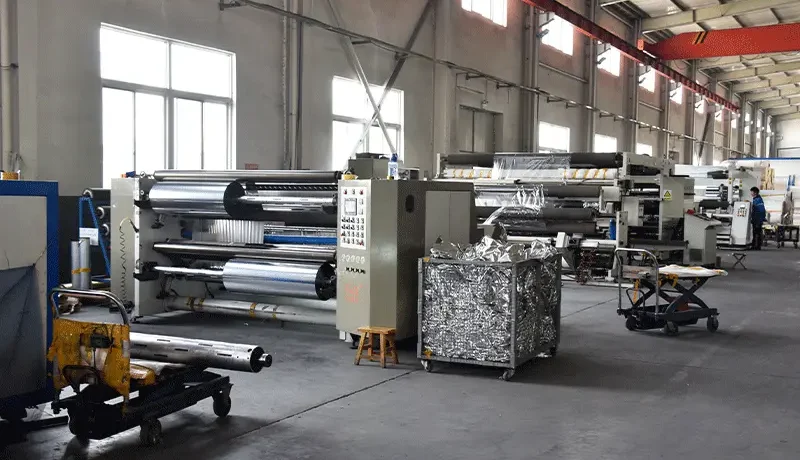
Substrate Outgassing and Moisture Control: Why a “Wet” Roll Ruins Your Vacuum Cycle
Two rolls arrive on the same pallet from the same supplier. One pumps down in fourteen minutes and coats without a blemish. The other drags the cycle past forty minutes, throws coating haze across the web, and forces three recipe adjustments before the operator gives up. The difference is not the film grade. It is substrate outgassing, and it depends on where that roll has spent the last two weeks.
Moisture is the single largest gas load in most vacuum coaters, and your incoming web brings a significant share of it into the chamber. Understanding where that water sits, how fast it leaves, and what it costs you turns a mysterious productivity problem into a manageable process variable.
This article covers the physics, the practical numbers, and the seven controls that actually dry a roll.
What Substrate Outgassing Actually Releases
Outgassing means the release of gas that a material has trapped, dissolved, absorbed, or frozen. In a polymer web inside a vacuum chamber, the released species include water, solvents, plasticizers, and hydrocarbons. Water dominates the list by a wide margin.
Two mechanisms drive substrate outgassing, and each responds to different controls.
Desorption from surfaces. Every surface in your chamber, and both faces of your web, carries adsorbed water. Metal surfaces exposed to air hold water in many monolayer thicknesses, and each successive monolayer becomes harder to remove by thermal vaporization.
Diffusion from the bulk. Water dissolved inside the polymer migrates to the surface and leaves from there. Diffusion in PET runs at roughly 4×10⁻¹⁰ cm²/s at 20 °C, so a thick film releases water more slowly than a thin one.
Consequently, a wet roll keeps releasing water long after you seal the chamber. Surface water leaves quickly, and bulk water keeps arriving for the rest of the cycle.
Why Water, and Not Air, Is Your Real Enemy
Water vapor behaves worse in a vacuum system than almost any other residual gas, for three reasons.
First, the water molecule is highly polar and adsorbs strongly on clean metal and oxide surfaces. It therefore has a long residence time on chamber walls compared to a permanent gas.
Second, that long residence time means removal requires many adsorption-desorption collisions. Each collision cycle slows the approach to base pressure, so the time needed to reach a given vacuum stretches out compared to a clean, dry system.
Third, water is the most common vapor in a good vacuum system. Residual gas analysis of a chamber pumped to 10⁻⁶ to 10⁻⁵ Torr shows water as the leading component, because internal surfaces outgas continuously and because the web feeds more water in.
Finally, one further hazard deserves mention. Where liquid water collects in a cold region, the evaporation cools it enough to freeze. Ice has a lower vapor pressure than liquid water, so the pumps remove it even more slowly.
Four Costs of Running a Wet Roll
Operators notice the first cost and rarely connect the other three. In reality, they compound.
1. Pump-Down Time and Ultimate Vacuum
A wet roll loads the chamber with water during the very phase when you need the pressure to fall. Because water leaves surfaces slowly, the base pressure you reach may sit above your target, and the cycle extends. On a machine that runs many cycles per shift, a few extra minutes per cycle quietly consumes a large share of your capacity, and lost capacity shows up directly in your return on the machine.
2. Heat Transfer at the Cooling Drum
Here the water story turns complicated. Water vapor trapped in the micron-scale gap between the web and the cooling drum is actually the main heat-transfer medium, and it accounts for the bulk of heat removal. So some water helps.
Too much water causes a different problem. Excess vapor raises the gap pressure until the flow regime changes from transition toward molecular behavior, and heat transfer drops off. Because the water that diffuses out of the web supplies much of that gap vapor, an inconsistently wet roll transfers heat inconsistently.
That coupling explains why our guide to chill roll temperature in vacuum metallizing keeps returning to film moisture as a hidden variable.
3. Coating Quality
Water arriving at the deposition zone competes with aluminum for the surface. The consequences show up as poor adhesion, coating haze, pinholes where outgassed vapor escapes through a partially formed layer, inconsistent optical density, and weaker barrier performance. None of these defects look like a moisture problem, which is exactly why teams chase them for weeks. When a defect refuses to resolve, work through our operator’s guide to troubleshooting coating defects before you touch a recipe.
4. Cycle Repeatability
This cost hides best. A roll that dries progressively during its run produces a process that changes from the core to the outer wraps. Early wraps coat differently from late wraps, so your recipe works for part of the roll and drifts for the rest. Operators then fight a moving target rather than a stable process.
How Much Water Does Your Film Carry?
Polymer chemistry decides how much water a web holds, and the spread is enormous.
That PET-versus-OPP contrast creates a genuine trap. PET carries far more water, but its higher water content improves heat transfer at the drum. As a result, an operator who copies a PET recipe onto OPP sees both a different temperature profile and a different moisture behavior.
Measuring the Load Instead of Guessing
You do not need to guess. ASTM E595, the standard test method for total mass loss and collected volatile condensable materials from outgassing in a vacuum environment, gives you a comparable number.
The method exposes a specimen to 125 °C at less than 7×10⁻³ Pa for 24 hours, then measures three parameters:
- TML — total mass loss, the overall volatile content
- CVCM — collected volatile condensable materials, the fraction that condenses on a 25 °C collector
- WVR — water vapor regained, measured after the main exposure
The aerospace industry has treated TML of 1.00% and CVCM of 0.10% as screening levels for rejecting materials, and NASA publishes an open outgassing database covering thousands of materials. You can use the same method to compare incoming film lots, or to qualify a new supplier.
One caveat matters here. The method specifies weighings under controlled conditions of 23 °C and 50% relative humidity, precisely because humidity swings change the result. That detail tells you how much water content depends on handling rather than on chemistry alone.
The Adsorbed Layer: Why Storage Beats Everything Else
Now, here is the uncomfortable part. Even after you pump the chamber to base pressure, an adsorbed water layer remains on the web surface. Water continues to arrive from the residual atmosphere and from diffusion inside the film, so the surface stays wet at the molecular scale throughout the run.
The vacuum environment itself contributes. At 10⁻⁶ Torr, water molecules strike the web continuously. Multiplying the impingement rate by the volume of a single water molecule gives an upper limit near 0.5 microns per second of equivalent water deposition. That figure is an upper bound rather than a real coating rate, but it demonstrates how persistent the water flux is.
Storage and handling therefore matter more than any in-chamber remedy, because they determine how much water the roll carries in the first place. Two facts make the point:
- The history of a moisture-absorbing material is an important variable in how much water vapor it releases during deposition. Control that history, and dry materials before they enter the chamber.
- Unwinding itself releases water. Some roll coaters unwind the web in a separately pumped chamber before it enters the deposition chamber, which isolates the deposition zone from most of the water liberated during unrolling.
That design principle applies to machine specification as much as to operation. When you compare quotations, ask whether the unwind section sits in its own pumping stage, because the answer changes your achievable cycle time on hygroscopic substrates.
Seven Controls That Actually Dry a Roll
Then work these in order. The list runs from incoming inspection to chamber hygiene, and each item reduces the water load at a different point.
1. Measure the Incoming Load
Do not assume that two rolls of the same grade carry the same water. Ask your supplier for TML and WVR data on the specific lot, or run your own check. Then record the result against the roll, so a slow pump-down has a number to compare against rather than a feeling.
2. Control Storage Conditions
Keep rolls wrapped, upright, and away from humid air. Limit the time that film spends exposed to moisture wherever the process allows. A set of fingerprints, for reference, takes several days to desorb, which shows how readily handled surfaces retain contamination.
Storage discipline also protects the finished product, because a coated roll that takes on moisture can block, curl, or lose barrier performance before your customer unwraps it. Treat the storage area as process equipment rather than as warehousing, and keep it on your maintenance inspection route.
3. Condition the Roll Before the Run
Where a roll has been stored in a humid warehouse, allow it to equilibrate in the plant before coating rather than taking it straight to the machine. Equilibration does not remove water, but it stops the moisture profile from shifting mid-run, and that stability is what protects cycle repeatability.
Remember the ASTM detail here: weighings for moisture testing happen at 23 °C and 50% relative humidity precisely because ambient humidity changes the answer. Your plant humidity has the same effect on your film.
4. Dry and Warm Fixtures and Substrates
The standard remedy list for water in vacuum systems begins with prevention: backfill with dry gas, minimize the time the system sits open to ambient, keep a dry gas flowing while it is open, keep chamber walls and surfaces warm to prevent condensation, and dry and warm fixtures before they enter the chamber.
That final point applies directly to web handling hardware. Cold, damp rollers and guide surfaces reintroduce water every cycle.
5. Warm the Web
Raising film temperature accelerates both surface desorption and bulk diffusion. Because diffusion scales with absolute temperature, a modest warm-up shortens the time required to release the same amount of water. Balance this against thermal limits, though, because the web still has to survive the coating zone without thermal stress.
6. Purge and Backfill With Dry Gas
Edwards describes purging and backfilling as one of the four main ways to reduce outgassing in a vacuum system. A constant flow of dry gas through the chamber removes contamination and lowers water vapor concentration, and even a short purge helps measurably. Backfilling or venting with nitrogen reduces water vapor for systems that regularly come up to atmosphere.
One warning comes with the technique. After a purge flow stops, humidity can climb back above 30% within a few hours, so a purge buys you a window rather than a permanent fix. On the supply side, vaporizing liquid nitrogen yields roughly 650 liters of dry gas per liter of LN2, which makes it a practical dry-gas source.
7. Keep the Chamber Itself Clean, Smooth, and Warm
Chamber surfaces contribute water too, and their condition sets your floor. Leybold quantifies what the common remedies are worth on a stainless steel surface with a typical outgassing rate near 2×10⁻⁷ mbar·L/s/cm²:
Bakeout temperature also depends on what you want to remove. Removing water vapor requires 100–500 °C, while pulling hydrogen out of the material’s bulk demands temperatures up to 1,000 °C. Repeated bakeout cycles deliver progressively lower outgassing rates than a single treatment.
Because your pump-down performance tracks chamber cleanliness, fold these checks into your preventive maintenance schedule rather than treating them as a one-off project.
A Field Procedure for a Suspect Roll
When a roll behaves badly, diagnose it instead of fighting it.
- Compare pump-down curves. Plot pressure against time for the suspect roll and a known-good roll of the same grade. A wet roll bends the curve upward in the middle of the cycle.
- Check where the problem starts. Defects that appear on the outer wraps point to storage or transport exposure. Defects that worsen toward the core point to residual moisture that never fully left.
- Test a sample. Cut a strip from the suspect roll and from a good roll, then compare them by weight before and after drying. A simple gravimetric check on a lab oven gives you a useful delta.
- Run a dry-gas purge before the next cycle. If the purge shortens pump-down measurably, water was the problem.
- Then fix the source. Correct storage, conditioning, or wrap integrity, because a purge that works every cycle costs you more than a dry roll does.
Troubleshooting Table
Common Misconceptions
“A dry-looking roll is a dry roll.” Visible moisture tells you almost nothing. Water sits in the film bulk and as molecular layers on the surface, both invisible.
“Longer pump-down always means a leak.” Outgassing and leaks produce different curves. A leak tends toward a pressure floor, while outgassing keeps falling slowly. Compare curves before you start hunting for leaks.
“One purge fixes it permanently.” Humidity returns within hours once purge flow stops, so treat purging as a repeatable step rather than a repair.
“All films behave the same.” The water content spread runs from roughly 0.03% in OPP to above 1% in polyimide. Store, condition, and schedule those materials differently. Our material pages on metallized PET, metallized BOPP, and metallized CPP describe the substrate properties worth writing into your specification.
Frequently Asked Questions
1. What is substrate outgassing in vacuum metallizing?
Substrate outgassing is the release of gas, mostly water vapor, from the web material and its surfaces once you expose it to vacuum. It comes from adsorbed surface layers and from water dissolved inside the polymer bulk. Because water leaves surfaces slowly, it dominates the gas load and sets your achievable pump-down time and base pressure.
2. How much water does a film roll actually contain?
It varies widely by polymer. Polyimide holds more than 1%, PET holds up to about 0.8%, and OPP holds roughly 0.03%. Laminates and coated structures introduce additional layers, each with its own history. Standards such as ASTM E595 let you compare lots on a consistent basis.
3. Does moisture really affect coating quality?
It does, and through several routes at once. Water arriving at the deposition zone competes with aluminum for the surface, which weakens adhesion and shows up in a tape or cross-hatch adhesion test. Outgassed vapor escaping through a partially formed layer creates pinholes. Inconsistent moisture produces inconsistent optical density and weaker barrier performance.
4. Is all moisture bad for the process?
No, and this surprises most operators. Water vapor trapped between the web and the cooling drum actually carries most of the heat out of the film, because heat leaves through gas conduction across that gap. Too little water hurts cooling, while too much pushes the gap into a less efficient flow regime. The goal is consistency rather than elimination.
5. How do I dry a film roll before coating?
You cannot dry a roll quickly once it is wound, because bulk diffusion is slow. Instead, prevent moisture pickup: keep rolls wrapped and controlled, equilibrate them in the plant before coating, purge the chamber with dry gas, and warm the web and the handling hardware. Some roll coaters unwind the web in a separately pumped chamber, which isolates the deposition zone from the water released during unrolling.
6. Why did my pump-down time jump without any equipment change?
Suspect the web first. A new supplier lot, a humid shipping period, or a longer storage interval all raise the water load without touching the machine. Plot pump-down curves for the suspect roll against a known-good roll, because the shape of the curve distinguishes outgassing from a leak.
7. How often should I verify vacuum performance?
Build it into routine maintenance. Pump-down curves, base pressure records, and chamber bakeout intervals belong in your vacuum pump system maintenance routine, and a slow drift in those numbers is your earliest warning that the gas load has changed. Our guide to speeding up evaporation boat replacement explains how to protect vacuum quality during routine interventions.
The Bottom Line
Substrate outgassing is a water problem, and water follows rules you can manage. It sits on surfaces and inside the film, it arrives slowly from the bulk, and it dominates your gas load because it refuses to leave quickly.
Consequently, the cheapest gains come before the chamber. Control storage, equilibrate rolls, verify incoming moisture, and keep the chamber clean, dry, and warm. Then use purge and backfill deliberately, knowing the effect fades within hours.
Finally, treat the symptom and the source differently. A purge rescues a single cycle, and a storage fix rescues every cycle after it.
Chasing slow pump-down or unexplained coating defects? Send us your substrate type, roll storage conditions, and a pump-down curve, and our engineering team will help you trace the moisture path. Contact us or review our fully automatic suspension metallizers to see how we configure pumping stages and unwind sections for hygroscopic webs.